Undergrad Transformation of Tensor Components

Click For Summary
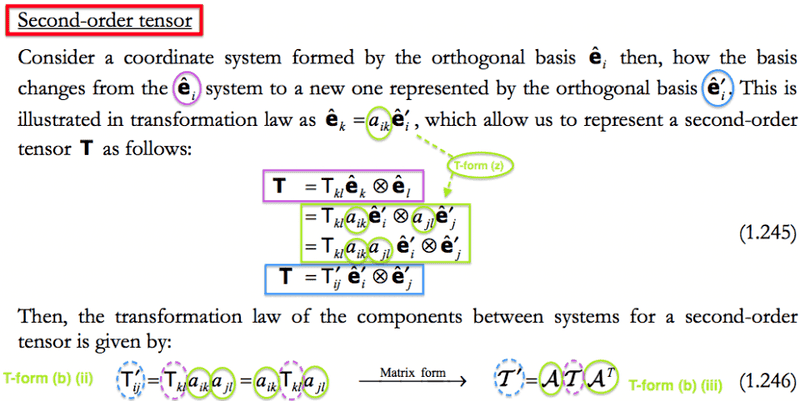
The transformation of tensor components involves rewriting the indicial form as aikTklajl to clarify the relationship between matrix elements and their transformations. This approach does not violate matrix multiplication's non-commutativity because the aik terms are scalar components that commute. The discussion highlights that the expression A T A in matrix form arises from the rules of matrix multiplication, where repeated indices imply summation. By defining new variables, the transformation can be expressed as the product of matrices, leading to the conclusion that the overall product is indeed A T A^T. This clarification aids in understanding tensor transformations in different coordinate systems.
FluidStu
Messages
25
Reaction score
3
In the transformation of tensor components when changing the co-ordinate system, can someone explain the following:
upload_2016-3-31_14-20-12.png


Firstly, what is the point in re-writing the indicial form (on the left) as aikTklajl? Since we're representing the components in a matrix, and the transformation matrix is also a matrix, aren't we violating the non-commutativity of matrix multiplication (AB ≠ BA)?

Secondly, how does this mean A T AT in matrix form? Why are we transposing the matrix?

Thanks in advance
 
Physics news on Phys.org
FluidStu said:
Firstly, what is the point in re-writing the indicial form (on the left) as aikTklajl? Since we're representing the components in a matrix, and the transformation matrix is also a matrix, aren't we violating the non-commutativity of matrix multiplication (AB ≠ BA)?
## \mathcal A##,etc. refers to the matrices themselves but ##a_{ik}##,etc. refers to the elements of those matrices. So the ##a_{ik}##s are just numbers and commute with each other.
Actually there is no need to rearrange them in that way but the author seems to think that it makes things more clear.
FluidStu said:
Secondly, how does this mean ## \mathbf{A T A^{T}} ## in matrix form? Why are we transposing the matrix?
Remember the rule for matrix multiplication? It reads like ## (AB)_{ij}=\sum_k A_{ik} B_{kj} ##, which, if we accept the rule that repeated indices are summed over, becomes ## (AB)_{ij}=A_{ik} B_{kj} ##.
So its clear that ## a_{ik}T_{kl} ## is actually ##C=\mathcal{AT} ##. Now we have ##c_{il} a_{jl} ##. Now if I define ##d_{lj}=a_{jl} ##, the result becomes ## c_{il} d_{lj} ## which is clearly the product of two matrices. The first is ## \mathcal{AT} ## and the second was defined as a matrix that has its rows and columns swapped(because I swapped l and j in ##a_{jl}## to get ## d_{lj} ##). So its clear that the second matrix is ## \mathcal{A}^T## and so the whole product is ## \mathcal{ATA}^T ##.
 
  • Like
Likes FluidStu
Shyan said:
## \mathcal A##,etc. refers to the matrices themselves but ##a_{ik}##,etc. refers to the elements of those matrices. So the ##a_{ik}##s are just numbers and commute with each other.
Actually there is no need to rearrange them in that way but the author seems to think that it makes things more clear.

Remember the rule for matrix multiplication? It reads like ## (AB)_{ij}=\sum_k A_{ik} B_{kj} ##, which, if we accept the rule that repeated indices are summed over, becomes ## (AB)_{ij}=A_{ik} B_{kj} ##.
So its clear that ## a_{ik}T_{kl} ## is actually ##C=\mathcal{AT} ##. Now we have ##c_{il} a_{jl} ##. Now if I define ##d_{lj}=a_{jl} ##, the result becomes ## c_{il} d_{lj} ## which is clearly the product of two matrices. The first is ## \mathcal{AT} ## and the second was defined as a matrix that has its rows and columns swapped(because I swapped l and j in ##a_{jl}## to get ## d_{lj} ##). So its clear that the second matrix is ## \mathcal{A}^T## and so the whole product is ## \mathcal{ATA}^T ##.
Got it! Thanks :)
 
I am studying the mathematical formalism behind non-commutative geometry approach to quantum gravity. I was reading about Hopf algebras and their Drinfeld twist with a specific example of the Moyal-Weyl twist defined as F=exp(-iλ/2θ^(μν)∂_μ⊗∂_ν) where λ is a constant parametar and θ antisymmetric constant tensor. {∂_μ} is the basis of the tangent vector space over the underlying spacetime Now, from my understanding the enveloping algebra which appears in the definition of the Hopf algebra...

Similar threads

  • · Replies 5 ·
Replies
5
Views
3K
  • · Replies 1 ·
Replies
1
Views
2K
  • · Replies 8 ·
Replies
8
Views
3K
  • · Replies 2 ·
Replies
2
Views
2K
  • · Replies 4 ·
Replies
4
Views
2K
  • · Replies 1 ·
Replies
1
Views
3K
Replies
27
Views
2K
  • · Replies 57 ·
2
Replies
57
Views
8K
  • · Replies 1 ·
Replies
1
Views
1K
  • · Replies 4 ·
Replies
4
Views
1K