Transformers for Maximum Power Transfer

Click For Summary
SUMMARY

The discussion focuses on determining the turns ratios a1 and a2 for maximum power transfer to a 20-ohm load resistor using transformer theory. The key equations mentioned include a = n2/n1, Rs = RL for maximum power transfer, and Z1 = a1^2 * Zs, where Z1 is defined as -j/(2*pi*f*c). Participants emphasize the importance of matching the source impedance to the load impedance by canceling out complex impedances using the turns ratios.

PREREQUISITES
  • Understanding of transformer theory and turns ratios
  • Familiarity with complex impedance and phasor analysis
  • Knowledge of resonant circuits involving inductors and capacitors
  • Basic principles of maximum power transfer theorem
NEXT STEPS
  • Study the relationship between turns ratios and impedance transformation in transformers
  • Learn about complex conjugate matching for maximum power transfer
  • Explore the calculations involved in resonant circuits with inductors and capacitors
  • Investigate practical applications of transformer design in RF circuits
USEFUL FOR

Electrical engineers, students studying circuit design, and professionals working with transformers and impedance matching will benefit from this discussion.

aznmax218
Messages
1
Reaction score
0
Determine the turns ratios a1 and 12 for maximum power transfer to the 20 ohm load resistor. a=n2/n1; Rs=RL for maximum power transfer, i.e. Zsource = the complex conjugate of the load.
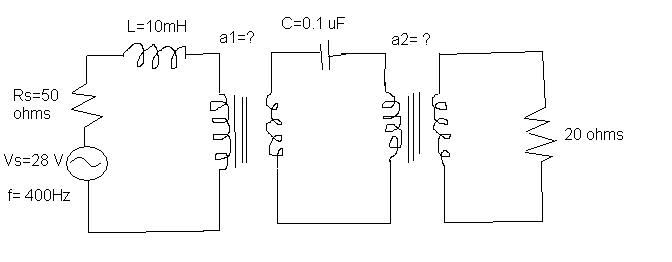
2hxlpfq.jpg
i have try to use
Z1=a1^2*Zs and Z2=a2^2*Z1
and i know Z1=-j/(2*pi*f*c)
 
Physics news on Phys.org
aznmax218 said:
Determine the turns ratios a1 and 12 for maximum power transfer to the 20 ohm load resistor. a=n2/n1; Rs=RL for maximum power transfer, i.e. Zsource = the complex conjugate of the load.


2hxlpfq.jpg


i have try to use
Z1=a1^2*Zs and Z2=a2^2*Z1
and i know Z1=-j/(2*pi*f*c)

Welcome to the PF.

Wow, on the surface, that looks like a hard problem.

I'd offer a couple of hints, in hopes that they lead you to the answer. First, notice how the source and load are both real resistors (excluding the inductor and cap). So the inductor and cap have to cancel each other out in terms of complex Z, or else you can't match to the 20 Ohm load. What can you do with the first turns ratio to cancel them out?

And second, assuming that you can cancel out the complex impedances with the first turns ratio, what do you now have to do with the 2nd turns ratio to match the source and load impedances?

Show us your work along those lines, to see if it can work that way...
 

Similar threads

  • · Replies 6 ·
Replies
6
Views
3K
  • · Replies 5 ·
Replies
5
Views
2K
  • · Replies 13 ·
Replies
13
Views
2K
  • · Replies 6 ·
Replies
6
Views
2K
  • · Replies 2 ·
Replies
2
Views
2K
Replies
11
Views
4K
  • · Replies 4 ·
Replies
4
Views
3K
  • · Replies 2 ·
Replies
2
Views
2K
  • · Replies 47 ·
2
Replies
47
Views
6K
  • · Replies 1 ·
Replies
1
Views
4K