Transition dipole -- Line shape function

Click For Summary
The discussion centers on the classical interpretation of transition dipole oscillation and its role in explaining spectral broadening during photon emission. It clarifies that while electrons oscillate within their orbitals, they can also transition between different energy levels, which involves a superposition of wavefunctions rather than a definitive state. The concept of lifetime is discussed as the time until electron oscillation is damped, influenced by various transition rates between orbitals. The limitations of applying solid-state physics models, like the Kronig-Penney model, to multi-atomic systems are highlighted, emphasizing the unique characteristics of atomic transitions. The oscillation frequency of the dipole is constrained to the energy difference between levels, aligning with quantum mechanical principles.
Goodver
Messages
101
Reaction score
1
I am confused with the classical approach of usage of a "transition dipole oscillation" in order to explain the broadening of spectrum of emission between energy levels.

1. If I understand it correctly then emission of photon is due to oscillation of a dipole consisting of an electron-proton pair, right? In this case, electrons just oscillate on orbitals but do not change their orbitals? Or electrons also jump to the higher and lower orbitals? If they change, then electron oscillates on its way from one orbital to another?

2. Lifetime defined as a time until electron oscillation gets damped, but electron stay on its orbital or time takes for electron to transit from one orbital to another? What determines the different lifetimes for different atoms?

3. Why broadening of a spectrum can not be explain with a solid state physics concept of Kronig-Penney model, where we have bands instead of level in a multi atomic system?

4. Why dipole can oscillates only with a frequency corresponding to the energy difference between energy levels?
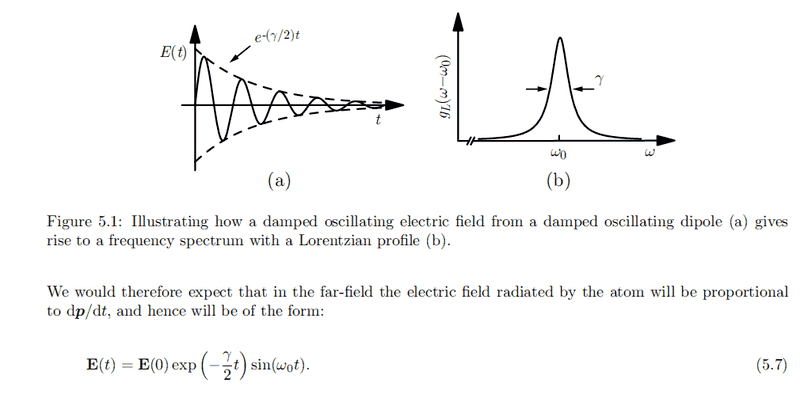
proxy.php?image=http%3A%2F%2Fs12.postimg.org%2Fd121pnj3x%2Flaser1.png

Picture taken from this thread:

Thank you.
 
Last edited:
Physics news on Phys.org
Goodver said:
If I understand it correctly then emission of photon is due to oscillation of a dipole consisting of an electron-proton pair, right?
That's a classical, non (fully) quantum view.
Goodver said:
In this case, electrons just oscillate on orbitals but do not change their orbitals?
In the present of perturbation such as external field, the true wavefunction of the electron can be represented as a linear combination of the unperturbed Hamiltonian eigenfunctions. So the expectation value of some observables such as radius is indeed time-dependent, but to say whether it either stays definitely in its orbital or change to another one is actually violating the QM postulate. As said above that the electron state can be expanded into superposition of the orbitals' wavefunction means that it has less-than-unity probability of ending up in various orbitals. In fact the lifetime of a given orbital is defined as the sum of all transition rates from that orbital toward the other possible orbitals
Goodver said:
Or electrons also jump to the higher and lower orbitals?
Is there any way an electron can change orbital with different energies without giving up its energy into some other form?
Goodver said:
If they change, then electron oscillates on its way from one orbital to another?
I'm not sure that there has been research which studies such transient behavior. You may want to look on this matter up yourself. Otherwise, to study this with sufficient accuracy, one should probably calculate the perturbed state up to some higher perturbation order.
 
Last edited:
Thread 'Unexpected irregular reflection signal from a high-finesse cavity'
I am observing an irregular, aperiodic noise pattern in the reflection signal of a high-finesse optical cavity (finesse ≈ 20,000). The cavity is normally operated using a standard Pound–Drever–Hall (PDH) locking configuration, where an EOM provides phase modulation. The signals shown in the attached figures were recorded with the modulation turned off. Under these conditions, when scanning the laser frequency across a cavity resonance, I expected to observe a simple reflection dip. Instead...

Similar threads

  • · Replies 2 ·
Replies
2
Views
656
  • · Replies 3 ·
Replies
3
Views
4K
  • · Replies 5 ·
Replies
5
Views
3K
  • · Replies 10 ·
Replies
10
Views
3K
  • · Replies 10 ·
Replies
10
Views
3K
  • · Replies 12 ·
Replies
12
Views
3K
  • · Replies 0 ·
Replies
0
Views
2K
  • · Replies 7 ·
Replies
7
Views
2K
  • · Replies 3 ·
Replies
3
Views
4K
  • · Replies 3 ·
Replies
3
Views
2K