Tried making a telegraph What am I doing wrong?

  • Thread starter Thread starter Vlfe
  • Start date Start date
Click For Summary
SUMMARY

The forum discussion focuses on troubleshooting a homemade telegraph setup using 22 gauge hookup wire, steel components, and an iron nail as the electromagnet core. Key recommendations include ensuring the metal is positioned close to the coil for effective attraction, testing the electromagnet's strength with paperclips, and considering a horseshoe-shaped core for improved magnetic field strength. Additionally, users are advised to minimize air gaps in the setup to enhance performance.

PREREQUISITES
  • Understanding of basic electromagnet principles
  • Familiarity with circuit assembly and testing
  • Knowledge of materials used in electromagnet construction
  • Experience with mechanical components and their interactions
NEXT STEPS
  • Research the design and benefits of horseshoe electromagnets
  • Learn about optimizing electromagnet performance by reducing air gaps
  • Explore mechanical designs for clickers and levers in electromagnet applications
  • Investigate the effects of different materials on electromagnet strength
USEFUL FOR

Electronics hobbyists, educators in physics, and anyone interested in building or improving electromagnet-based devices.

Vlfe
Messages
4
Reaction score
0
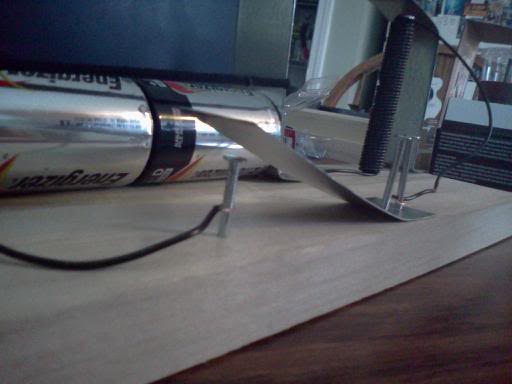
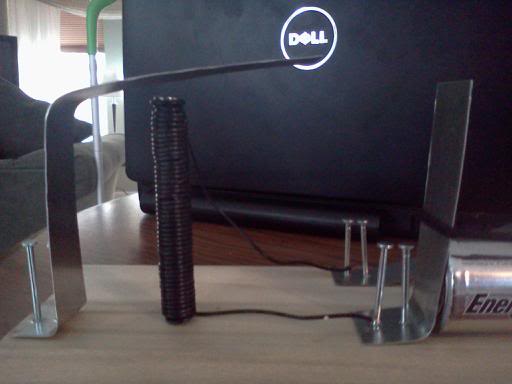
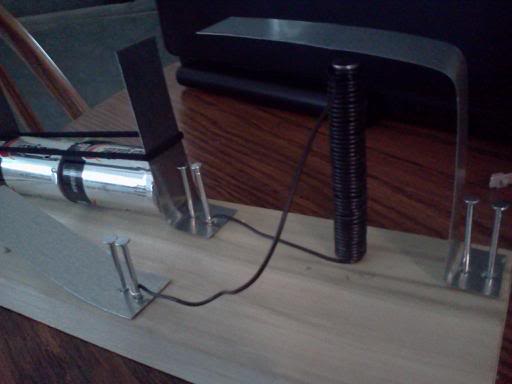
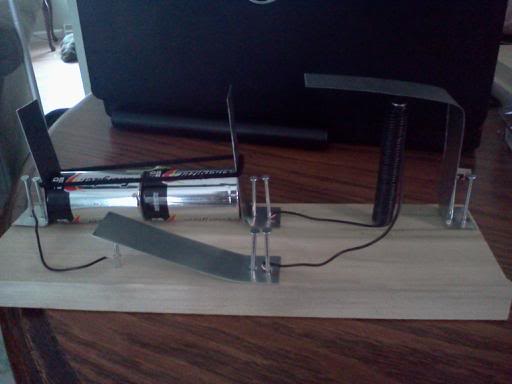
Here is how I set it up:
----.jpg

---.jpg

--.jpg

-.jpg


I am using 22 gauge hookup wire, all of the metal is steel (magnetic), and the nail in the electromagnet part is iron.

Am I connecting the wires to the wrong metal parts, or doing so incorrectly? I found this set up at: http://w1tp.com/perbuild.htm

Please help, I am so lost :(
 
Engineering news on Phys.org
Try holding a nail very close to the coil at one end. If you can feel the nail move when you turn the current on and off, the rest of the circuit is probably working OK.

If you have a magnetic compass, that should give a strong indication when it is held near the coil.

This circuit is very rough on batteries, so you would need almost new batteries to make it work.

The metal being attracted to the coil needs to be very close to the coil core to get much attraction. So, if possible, bend your metal so that it is very close to the end of the coil.
This will mean you have to shape the metal to also get proper switching action.
 
That 'bendy' bit of metal (are you sure it's steel? Aluminium won't work.) looks a bit thick / stiff and it's a long way from the solenoid. You may just be short of magnetic field to make it move. Try bending it lower down, nearer the solenoid and put the solenoid right at the end (better leverage).
If the 'nail test' (above) shows that you actually have an electromagnet then you could improve it considerably by using a 'horseshoe' (a U shaped core) rather than just a rod. Two rods, side by side, sitting on an iron bar would do the job. You need not rewind your coil; it can be just on one of the rods.
Horseshoe magnets (as in all cartoons!) were always used in the past because you could get a much stronger field between the two poles than at just one end. Old steel permanent magnets were rubbish, actually!

I just thought - that bendy strip could be replaced by a see saw mechanism, which would need much less force to make it move.
 
First check if you actually have an electromagnet by pushing the switch that you made, and see if the solenoid attracts paperclips.

If it does attract paperclips, then your problem is mechanical in nature: the magnet is not strong enough to attract your L-shaped metal "clicker", but is strong enough to attract paperclips.

You can try to increase the strength of the magnet, or decrease the strength of the L-shape by making it more bendable.

A poor man's "clicker" would involve taking a paperclip, straightening the paperclip out, and bending the end to form an L, and jab the end of the paperclip into a styrofoam base. The point is that a paperclip wire is very thin and bendable, so you should have more success.
 
The L shaped clicker should be U shaped and one end should be under the coil and the other end should be closer to the coil.
Also you might move the body of the clicker farther from the coil so the clicker pulls in easier when the coil in energized.

Great pictures.
 
a "C Clamp" for electromagnet with coil wrapped around its backside would give you a smaller airgap that'd be adjustable...

you'd have to figure out how to mount it,
but payoff is the smaller the airgap the better the electromagnet will work.
 
Last edited:

Similar threads

  • · Replies 3 ·
Replies
3
Views
4K
Replies
76
Views
10K
  • · Replies 37 ·
2
Replies
37
Views
4K
  • · Replies 11 ·
Replies
11
Views
2K
  • · Replies 83 ·
3
Replies
83
Views
7K
  • · Replies 9 ·
Replies
9
Views
2K
  • · Replies 18 ·
Replies
18
Views
2K
  • · Replies 4 ·
Replies
4
Views
5K
  • · Replies 1 ·
Replies
1
Views
2K
  • · Replies 5 ·
Replies
5
Views
2K