Can Trig Substitution with Cosine be Used Instead of Sine?

Click For Summary
Trig substitution can be performed using either sine or cosine, as both methods are valid and yield similar results. While textbooks often favor sine substitutions, cosine can also be used effectively, though it may introduce additional constants in the final answer. The key is to ensure that the substitution chosen aligns with the function's defined interval, which for the given function is 0 < |x| ≤ 3. Both sine and cosine substitutions can lead to the same integral results, differing only by constants that can be absorbed into the integration constant. Ultimately, the choice between sine and cosine depends on convenience and the specific problem at hand.
UMath1
Messages
361
Reaction score
9
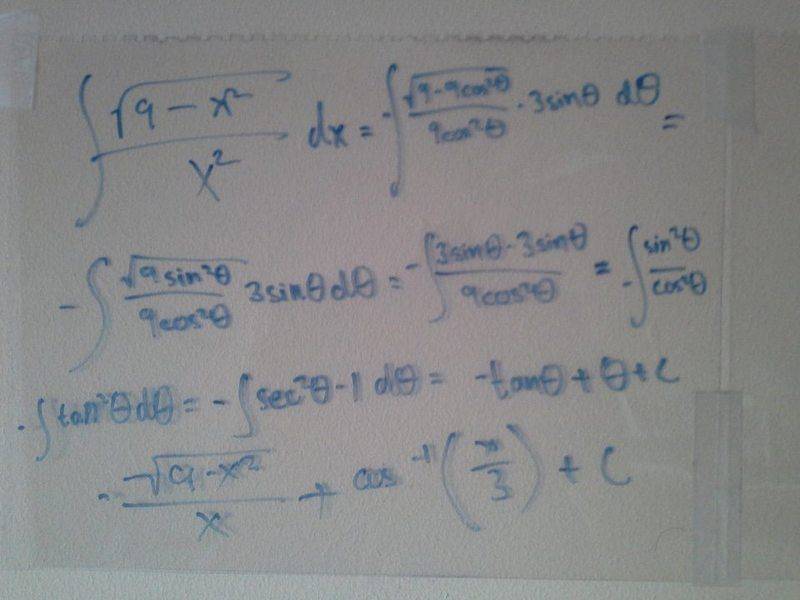
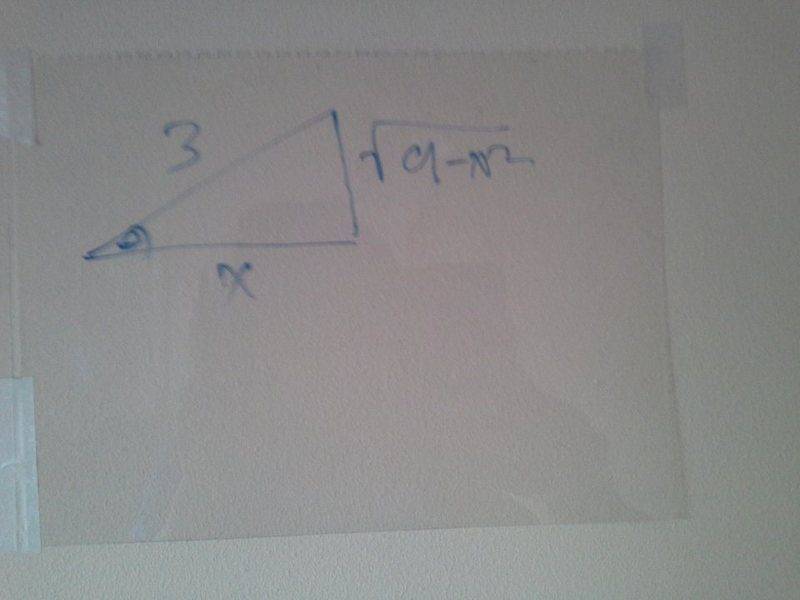
I was wondering if you could do a trig substitution with cosine instead of sine. All the textbooks I have referred to use a sine substitution and leave no mention as to why cosine substitution was not used. It seemed that it should work just the same, until I tried it for the following Fint [sqrt(9-x^2)]/ [x^2]. I checked to see if my answer differed by only a constant but that was not the case. I have attached pictures of my work. Can anyone tell me why it does not work?
20160130_164904.jpg
20160130_164853.jpg
 
Physics news on Phys.org
If you use sine instead, you will end up with ##\sin^{-1}## in place of ##\cos^{-1}##. But the two expressions are related by ##\cos^{-1}x = \pi/2-\sin^{-1}x##.
 
I know but why are the answers different? Is one less valid than the other?

Btw the textbook which uses sine has the same answer but with -sin^-1(x/3) instead of cos^-1(x/3) like I have it.
 
UMath1 said:
Btw the textbook which uses sine has the same answer but with -sin^-1(x/3) instead of cos^-1(x/3) like I have it.
That's exactly the point I addressed in my previous post. Replace -sin^-1(x/3) with the equation I wrote before. You will indeed have an additional ##\pi/2## but it's a constant and hence can be absorbed into the integration constant ##C##.
 
There's really nothing magic about using sin or cos. It just depends on what is more convenient for each case. As for signs, using the relevant relations from trigonometry - like the one that blue_leaf77 mentions, you can substitute sin for cos and vice versa and find the appropriate sign.
 
The function being integrated is

f(x) = √(9 - x2) / x2

. This is defined for 0 < |x| ≤ 3.

When making a substitution we want to choose an interval where f(x) makes sense, and the easiest one is 0 < x ≤ 3.

We also want to choose a substitution that takes the same values that f(x) does over the interval of definition, and that's between 0 and 3.

Each of y = 3 sin(x) and y = 3 cos(x) satisfy this condition, so either one can be used for the substitution.

Using 3 sin(x) to substitute might be a tiny bit easier than cosine because its derivative is 3 cos(x), and this does not introduce negative signs.
 
Ok...I see it now. I tried some test bounds of integration and got the same answer from both options.
 

Similar threads

  • · Replies 6 ·
Replies
6
Views
2K
  • · Replies 6 ·
Replies
6
Views
3K
  • · Replies 3 ·
Replies
3
Views
3K
  • · Replies 7 ·
Replies
7
Views
2K
  • · Replies 1 ·
Replies
1
Views
2K
  • · Replies 1 ·
Replies
1
Views
2K
  • · Replies 5 ·
Replies
5
Views
2K
  • · Replies 1 ·
Replies
1
Views
2K
Replies
11
Views
4K
  • · Replies 5 ·
Replies
5
Views
2K