Triple equation for integral on a graph

Click For Summary
SUMMARY

The discussion focuses on calculating the volume of a regular tetrahedron using integrals in a 3D coordinate system. The user struggles with expressing the equations of the planes correctly for integration, specifically with the equation involving the parameter "a," which represents the length of the edges. The user identifies that while they can express some planes like z=3y as integrable functions, others, such as the bisector of the triangle in 3D space, present challenges. Resources such as Paul's online notes and a YouTube video are recommended for further understanding of integration techniques with complex limits.

PREREQUISITES
  • Understanding of triple integrals in multivariable calculus
  • Familiarity with 3D coordinate systems and geometric shapes
  • Knowledge of the properties of regular tetrahedrons
  • Ability to manipulate equations involving parameters in integrals
NEXT STEPS
  • Study the application of triple integrals for calculating volumes of irregular shapes
  • Learn about parameterization of surfaces in 3D space
  • Explore integration techniques for functions with complex limits
  • Review resources on the geometry of tetrahedrons and their properties
USEFUL FOR

Students in calculus courses, particularly those studying multivariable calculus, as well as educators and anyone interested in advanced integration techniques for geometric shapes.

NODARman
Messages
57
Reaction score
13
TL;DR
.
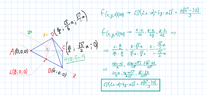
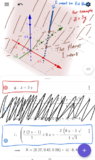
Hi, so I'm trying to find the volume of a shape using integral, I found the equation of one plane in 3D space but the second one is something like that, which I cannot write in integral as a function: ##\frac{2(2x-a)}{a}=-\frac{2(6y-a\sqrt3)}{a\sqrt3}=\frac{2z-a\sqrt3}{a\sqrt3}##
In the 3D viewer program, I wrote this and it made a line, but I needed a plane. Other points of that shape were connected, for example, z=3y and it was a plane, that can be written in integral. When I solve for x it wasn't right in the 3D coordinate system space.
Like I can write integral of (3y)dy but not integral of (2x=3y=4z)dxdydz... :(
 

Attachments
  • Screenshot_20221226-215713.png
    Screenshot_20221226-215713.png
    32.3 KB · Views: 181
Last edited by a moderator:
Physics news on Phys.org
Is this homework?

Are there other surfaces that bound the volume?

How is the parameter "a" used?
 
scottdave said:
Is this homework?

Are there other surfaces that bound the volume?

How is the parameter "a" used?
Sorry, I wrote little information, so it's a regular tetrahedron.
I recalculated that and the function of the line (which is bisectriz of the BCD triangle/surface) is a little bit different. But the main problem is how to calculate the volume under that triangle. I've searched the formula of the line (in 3D space) on the internet btw.

"a" is the length of the edges.

P.S. Kinda homework-ish...
 

Attachments

  • Screenshot 2022-12-27 18.57.23.png
    Screenshot 2022-12-27 18.57.23.png
    27.9 KB · Views: 170

Similar threads

  • · Replies 2 ·
Replies
2
Views
3K
  • · Replies 8 ·
Replies
8
Views
2K
  • · Replies 4 ·
Replies
4
Views
1K
  • · Replies 1 ·
Replies
1
Views
1K
  • · Replies 4 ·
Replies
4
Views
2K
Replies
20
Views
2K
  • · Replies 3 ·
Replies
3
Views
2K
  • · Replies 4 ·
Replies
4
Views
3K
  • · Replies 4 ·
Replies
4
Views
2K
  • · Replies 7 ·
Replies
7
Views
2K