Trouble Understanding Indexed Union of Lines in the Plane

  • Context: Graduate 
  • Thread starter Thread starter MotoPayton
  • Start date Start date
  • Tags Tags
    Lines Plane Union
Join the discussion
Ask a follow-up here, or get your own question answered by working scientists, mathematicians and engineers — people, not an autocomplete.
Real named experts · corrections over time · the nuance an AI answer skips
2 replies · 2K views
MotoPayton
Messages
96
Reaction score
0
I am having trouble understanding how the indexed union of ln in the first picture is equal to a subset of the plane; an element of it is a point on one of the lines. If I were to choose say 0 1 2 then the indexed union should be y=0 union y=1 union y=2. These lines would have no points in common so the total indexed union should be the empty set. I understand the second second set, it is the indexed union giving me trouble. Sorry if the pictures are blurry my phone isn't the greatest.
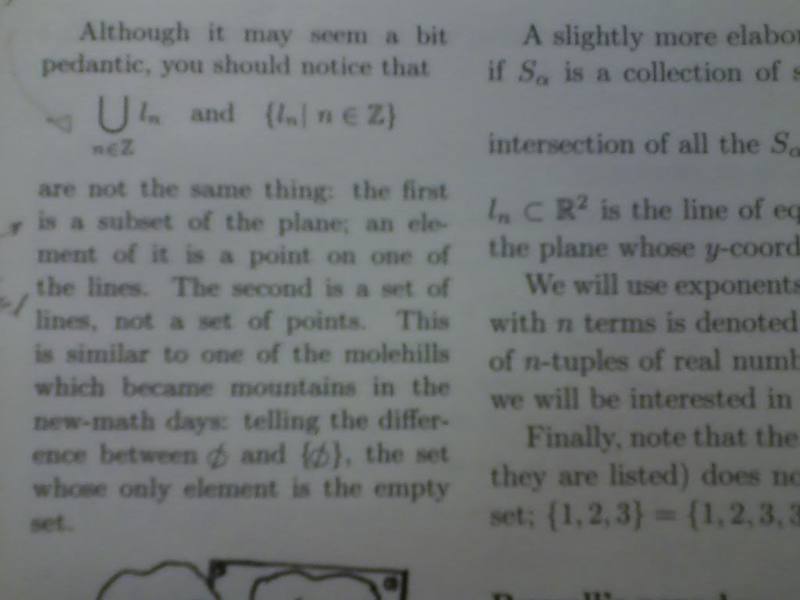
0306132054a.jpg


http://i603.photobucket.com/albums/tt113/KtmPayton/0306132054.jpg
 
on Phys.org
MotoPayton said:
These lines would have no points in common so the total indexed union should be the empty set.


You didn't include the part of the text where [itex]I_n[/itex] is defined.

Why would having points in common be relevant to a union of sets? Are you thinking of an intersection of sets instead?
 
The definition of In is on the next link. In is a subset of R2 and is the line of equation y=n.
I have to admit for some reason I was stuck on thinking this was an intersection. Thinking about it some more I have realized that the individual sets of the indexed union each contain a line. Those particular sets contain all the points that make up the line.
That is how it differs from the other one where the individual set contains all the different lines. Pretty sure I have it now. Thanks for helping.