Troubleshooting Circuit Analysis: How to Convert Current to Voltage Sources?

Click For Summary
SUMMARY

This discussion focuses on troubleshooting circuit analysis, specifically converting current sources to voltage sources using mesh analysis. The user successfully converted a current source to a voltage source of 20V but struggled with redrawing the circuit. The solution provided emphasizes marking nodes A, B, C, and D, and suggests using nodal analysis for non-planar circuits, which simplifies the process. The method involves ensuring a planar network by appropriately connecting components and marking equipotential nodes.

PREREQUISITES
  • Understanding of mesh analysis in circuit theory
  • Familiarity with nodal analysis techniques
  • Knowledge of circuit components and their configurations
  • Ability to identify planar and non-planar circuits
NEXT STEPS
  • Learn advanced mesh analysis techniques for complex circuits
  • Study nodal analysis in-depth, focusing on its applications in non-planar circuits
  • Explore circuit simulation tools like LTspice for practical applications
  • Investigate the principles of equipotential nodes in circuit design
USEFUL FOR

Electrical engineering students, circuit designers, and anyone involved in circuit analysis and troubleshooting will benefit from this discussion.

bibo_dvd
Messages
37
Reaction score
0
hello guys

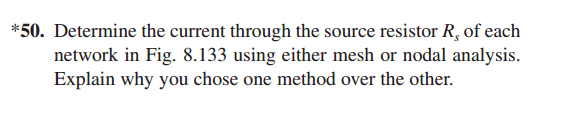
i have been trying to solve this problem for a long time but i couldn't so i need your help..
KAuNXiE.png


LxAzH0e.png


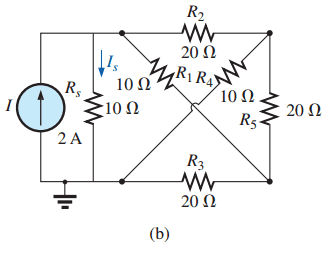
iam trying to analyze the circuit using mesh analysis

so i converted the current so to voltage source E=2*10=20V

i don't know how to redraw the circuit taking this shape ..so can you help me please ??

Thanks Guys :))
 
Physics news on Phys.org
I can see four nodes in this circuit. Mark those nodes as A, B, C, D starting from the top in clockwise direction. like this:
Capture3.PNG


Now redraw the circuit by first marking the nodes A, B, C, D one below the other. Then connect the components between the nodes in such a way that you get a planar network. Now write down the equations by mesh analysis.

But if you observe the circuit again, you will see that they have already grounded node D. So the simpler way is: Nodal analysis!

Whenever i see a non planar circuit, I blindly proceed using nodal analysis.

Hope this helped :smile:
 
You can follow this method to redraw any circuit.

(1) Mark all the nodes using notations of your choice.
(2) Then start redrawing by marking these nodes in a different manner such that, when you connect the components back, you obtain a planar circuit!
(3) If you find two or more nodes such that they are equipotential (Like in a balanced wheatstone's bridge), mark both the nodes with a common notation and then redraw the circuit.
 
  • Like
Likes   Reactions: 1 person
Simply move R1. Instead of as it is, going from upper left to lower right, starting at the upper left node, go up and clockwise around the upper right node, down to the lower right node.

In other words, instead of connecting R1 "inside the square", go around the "outside" of the square.
 
  • Like
Likes   Reactions: 1 person
thx guys this helped me a lot :)
 

Similar threads

  • · Replies 7 ·
Replies
7
Views
2K
Replies
15
Views
2K
  • · Replies 1 ·
Replies
1
Views
2K
Replies
7
Views
2K
  • · Replies 7 ·
Replies
7
Views
3K
  • · Replies 10 ·
Replies
10
Views
4K
  • · Replies 2 ·
Replies
2
Views
2K
  • · Replies 5 ·
Replies
5
Views
2K
  • · Replies 5 ·
Replies
5
Views
2K
  • · Replies 5 ·
Replies
5
Views
3K