Help Me Solve This Khan Academy Question: Friction and Initial Velocity

Click For Summary
SUMMARY

This discussion revolves around solving a Khan Academy physics problem involving friction and initial velocity. The user calculates the friction force (Ff) between two boxes using the formula Ff = Fn x μbox, arriving at a value of 1.96 N. The user struggles to relate the coefficients of friction for the floor and the boxes, particularly when trying to determine the maximum value of μfloor. Key insights include the importance of understanding the relationship between forces and accelerations when the boxes are in contact and not slipping.

PREREQUISITES
  • Understanding of Newton's laws of motion
  • Familiarity with friction coefficients (μ)
  • Knowledge of free body diagrams
  • Basic algebra for solving equations
NEXT STEPS
  • Study the relationship between friction and acceleration in systems with multiple objects
  • Learn about free body diagrams and their application in physics problems
  • Explore the concept of static vs. kinetic friction
  • Review problems involving multiple masses and frictional forces
USEFUL FOR

Students studying physics, particularly those focusing on mechanics and friction, as well as educators looking for examples of problem-solving strategies in physics.

Iwanttolearnphysics
Messages
44
Reaction score
9
Homework Statement
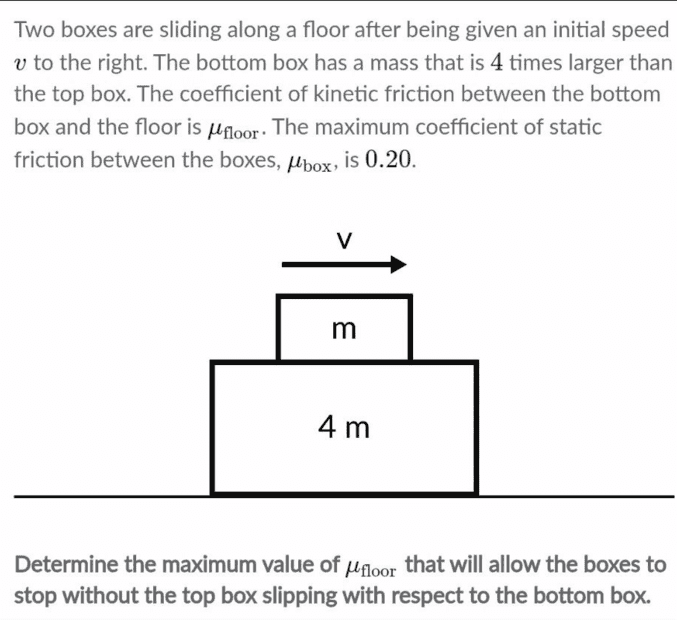
Two boxes are sliding along a floor after being given an initial speed v to the right. The bottom box has a mass that is 4x larger than the top box. The coefficient of kinetic friction between the bottom box and the floor is μfloor. The maximum coefficient of static friction between the boxes, μbox is 0.20. Determine the maximum value of μfloor, that will allow the boxes to stop without the top box slipping with respect to the bottom box.
Relevant Equations
Ff = Fn x μ
Here's a picture of the question:
1638668308571.png


This is a Khan Academy question and although I could just click on hint to find out what the answer is, I think it would be helpful to still ask this here before looking at the answer over there, so that I know what I did wrong. Thank you in advance to anyone willing to help me.

Here's my thinking:
  • Ff = Fn x μbox
  • Ff = mg x μbox
  • Ff = 1(9.81) x 0.20
  • Ff = 1.96 N
  • That's the friction between box m and box 4m.
  • I don't know how that would help me solve the problem. It says to determine the maximum value of μfloor. How do I even relate them to each other?
  • I can use Ff = Fn x μfloor
  • Ff = mg x μbox
  • Ff = 5(9.81) x μbox
  • Now I'm stuck. I can't assume that the Friction for the floor and box m are the same as what I computed before.
  • I don't know what I'm missing. It says the box was given an initial velocity, "v". But how is that helpful?
I do not like problems without numbers. I cannot make sense of them. This tells me that there's still so much I don't understand.
 
Physics news on Phys.org
Iwanttolearnphysics said:
It says the box was given an initial velocity, "v". But how is that helpful?
What matters is that it is moving. If the top box is not slipping, what can you say about the accelerations? Relate those to the forces.
 
  • Like
Likes Iwanttolearnphysics
haruspex said:
What matters is that it is moving. If the top box is not slipping, what can you say about the accelerations? Relate those to the forces.
I thought about that too, but I think I made a mistake so I scrapped that idea. I thought about acceleration possibly being zero because the boxes are in contact with each other and the top one is not slipping, my equation became:
  • Ff = Fn x μfloor
  • ma = Fn x μfloor
  • 5(0) = 5(9.81) x μfloor
  • μfloor = -49.05?
  • I do not think this is right at all. μ is usually a very small number and not negative.
  • Also, in the equation I wrote above, it's right that I added the masses right? Since the top box is adding to the weight force of the bottom one (thus, affecting it's normal force).
  • I also was not able to use the 0.20 in this equation. I don't know how to relate these two things to each other.
Thank you very much.
 
Iwanttolearnphysics said:
I thought about acceleration possibly being zero because the boxes are in contact with each other and the top one is not slipping
Which acceleration? The boxes are not going to slide forever on a frictional floor.
 
haruspex said:
Which acceleration? The boxes are not going to slide forever on a frictional floor.
You're right. Let me think about this problem some more. I am stuck and although what you said makes sense, I cannot seem to apply it to this problem. Thank you for your help! I'll figure it out and come back here.
 
Think about how the boxes would behave in each of both following extreme situations:
1) Zero coefficient of friction between both boxes, but some friction between the lower box and the floor.
1) Some friction between both boxes, but zero coefficient of friction between the lower box and the floor.
 
  • Like
Likes Iwanttolearnphysics

Similar threads

Replies
10
Views
2K
Replies
1
Views
2K
  • · Replies 7 ·
Replies
7
Views
2K
  • · Replies 3 ·
Replies
3
Views
849
  • · Replies 8 ·
Replies
8
Views
2K
Replies
15
Views
2K
  • · Replies 7 ·
Replies
7
Views
2K
  • · Replies 1 ·
Replies
1
Views
2K
  • · Replies 1 ·
Replies
1
Views
2K
  • · Replies 6 ·
Replies
6
Views
2K