Two cylinders rotating with contact at an angle (reformulation of the problem)

Click For Summary
SUMMARY

The discussion centers on the dynamics of two cylinders in contact, each rotating about a fixed axis while exerting forces on each other. The problem involves analyzing the angular velocities, denoted as ##\omega_P## and ##\omega_Q##, under the influence of torques ##\tau_P## and ##\tau_Q##, and a friction coefficient ##k##. The participants aim to draw a phase diagram for varying parameters and have established that slipping occurs for any nonzero angular velocities when the angle ##\theta## is between 0 and ##\pi/2##. The system of differential equations governing the motion is defined, highlighting the complexity of the solution.

PREREQUISITES
  • Understanding of rotational dynamics and moments of inertia (##J_P, J_Q##)
  • Knowledge of friction mechanics, specifically dry friction and its coefficient (##k##)
  • Familiarity with torque concepts and their mathematical representation (##\tau_P, \tau_Q##)
  • Basic proficiency in solving ordinary differential equations (ODEs)
NEXT STEPS
  • Study the derivation of phase diagrams in mechanical systems
  • Learn about the application of torque in rotational motion analysis
  • Explore the qualitative analysis of ordinary differential equations (ODEs)
  • Investigate the effects of friction on the motion of rigid bodies
USEFUL FOR

Mechanical engineers, physics students, and educators interested in advanced dynamics and the behavior of rotating systems under frictional forces.

wrobel
Science Advisor
Insights Author
Messages
1,242
Reaction score
1,050
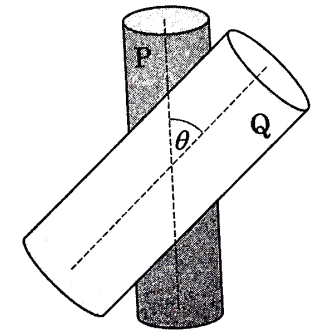
Some time ago there was a problem with the following picture somewhere out here. I think this problem was underestimated a little bit.
t.png


Let us reformulate the problem. Assume that each cylinder, if it was not influenced by the other one, could rotate freely about its fixed axis. But the cylinders press each other with a force ##N>0##. The coefficient of dry friction between them is ##k>0##. Assume also that both cylinders experience torques ##\tau_P,\tau_Q##. The torques are constants and directed along the corresponding axes of cylinders. Moments of inertia ##J_P,J_Q## of cylinders are given.
The task is to draw a phase diagramme on the plane ##\omega_P,\omega_Q## for different values of parameters. Here ##\omega_P,\omega_Q## are the angular velocities. I even think that it would be interesting for an educational journal. I think to give it to my students.

Any comments are welcome :)
 
  • Like
  • Love
Likes PhDeezNutz, etotheipi and Lnewqban
Physics news on Phys.org
In the case of ##\theta=\pi/2## torque of P and Q push each other to move along the axis. Do you allow such translation motion to P and Q ?
 
no, I consider the motion along the axis to be forbidden for both cylinders
 
So we allow the rolls slip in that case. In general we allow slip of the axis component of roll velocity v sin##\theta##.
 
anuttarasammyak said:
So we allow the rolls slip in that case.
yes and they are slipping for any nonzero angular velocities; ##\theta\in(0,\pi/2]##
 
@wrobel I'd be interested to see how you went about solving this. I haven't gotten very far o0)

Draw a Cartesian frame ##O\mathrm{xyz}## with ##O## at the point of contact of the cylinders, the ##\mathrm{y}## axis parallel to the axis of ##P## and the ##\mathrm{z}## axis pointing vertically upward. Let the unit vectors parallel to the axes of each cylinder be ##\mathbf{e}_P := \mathbf{e}_y## and ##\mathbf{e}_Q := \mathbf{e}_y \cos{\theta} + \mathbf{e}_x\sin{\theta}##. Writing ##\boldsymbol{\omega}_P = \omega_P \mathbf{e}_P## and ##\boldsymbol{\omega}_Q = \omega_Q \mathbf{e}_Q## the relative velocity of the cylinders at the point of contact is $$\boldsymbol{V} := \boldsymbol{v}_P(O,t) - \boldsymbol{v}_Q(O,t) = (r_p \boldsymbol{\omega}_P + r_Q \boldsymbol{\omega}_Q) \times \mathbf{e}_z = \mathbf{e}_x(r_P \omega_P + r_Q \omega_Q \cos{\theta}) - \mathbf{e}_y r_Q \omega_Q \sin{\theta} $$Now define ##\hat{\boldsymbol{V}} := \boldsymbol{V} / |\mathbf{V}|##. The friction force acting on ##P## due to ##Q## is ##\mathbf{F}_P = - k N \hat{\boldsymbol{V}} = - \mathbf{F}_Q##. Let ##\mathcal{A}_P## and ##\mathcal{A}_Q## be arbitrary points along the axes of ##P## and ##Q## respectively. The moment ##\Gamma_P## associated with ##\mathbf{F}_P## about the axis ##(\mathcal{A}_P, \mathbf{e}_y)## of ##P## is$$\Gamma_P = r_P \mathbf{e}_z \times (- k N \hat{\boldsymbol{V}}) \cdot \mathbf{e}_y = \frac{-r_P k N(r_P \omega_P + r_Q \omega_Q \cos{\theta})}{|\boldsymbol{V}|}$$Similarly, the moment ##\Gamma_Q## associated with ##\mathbf{F}_Q## about the axis ##(\mathcal{A}_Q, \mathbf{e}_Q)## of ##Q## is $$\begin{align*}

\Gamma_Q &= -r_Q \mathbf{e}_z \times (k N \hat{\boldsymbol{V}}) \cdot (\mathbf{e}_y \cos{\theta} + \mathbf{e}_x\sin{\theta}) \\ \\

&= \frac{-r_Q k N([r_p \omega_p + r_Q \omega_Q \cos{\theta}]\cos{\theta} + r_Q \omega_Q \sin^2{\theta})}{|\boldsymbol{V}|} = \frac{-r_Q k N(r_p \omega_p \cos{\theta} + r_Q \omega_Q )}{|\boldsymbol{V}|}

\end{align*}$$The system of differential equations to solve is$$\begin{bmatrix} \dot{\omega}_P \\ \dot{\omega}_Q \end{bmatrix} = \begin{bmatrix} \frac{1}{J_P} (\tau_P + \Gamma_P) \\ \frac{1}{J_Q} (\tau_Q + \Gamma_Q) \end{bmatrix}$$and it looks like it is a bit difficult to solve :nb)
 
Last edited by a moderator:
Qualitative analysis of ODE is needed I guess
 
  • Like
Likes etotheipi

Similar threads

  • · Replies 8 ·
Replies
8
Views
957
  • · Replies 22 ·
Replies
22
Views
4K
  • · Replies 2 ·
Replies
2
Views
3K
Replies
2
Views
1K
  • · Replies 11 ·
Replies
11
Views
2K
  • · Replies 9 ·
Replies
9
Views
3K
  • · Replies 1 ·
Replies
1
Views
2K
  • · Replies 7 ·
Replies
7
Views
10K
  • · Replies 1 ·
Replies
1
Views
2K
  • · Replies 14 ·
Replies
14
Views
9K