Graduate How Does the Two-Particle Green Function Relate to Hartree-Fock Theory?

Click For Summary
The discussion centers on the relationship between the two-particle Green function and Hartree-Fock (HF) theory, specifically questioning how the splitting of the Green function leads to HF equations. Participants express confusion about the graphical representations and their alignment with the equations, particularly regarding the propagation of particles and the validity of certain figures. There is a desire for a simpler approach to understanding many-body physics, as the existing literature often relies on Wick's theorem, which may not be accessible to beginners. The need for a formal proof of the HF equations, akin to that of the Hartree potential, is emphasized. Overall, the conversation highlights the complexities of connecting Green functions to HF theory and the challenges faced by those new to the subject.
Rzbs
Messages
52
Reaction score
11
TL;DR
relation between two-particle green function and Hartree-Fock
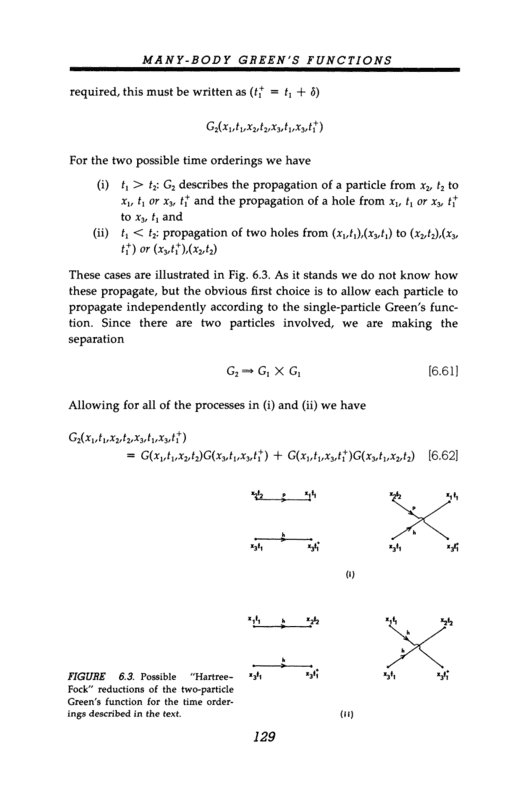
could anyone explain why in the page of book this figure is related to hartree-fock? I mean why if t1>t2 we have these possibilities? and why not particle propagate from x2t2 to x3t3 instead x3t3+?
1596383273547.png
1596383273547.png
 
Physics news on Phys.org
Because you can show that if you write ##G_{12} = G_1G_2## you can get HF equations. It's not difficult but it's not easy as well. I can look up my old notes if you are interested in a formal proof.
 
  • Like
Likes Rzbs
dRic2 said:
Because you can show that if you write ##G_{12} = G_1G_2## you can get HF equations. It's not difficult but it's not easy as well. I can look up my old notes if you are interested in a formal proof.
Thanks very much for your answer
I really want to why these spliting of G2 result in HF and I want to match the graphs to relation 6.62 but I think the right-up graph does'n match to any of G1s.
I will be grateful if you check your notes or introduce a book with similar notation of this book: Inkson, manybody theory of solids.
 
fateme said:
but I think the right-up graph does'n match to any of G1s.
It looks like an error to me too, but don't take my world without checking for yourself.

Anyway I'll be back this afternoon or tomorrow because I need some time to find and make sense of my notes again o0)
 
Thanks again for replying.
 
Last edited:
Thanks a lot but I think it's not the thing I'm looking for. Because I am new in many-body physics I want a simple approach and according to Inkson's book there are two approaches "equation of motion method ...more physically understandable than the use of wick's theorem" . And many of books I think use wick theorem, whereas I need another method.
So I think I need a proof for HF like its proof for Hartree potential.
Screenshot_20200805-091802.png
 
The article I linked says exactly the same things as the one you posted. What is not clear to you ?
 
Actually I didn't follow the proof and it's notations. I can't understand the relation between the HF formula that was in the first chapter and the HF formula in terms of green function; It's not clear to me. I want to start with 6.66 eq. and reach to 1.30 or 1.31 eq. It's not clear for me at all how can I do this.
Screenshot_20200805-180140.png
 

Similar threads

  • · Replies 9 ·
Replies
9
Views
3K
  • · Replies 4 ·
Replies
4
Views
2K
  • · Replies 1 ·
Replies
1
Views
2K
  • · Replies 13 ·
Replies
13
Views
2K
  • · Replies 0 ·
Replies
0
Views
1K
  • · Replies 1 ·
Replies
1
Views
1K
  • · Replies 1 ·
Replies
1
Views
1K
  • · Replies 1 ·
Replies
1
Views
2K
  • · Replies 4 ·
Replies
4
Views
4K
Replies
1
Views
2K