Umklapp Scattering: Causes, Importance, and Phonon Momentum

  • Context: Graduate 
  • Thread starter Thread starter Altruist
  • Start date Start date
  • Tags Tags
    Scattering
Click For Summary
SUMMARY

Umklapp scattering is a critical phenomenon in solid-state physics that involves the interaction of phonons, specifically how their momentum is affected by the periodic structure of a crystal lattice. The discussion highlights that k-vectors outside the first Brillouin zone are equivalent to those within it, emphasizing that k values differing by 2π/a represent the same physical state. The relationship between k values and atomic displacement during lattice vibrations is illustrated through cosine functions, demonstrating how different k values affect the phase of atomic oscillations.

PREREQUISITES
  • Understanding of phonon momentum and lattice vibrations
  • Familiarity with Brillouin zones and k-vectors
  • Knowledge of cosine functions and their graphical representation
  • Basic concepts of solid-state physics
NEXT STEPS
  • Study the principles of Umklapp scattering in detail
  • Learn about Brillouin zones and their significance in solid-state physics
  • Explore the mathematical representation of phonon dispersion relations
  • Investigate the role of lattice vibrations in thermal conductivity
USEFUL FOR

Physicists, materials scientists, and students studying solid-state physics, particularly those interested in phonon behavior and crystal lattice dynamics.
Altruist
Messages
25
Reaction score
0
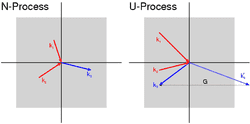
what causes this? why is it important? I don't understnad why the phonon momentum is different but the k-vectors outside the first Brillouin zone are physically equivalent to vectors inside it. I can see that physically the vector is shifted by pi back into the Brillouin zone by G. Is the k vector representing momentum of the phonon? if not, what is?
250px-Phonon_nu_process.png
n process on the left, u process on the right
 
Last edited:
Physics news on Phys.org
First draw a grid of points (2 or 3 points is fine) in 1D separated by the distance a. The grid points are the atoms

Next draw the curve Cos[k*x] for the below k values. Place the atoms on the curve. The oscillation is the displacement of atoms in a transverse lattice vibration.

k=0
k=0.5*pi/a
k=pi/a
k=2*pi/a
k=4*pi/a

Note that:

for k=0 all the atoms are uniformly shifted.

for k=0.5* pi/a it takes two periods for the atoms to be completely out of phase (one all the way up and the other all the way down)

for k=pi/a nearest neighbor atoms are completely out of phase

for k=2*pi/a again all the atoms are uniformly shifted. k=0 and k=2*pi/a are identical

for k=4*pi/a again the same... and so on for each additional n*2*pi/a (n=0,1,2,3,...)

So k values that are differ by 2*pi/a are identical.

You can test this by plotting Cos[(0.5*pi/a) * x] and Cos[(0.5*pi/a + 2*pi/a) * x].
 

Similar threads

  • · Replies 1 ·
Replies
1
Views
2K
  • · Replies 2 ·
Replies
2
Views
2K
  • · Replies 1 ·
Replies
1
Views
2K
  • · Replies 2 ·
Replies
2
Views
4K
  • · Replies 6 ·
Replies
6
Views
3K
  • · Replies 0 ·
Replies
0
Views
3K
  • · Replies 2 ·
Replies
2
Views
3K
  • · Replies 1 ·
Replies
1
Views
5K
  • · Replies 11 ·
Replies
11
Views
18K
  • · Replies 4 ·
Replies
4
Views
6K