Unclear Transformer Specifications

  • Thread starter Thread starter teroenza
  • Start date Start date
  • Tags Tags
    Transformer
Click For Summary

Discussion Overview

The discussion revolves around the specifications and characteristics of an old transformer-like device, focusing on its input and output power discrepancies, fuse ratings, and operational context. Participants explore the nature of the device, its potential applications, and safety considerations.

Discussion Character

  • Exploratory
  • Technical explanation
  • Debate/contested

Main Points Raised

  • One participant expresses confusion about the differing input and output power ratings of the device, questioning the meaning of the fuse rating.
  • Another participant clarifies that the input power is rated in Volt-Amps rather than Watts, explaining the concept of Power Factor (PF) and its implications for current and voltage relationships in transformers.
  • Some participants suggest that the device may not function as a traditional transformer, noting its output specifications of 0 to 40 kV DC at 2 mA max and its potential design for aircraft operation.
  • There is a discussion about the age of the device, with references to outdated terminology on nameplates.
  • Concerns are raised about safety when handling high voltage outputs, emphasizing the need for caution.
  • One participant speculates on the possibility of the fuse rating indicating a single fuse of 2/10 amp, while another points out the implications of the primary current rating in relation to the fuse rating.
  • A participant mentions a similar device available from a surplus supplier, indicating a lack of specific information on the original device.
  • Another participant reflects on their initial intention to use the device for a Jacob's ladder, but questions the adequacy of the output current for that purpose.
  • One reply encourages experimentation with the device, suggesting that the participant try it out and report back.

Areas of Agreement / Disagreement

Participants do not reach a consensus on the nature of the device, with multiple competing views regarding its specifications and intended use. The discussion remains unresolved regarding the implications of the power ratings and safety considerations.

Contextual Notes

There are limitations in the discussion, including assumptions about the device's specifications, the potential for losses in the transformer, and the lack of clarity on the fuse rating. The discussion also reflects uncertainty about the operational context of the device.

teroenza
Messages
190
Reaction score
5
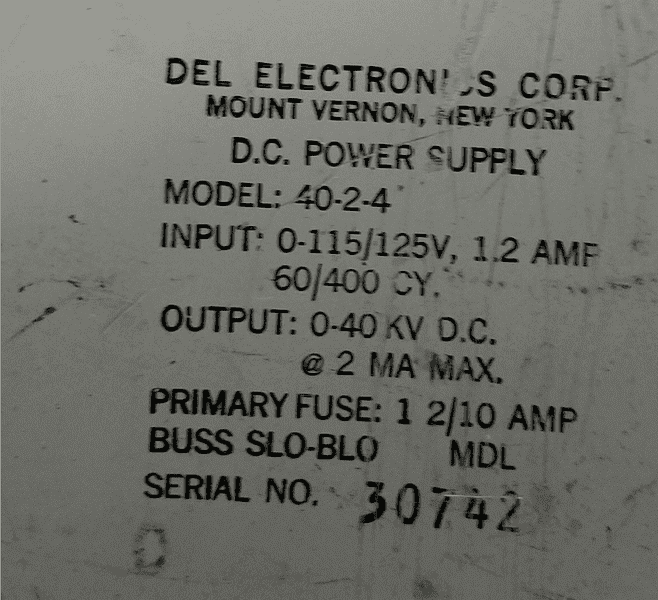
Can someone help me better understand the specs for this old transformer I found? I'm confused why the input and output power see to differ greatly (115V*1.2A ~140W while 40,000V*2mA~ 80W).

Also, the fuse rating is unclear to me. Does that mean 1 and 2/10 amp?
Untitled-picture-r0u753.png
 

Attachments

  • Untitled-picture-r0u753.png
    Untitled-picture-r0u753.png
    73 KB · Views: 849
Engineering news on Phys.org
Here is a basic description.

The input is rated in Volt-Amps, not Watts. Using the nameplate ratings, the Power Factor (PF) is about 0.57. Since a transformer is coils of wire, it has Inductance, and an Inductance opposes any change in the current flowing thru it. That means, for instance, that the peak current in an inductor (the primary of the transformer) lags, or occurs later than, the voltage peak.

A PF of 0.57 means the phase angle between the input voltage and the input current is about 55 degrees; with a full electrical cycle of the input AC being 360 degrees.

In an actual, physical, transformer there are also losses in the core and in the resistance of the windings that need to be accounted for to get a precise answer. For this specific transformer one of the limiting factors for output current is likely the temperature of the secondary winding. It uses very fine wire to get many more turns to step up the input voltage. A long piece of small diameter wire has a relatively high resistance which means it gets hot with just a little current flowing thru it.
 
It doesn't appear to be a transformer per se. Output is 0 to 40 kV DC at 2 mA max.

0-115/125 V AC at 60/400 Hz suggests it may have been made to operate from aircraft (400 Hz) as well as from 60 Hz U.S. line supply.

It is probably old; been awhile since nameplates used "CY" (cycles) or CPS (cycles per second) instead of Hz (Hertz).

Primary fuse is a Bussmann type MDL (250V, slow blow, 1/4 x 1-1/4", glass tube) rated one and two-tenths (1-2/10) amps.

Be careful. Handling 40 kV at 2 mA requires a respectful nature.
 
Asymptotic said:
It doesn't appear to be a transformer per se. Output is 0 to 40 kV DC at 2 mA max.

0-115/125 V AC at 60/400 Hz suggests it may have been made to operate from aircraft (400 Hz) as well as from 60 Hz U.S. line supply.

It is probably old; been awhile since nameplates used "CY" (cycles) or CPS (cycles per second) instead of Hz (Hertz).

Primary fuse is a Bussmann type MDL (250V, slow blow, 1/4 x 1-1/4", glass tube) rated one and two-tenths (1-2/10) amps.

Be careful. Handling 40 kV at 2 mA requires a respectful nature.
It also might mean there is only one fuse of a rating 2/10 amp.
 
arydberg said:
It also might mean there is only one fuse of a rating 2/10 amp.
True, but primary current rating is 1.2 amps. This is 100% of a 1-2/10 amp rated fuse, but 600% of a 0.2 amp fuse.
 
Couldn't find this particular supply, but suspect it is similar to several available at Surplus Sales of Nebraska like the one pictured below.

HiV Supply.jpg
 

Attachments

  • HiV Supply.jpg
    HiV Supply.jpg
    15.6 KB · Views: 447
Thank you all for the information. I should have noticed off the bat that it's output was DC. After finding it, my original idea was to build a Jacob's ladder, but <2mA of output current seems too low.
 
teroenza said:
but <2mA of output current seems too low.
Try it and see.

Oh, and let us know too.
 

Similar threads

  • · Replies 8 ·
Replies
8
Views
3K
  • · Replies 10 ·
Replies
10
Views
4K
  • · Replies 7 ·
Replies
7
Views
7K
  • · Replies 8 ·
Replies
8
Views
3K
Replies
14
Views
3K
Replies
6
Views
3K
  • · Replies 10 ·
Replies
10
Views
6K
  • · Replies 15 ·
Replies
15
Views
5K
  • · Replies 6 ·
Replies
6
Views
2K
  • · Replies 10 ·
Replies
10
Views
4K