Buck-boost converter output current limiter

Click For Summary

Discussion Overview

The discussion revolves around the challenges of achieving higher output current from a buck-boost converter than its maximum rated current, specifically in the context of repurposing the converter for use in electronic cigarettes. Participants explore technical specifications, component limitations, and alternative solutions while addressing the nuances of current discharge in e-cig applications.

Discussion Character

  • Technical explanation
  • Debate/contested
  • Exploratory

Main Points Raised

  • One participant inquires about bypassing the current limiter of a buck-boost converter to achieve output currents up to 25 Amps for short durations.
  • Another participant asserts that a high continuous current discharge power source at the input would not help in achieving higher output currents.
  • Some participants suggest selecting a different buck converter rated for 25A instead of modifying the existing one.
  • There is a discussion about the potential to modify the current limit by replacing a resistor, though concerns are raised about the suitability of the inductor, FETs, and PCB for such modifications.
  • A participant questions how buck-boost converters in electronic cigarettes manage high current discharges with seemingly less robust components.
  • References to specific buck and buck-boost converter designs suitable for e-cig applications are provided, including those from Texas Instruments and Evolv.
  • Participants discuss the availability and standards of voltage and current in the e-cig industry, questioning whether datasheets are publicly accessible or proprietary.
  • Concerns are raised about the limitations of various lithium-ion battery types used in e-cigs and their impact on performance.

Areas of Agreement / Disagreement

Participants generally agree on the need for a different converter rated for higher currents, but there is no consensus on the feasibility of modifying the existing buck-boost converter or on the specifics of e-cig circuitry.

Contextual Notes

Participants express uncertainty about the implications of modifying current limits and the specific requirements for components in high-current applications. There are also unresolved questions regarding the proprietary nature of e-cig circuit designs and standards.

Who May Find This Useful

Individuals interested in electronics design, particularly in power management for applications like electronic cigarettes, may find this discussion relevant.

Sid55
Messages
26
Reaction score
1
How can I get around current limiter of this buck-boost converter to achieve a lot higher current output than max rated current output for a very short amount of time ?

Does having high continuous current discharge power source at the input help it in any way ?

This buck-boost converter offers roughly the output power I need (80 - 120 Watts) but I need only low to moderate voltages (2.5V to 5.75V) to achieve those power levels.
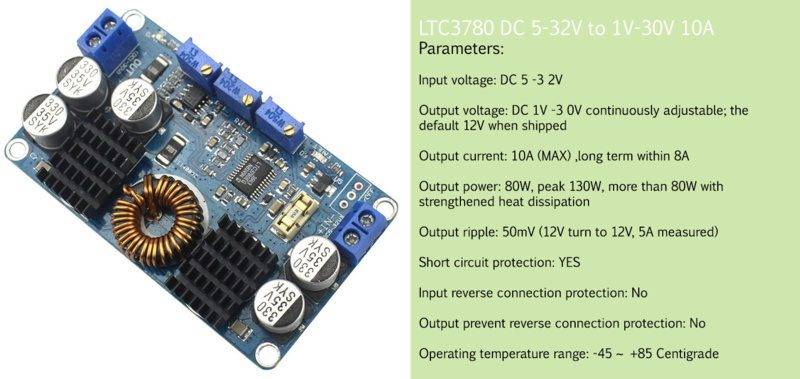
1.jpg


# Manufacturer max rating :-10 Amps, has 15 Amps onboard protection fuse

# Desired output current :- Up to 25 Amps for 5 seconds or less at a time

# For typical output voltage range : 2.5V to 5.75V

# Power input :- Parallel 2 X 3.6 V (nominal) + Parallel 2 X 3.6 V (nominal) in series (7.2V nominal) lithium-ion batteries with max continuous current discharge of 20 Amps per battery.

# Application :- Repurposing for DIY electronic cigarette (e-cig)

The product is listed here.
 

Attachments

  • 1.jpg
    1.jpg
    44.8 KB · Views: 1,786
Last edited:
Engineering news on Phys.org
Sid55 said:
Does having high continuous current discharge power source at the input help it in any way ?
No.

Sid55 said:
Power input :- Parallel 2 X 3.6 V (nominal) + Parallel 2 X 3.6 V (nominal) in series (7.2V nominal) lithium-ion batteries with max continuous current discharge of 20 Amps per battery.
You should pick a different (just buck) converter rated for 25A. In theory this converter has an external current sense, so you might be able to modify the limit with replacing the resistor, but 2.5 times higher current is not OK with the inductor, the FETs, the PCB and the connectors. Also, since the dissipation will be at least 2.5 times higher the heatsinks will be definitely very busy.
 
berkeman said:
Do you have a local person who can mentor you on thie project?
No, unfortunately I don't.

berkeman said:
And from your previous thread, it looks like you are not real experienced in using electronics and batteries.
I'm not. That's why I'm here.

berkeman said:
And what does "repurposing an e-cig lighter" mean?
No idea what you mean by "e-cig lighter." I never mentioned "e-cig lighter" in my inquiry, if you bother to re-read my previous post.

Seems like you're confusing electronic lighter with electronic cigarette. Electronic lighter is purpose-designed/built to light up traditional cigarettes, the ones with tobacco wrapped with paper, whereas electronic cigarette is purpose-designed/built to heat up cotton soaked with thick liquid to vaporize the liquid. The vaporized liquid may or may not contain nicotine depending on user's customization.

e-smoke.jpg
My more fundamental question, aside from technical questions in my previous post, is how do buck-boost converters inside electronic cigarettes handle such insane levels of current discharge despite being built with no so beefy components while being incredibly tiny in physical size compared to buck-boost converter mentioned in my previous post ?
 

Attachments

  • e-smoke.jpg
    e-smoke.jpg
    39.9 KB · Views: 1,333
Sid55 said:
No idea what you mean by "e-cig lighter." I never mentioned "e-cig lighter" in my inquiry, if you bother to re-read my previous post.

Seems like you're confusing electronic lighter with electronic cigarette.
Oops, sorry for my brain fade. I don't use either, so I glossed over the details of what you asked. o0)
Sid55 said:
My more fundamental question, aside from technical questions in my previous post, is how do buck-boost converters inside electronic cigarettes handle such insane levels of current discharge despite being built with no so beefy components while being incredibly tiny in physical size compared to buck-boost converter mentioned in my previous post ?
That's a reasonable question. Do you have a schematic of such 25A e-cig circuits? As long as you take care with the safe operating area (SOA) of the semiconductors and size the important things correctly, you can take advantage of the low duty cycle of the 25A requirement.
 
Rive said:
You should pick a different (just buck) converter rated for 25A.

I have now come to agree with you.

The one I could find is SZBK07 300W 20A (listed here) buck converter though it does not seem to output high current discharge at low output voltages as demonstrated here -
 
berkeman said:
Do you have a schematic of such 25A e-cig circuits?

Texas Instruments has 200W 1V to 10V at 20A to 45A output synchronous 4-switch buck-boost converter design based on the LM5175 controller for e-cigarette applications. Schematic PDF here and test results PDF here. Overview here.Texas Instruments 200 Watts 1V to 10V at 20A to 45A output chipset board PMP20327
200W E-Cigarette Buck Boost.png

Evolv DNA 200 Watts 0.5V - 9V (up to 50A) output chipset board. Evolv DNA 200W datasheet here.
dna200.jpg

Texas Instruments 200 Watts 1V to 10V at 20A to 45A schematic (screenshot from schematic PDF)

Ca.JPG
 

Attachments

  • 200W E-Cigarette Buck Boost.png
    200W E-Cigarette Buck Boost.png
    91.4 KB · Views: 1,397
  • dna200.jpg
    dna200.jpg
    25.4 KB · Views: 1,181
  • Ca.JPG
    Ca.JPG
    31.4 KB · Views: 1,652
Sid55 said:
whereas electronic cigarette is purpose-designed/built to heat up cotton soaked with thick liquid to vaporize the liquid.
So are there voltage and current standards in the industry for getting optimum vapors off of these modules? Are there datasheets available to the public, or are they mostly proprietary to the e-cig industry?
 
Sid55 said:
Texas Instruments has 200W 1V to 10V at 20A to 45A output synchronous 4-switch buck-boost converter design based on the LM5175 controller for e-cigarette applications. Schematic PDF here and test results PDF here. Overview PDF here.
Can you just use that?
 
  • #10
berkeman said:
So are there voltage and current standards in the industry for getting optimum vapors off of these modules? Are there datasheets available to the public, or are they mostly proprietary to the e-cig industry?
E-cig chipset makers are limited by what they can get out of 3.6V (nominal) lithium-ion and lithium polymer batteries.

18650 3.6V (nominal) lithium-ion high continuous discharge battery is the most commonly available and the widely used power source. Used in single or dual (series) or triple (series) and quad (parallel-series) connection.

20700 3.6V (nominal) lithium-ion high continuous discharge battery is far less available than 18650 3.6V and is far less used power source.

21700 3.6V (nominal) lithium-ion high continuous discharge battery is just as far less available and is far less used power source as 20700 lithium-ion battery.

26650 3.6V (nominal) lithium-ion battery is almost exclusively used as a single battery power source e-cigs.

Lithium polymer batteries are most commonly used for powering low power (about 70 Watts or less) e-cigs and is rarely used in high power e-cigs due to lithium polymer battery's inherent volatility at very high current discharge and due to other risk factors.

JPH_Maxim.jpg
 

Attachments

  • JPH_Maxim.jpg
    JPH_Maxim.jpg
    20.5 KB · Views: 1,081
  • #11
berkeman said:
Can you just use that?

I highly doubt the schematic would be drastically different from other e-cig chipset makers however components used more than likely would be.
 

Similar threads

  • · Replies 14 ·
Replies
14
Views
2K
  • · Replies 13 ·
Replies
13
Views
4K
  • · Replies 27 ·
Replies
27
Views
6K
  • · Replies 10 ·
Replies
10
Views
3K
  • · Replies 32 ·
2
Replies
32
Views
6K
  • · Replies 10 ·
Replies
10
Views
2K
  • · Replies 9 ·
Replies
9
Views
4K
Replies
4
Views
3K
Replies
19
Views
3K
  • · Replies 2 ·
Replies
2
Views
2K