Engineering Underdamped Parallel RLC Circuit

Click For Summary
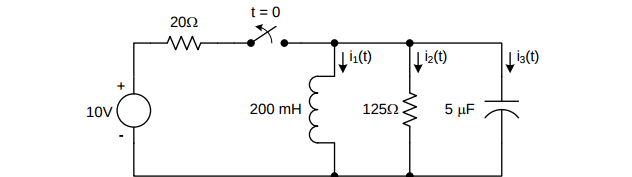
The discussion revolves around solving for the voltage across a capacitor in an underdamped parallel RLC circuit. The user has derived the voltage equation v(t) = [A_1 cos(600t) + A_2 sin(600t)]e^(-800t) but struggles to find the constants A_1 and A_2. Initial conditions, specifically v(0) = 0V and the inductor current of 0.5A, are suggested as a means to establish two equations necessary for solving these constants. There is also a mention that the initial equation form may not be correct since it does not align with expected values at t=0+. The conversation emphasizes the importance of correctly applying initial conditions and potentially using frequency domain analysis for simplification.
Jayalk97
Messages
45
Reaction score
5
Please post this type of questions in HW section using the template.
Hey guys, so I'm having trouble with this circuit analysis question. I need to find voltage across the capacitor as a function of time. I nearly finished analyzing but I'm having trouble solving for the initial value constants in the voltage equation. So first I used KCL to create the equation, then created a characteristic equation to find the type of response, which ended up being under-damped. I'm not trying to get any help with the acgtual numbers, but I end up with the equation v(t) = [A_1 cos(600t)+A_2 sin(600t)]e^(-800t). I'm fairly sure I'm correct so far, but how would I go about solving for A_1 and A_2? Thanks in advance!
upload_2017-10-30_16-56-8.png
 

Attachments

  • upload_2017-10-30_16-56-8.png
    upload_2017-10-30_16-56-8.png
    4.3 KB · Views: 2,069
Physics news on Phys.org
Jayalk97 said:
Hey guys, so I'm having trouble with this circuit analysis question. I need to find voltage across the capacitor as a function of time. I nearly finished analyzing but I'm having trouble solving for the initial value constants in the voltage equation. So first I used KCL to create the equation, then created a characteristic equation to find the type of response, which ended up being under-damped. I'm not trying to get any help with the acgtual numbers, but I end up with the equation v(t) = [A_1 cos(600t)+A_2 sin(600t)]e^(-800t). I'm fairly sure I'm correct so far, but how would I go about solving for A_1 and A_2? Thanks in advance!
View attachment 214062
You should be able to write 2 equations from the initial conditions that will help you solve for those 2 constants.

What is v(0)? What other initial equation can you write for t=0+ ?
 
berkeman said:
You should be able to write 2 equations from the initial conditions that will help you solve for those 2 constants.

What is v(0)? What other initial equation can you write for t=0+ ?

V(0) = 0V right? and Current across the inductor is 0.5A. I understand that I am supposed to use those to find the initial conditions, but how are those related to the equation I obtained?
 
Jayalk97 said:
Current across the inductor is 0.5A
current *through the inductor is 0.5A. I know it sounds like a trivial difference, but it is not. current goes through a component. Voltage goes across a component.
Jayalk97 said:
I understand that I am supposed to use those to find the initial conditions, but how are those related to the equation I obtained?
Well V(0)=0 is the initial condition. I already know the form of your equation in your first post is not correct, because at t=0+ it does not match expectations. Do you know how to evaluate circuits in the frequency domain, it would make the work easier. If not, why don't you post your KCL/kvl equations.
 
  • Like
Likes berkeman

Similar threads

  • · Replies 3 ·
Replies
3
Views
2K
  • · Replies 13 ·
Replies
13
Views
8K
  • · Replies 12 ·
Replies
12
Views
2K
  • · Replies 6 ·
Replies
6
Views
2K
  • · Replies 25 ·
Replies
25
Views
5K
  • · Replies 7 ·
Replies
7
Views
5K
  • · Replies 5 ·
Replies
5
Views
2K
  • · Replies 34 ·
2
Replies
34
Views
6K
  • · Replies 8 ·
Replies
8
Views
2K
  • · Replies 2 ·
Replies
2
Views
4K