Understand Special Relativity and Time paradox
- Level: Graduate
- Thread starter jaumzaum
- Start date
Join the discussion
Registration is free. Start your own thread to ask a follow-up.
406 replies · 57K views · last reply
Physics news on Phys.org
Science Advisor
Gold Member
- 5,122
- 150
You're very welcome and thanks for feedback.jaumzaum said:Thanks George! I mean, I really want to thank you, in all of the threads I've already posted here, I've never seen such a good and detailed answer as yours. I'm new in special relativity and you explained everything so carefully I could understood almost completely. I thought I had understood before, but I didn't know the explanation had nothing to do to what I suppose it was correct. There should be more guys like you here in PF. I want to thank everyone who answered this thread but the george's answer was phenomenal (at least for me). Now I think I'm startin g to understand special relativity.
The problem with the type of diagram that you are asking for is that it would not be inertial because your brother is not inertial. Inertial, in the context of Special Relativity means that he would be traveling at a constant speed in a constant direction, in other words, not accelerating. That means that it is impossible to use the Lorentz Transformation process to get from one of the IRF's we already considered to a not-inertial frame in which your brother was always at rest.jaumzaum said:And yes, I do have some questons, I would appreciate if you could help me again
How it would be the diagram if we take the referential frame as the whole trip of my brother (I mean, my brother is at rest in the whole time). I'm not being able to "close" the graphic. If my brother is a straight line, my lines can't be together as they are smaller than his. Is this right?
Besides, I'm curious, why do you want to have such a diagram? What do you think it will tell you that you don't already know from studying anyone of the IRF diagrams?
bobc2
- 842
- 7
DaleSpam said:I already addressed this in post 50, but that is exactly what you were doing in claiming that the red guy's time was going backwards. If you talk about a sequence of inertial frames then his clock goes forwards at all times and in all frames. If you talk about a sequence of "3D worlds" then you are talking about a 4D non-inertial frame, and mathematically that frame cannot cover the red guy's worldline.
You are still not getting it. I am not saying the red guy's clock goes backward for the red guy sitting at rest in his own frame of reference (see sketch at the bottom of my post #32). The red guy always sees his clock moving forward as he moves along his world line in his positive X4 (time) direction.
But if you were to make a list of the RED clock readings in the order they are presented in the blue guy's frame each time he (blue--referring to my earlier sketch at the bottom of post #32) boosts to his next inertial frame, then you would see those clock readings getting smaller and smaller as blue advances along his worldline (with blue's own clock readings moving forward in time). So, each time blue is coasting in a new inertial frame you note the clock reading on the red worldline at the intersection of the blue X1 axis with the red worldline (you can of course calculate this using the Lorentz transformation between red and blue coordinates, where red's frame is the same as black's except displaced along the black X2 axis). And of course you will perform a new Lorentz transformation for each new period of blue coasting in a new inertial frame.
So, we are not trying to manufacture some single coordinate transformation for a curvalinear non-inertial frame at all. We could talk about using something like Rindler coordinates, etc., but that's not at all what I've been trying to convey.
DaleSpam said:Reference please?
Here are a couple of Einstein quotes on solipsism from The Library of Living Philosophers Volume VII – Albert Einstein: Philosopher-Scientist, Paul Arthur Schillp,Editor
I've included comments with a sketch to clarify the way the problem of solipsism comes into special relativity and hyperplanes of simultaneity.
Page 673 …A few more remarks of a general nature concerning concepts and [also] concerning the insinuation that a concept - for example that of the real - is something metaphysical (and therefore to be rejected). A basic conceptual distinction, which is a necessary prerequisite of scientific and pre-scientific thinking, is the distinction between "sense-impressions" (and the recollection of such) on the one hand and mere ideas on the other...one needs this distinction in order to be able to overcome solipsism… we shall make use of this distinction unconcerned with the reproach that, in doing so, we are guilty of the metaphysical "original sin."
Page 673 (further down the page) …We represent the sense-impressions as conditioned by an "objective" and by a "subjective" factor. For this conceptual distinction there also is no logical-philosophical justification. But if we reject it, we cannot escape solipsism.
Also from Schillp, Page 81: "Physics is an attempt conceptually to grasp reality as it is thought independently of its being observed. In this sense one speaks of 'physical reality'."
"Belief in an external world independent of the perceiving subject is the basis of all natural science."
Einstein, "Maxwell's Influence on the Evolution of the Idea of Physical Reality," 1931, in Einstein, Albert, Ideas and Opinions, New York: Random House, 266.
“I am not a positivist. Positivism states that what cannot be observed does not exist. This conception is scientifically indefensible, for it is impossible to make valid affirmations of what people 'can' or 'cannot' observe. One would have to say 'only what we observe exists', which is obviously false.
Autobiographical Notes, 1949, in Schilpp 1949 p.81
The sketch depicts the problem with denying the real external world does not exist for observers if they cannot observe it. A common objection to the external world existing for an observer at a particular moment in time is that he cannot know anything about such a world “out there” until light signals arrive to inform the observer—by then the external world he is informed of is in the distant past (such as observation of stars, etc.).
So, the problem as depicted below is that under such objections the observer cannot know of anything but himself, for he is continually advancing forward along his worldline at the speed of light at the apex of his backward light cone. At that apex point he has no knowledge of the world of his hyperplane of simultaneity, and by the positivist’s claim he must consider himself to be a solipsist—the only known existing entity.
Last edited:
Mentor
- 51,013
- 27,054
bobc2 said:the observer cannot know of anything but himself, for he is continually advancing forward along his worldline at the speed of light at the apex of his backward light cone. At that apex point he has no knowledge of the world of his hyperplane of simultaneity, and by the positivist’s claim he must consider himself to be a solipsist—the only known existing entity.
Sorry to be blunt, but this is hogwash. The observer has information coming in from his past light cone, and that information tells him about the existence of other objects. The information is time-delayed, but so what? It's still perfectly good information about the existence of other objects.
Edit: On reflection, it's even worse than that. You (bobc2) are arguing for a "block universe" interpretation of SR. But on that interpretation, "objects" don't exist in 3-D worlds; they exist in 4-D spacetime. So knowledge of *any* event on an object's worldline counts as knowledge of the object's existence, since the object *is* its worldline. So not only are you incorrectly stating the opposing view, you aren't even consistently applying your own view.
Last edited:
Mentor
- 51,013
- 27,054
bobc2 said:Here are a couple of Einstein quotes on solipsism from The Library of Living Philosophers Volume VII – Albert Einstein: Philosopher-Scientist, Paul Arthur Schillp,Editor
These are all general comments. How about some quotes where Einstein talked specifically about relativity? As in, where he said the same sorts of things I said in my post #49?
Mentor
- 37,302
- 16,434
OK, those quotes all show that Einstein didn't like solipsism, which wasn't in doubt. Not one of them support your claim that Einstein said that rejecting the physical meaningfulness of coordinate time leads to solipsism.bobc2 said:Here are a couple of Einstein quotes on solipsism
Last edited:
bobc2
- 842
- 7
PeterDonis said:Sorry to be blunt, but this is hogwash. The observer has information coming in from his past light cone, and that information tells him about the existence of other objects. The information is time-delayed, but so what? It's still perfectly good information about the existence of other objects.
You have just made my case. What do you think I've been trying to get across all of this time? I've certainly not been claiming that there is no external world just because the observer is always moving at the apex of his light cone. That was my example of the absurdity you arrive at when denying the external world of the hyperplanes of simultaneity. You're the one who has been denying the reality of the real external objective world represented by the hyperplanes of simultaneity.
PeterDonis said:Edit: On reflection, it's even worse than that. You (bobc2) are arguing for a "block universe" interpretation of SR. But on that interpretation, "objects" don't exist in 3-D worlds
No. 1: I have said nothing of block universe. But, what an absurdity for you to come to the conclusion that objects don't exist in the 3-D world because they are 4-D objects. That's like saying a thin slice of a wooden 2 x 4 lumber doesn't exist because its length is 8 ft and the slice is only 0.001 inch thick. How does a 3-D piece of an object not exist just because it is a piece of a 4-D object. You have lost all logic here.
PeterDonis said:...they exist in 4-D spacetime. So knowledge of *any* event on an object's worldline counts as knowledge of the object's existence, since the object *is* its worldline. So not only are you incorrectly stating the opposing view, you aren't even consistently applying your own view.
Sorry to be blunt, but you have just presented a total distortion of what my posts have been conveying, and you logic is totally flawed. And, again, I've said nothing of block universe--I don't think the monitor wants any more of that.
Last edited:
Mentor
- 37,302
- 16,434
I understand that. You are talking about your take on the blue observer's "perspective". The problem is that the math simply doesn't support your claim.bobc2 said:You are still not getting it. I am not saying the red guy's clock goes backward for the red guy sitting at rest in his own frame of reference (see sketch at the bottom of my post #32). The red guy always sees his clock moving forward as he moves along his world line in his positive X4 (time) direction.
That is exactly what you are trying to do. You are going to great linguistic lengths to disguise that fact, but it is exactly what you are trying to do.bobc2 said:But if you were to make a list of the RED clock readings in the order they are presented in the blue guy's frame each time he (blue--referring to my earlier sketch at the bottom of post #32) boosts to his next inertial frame, then you would see those clock readings getting smaller and smaller as blue advances along his worldline (with blue's own clock readings moving forward in time). So, each time blue is coasting in a new inertial frame you note the clock reading on the red worldline at the intersection of the blue X1 axis with the red worldline (you can of course calculate this using the Lorentz transformation between red and blue coordinates, where red's frame is the same as black's except displaced along the black X2 axis). And of course you will perform a new Lorentz transformation for each new period of blue coasting in a new inertial frame.
So, we are not trying to manufacture some single coordinate transformation for a curvalinear non-inertial frame at all. We could talk about using something like Rindler coordinates, etc., but that's not at all what I've been trying to convey.
You are adopting a simultaneity convention, and giving it an ordering corresponding to readings on a clock, so that clearly establishes a time coordinate. That time coordinate is not the time coordinate of an inertial frame, so your frame is non inertial.
All of your verbose obfuscations do not hide that fact. If you do not adopt a simultaneity convention and give it an ordering then you cannot claim that red's clock runs backwards according to blue. As soon as you do that, then you have established a non inertial frame.
Last edited:
bobc2
- 842
- 7
DaleSpam said:OK, those quotes all show that Einstein didn't like solipsism, which wasn't in doubt. Not one of them support your claim that Einstein said that rejecting the physical meaningfulness of coordinate time leads to solipsism.
DaleSpam, your not connecting the dots. The collection of Einstein quotes makes it quite clear the point Einstein was making about solipsism, and it is quite obvious that the external reality he refers to is associated with the hyperplanes of simultaneity. Can you imagine any other component of the Einstein-Minkowski model that could play that role in the description of physical reality?
I knew this would spiral into a monitor lockdown.
Mentor
- 37,302
- 16,434
If the dots have to be connected to make your point then it is not something Einstein actually said, is it?bobc2 said:DaleSpam, your not connecting the dots.
It is one thing to claim that X leads to Y, but you are trying to give your claim a false veneer of authority. It is both fallacious and counter-factual. Einstein never said what you claim he said, and even if he did that doesn't make it correct.
Yes, the invariants could play that role.bobc2 said:it is quite obvious that the external reality he refers to is associated with the hyperplanes of simultaneity. Can you imagine any other component of the Einstein-Minkowski model that could play that role in the description of physical reality?
It is not obvious at all to me that he is referring to hyperplanes of simultaneity, and he certainly wasn't explicit about it. You are putting your own words in his mouth. I think that you need to re-read what he actually said and not insert your own biases.
Last edited:
zonde
Gold Member
- 2,978
- 227
Well, not only solipsism but positivism too. For example this one:DaleSpam said:OK, those quotes all show that Einstein didn't like solipsism, which wasn't in doubt. Not one of them support your claim that Einstein said that rejecting the physical meaningfulness of coordinate time leads to solipsism.
“I am not a positivist. Positivism states that what cannot be observed does not exist. This conception is scientifically indefensible, for it is impossible to make valid affirmations of what people 'can' or 'cannot' observe. One would have to say 'only what we observe exists', which is obviously false."
And what you say sounds like positivism: "what cannot be observed does not exist".
Mentor
- 51,013
- 27,054
bobc2 said:I've certainly not been claiming that there is no external world just because the observer is always moving at the apex of his light cone. That was my example of the absurdity you arrive at when denying the external world of the hyperplanes of simultaneity.
But in the block universe view, the "external world" is a single 4-D world. It is not a bunch of 3-D hyperplanes of simultaneity. The hyperplanes of simultaneity are completely unnecessary to the block universe view.
bobc2 said:You're the one who has been denying the reality of the real external objective world represented by the hyperplanes of simultaneity.
I have been denying that hyperplanes of simultaneity are "real physical things" because they are frame-dependent, and "real physical things" are represented in the theory by frame-independent quantities. So far you have said absolutely nothing that refutes that view. I have certainly not been denying the reality of the "real external objective world"; I just deny that that real external objective world is represented by hyperplanes of simultaneity. And since that is precisely the point at issue, you can't help yourself to it by implying that "the real external objective world" *is* in fact represented by hyperplanes of simultaneity. You have to first *prove* that, and you haven't.
bobc2 said:No. 1: I have said nothing of block universe.
Then what position, exactly, are you defending? I'm very confused.
bobc2 said:But, what an absurdity for you to come to the conclusion that objects don't exist in the 3-D world because they are 4-D objects.
I said no such thing. What I have been saying is that "3-D worlds" are frame-dependent, and the actual physics of SR is contained in the things that are frame-independent, so the actual physics of SR is *not* contained in 3-D worlds. That in no way denies the "reality" of objects; the only things whose "reality" it denies are the 3-D worlds, and only in the sense that they are frame-dependent, so you don't need them to describe the physics.
bobc2 said:That's like saying a thin slice of a wooden 2 x 4 lumber doesn't exist because its length is 8 ft and the slice is only 0.001 inch thick.
No, it's like saying that the 0.001 inch thick slice of the 8 ft. 2x4 is not the same thing as a complete slice out of the entire universe that contains the 0.001 inch thick slice of lumber.
bobc2 said:How does a 3-D piece of an object not exist just because it is a piece of a 4-D object. You have lost all logic here.
I didn't say a 3-D piece of an object doesn't exist. See above for further elaboration of what I did say. Please read more carefully.
bobc2 said:Sorry to be blunt, but you have just presented a total distortion of what my posts have been conveying
If you're not talking about the "block universe", then you're right, I have no idea what you think your posts have been conveying.
bobc2 said:and you logic is totally flawed.
No, my logic is just not what you have been claiming it is.
bobc2 said:And, again, I've said nothing of block universe--I don't think the monitor wants any more of that.
There's nothing wrong with talking about the block universe in itself. The only things that have gotten people in trouble are claims that the block universe is the only possible interpretation of SR.
- 9,573
- 2,692
bobc2:
Still waiting for a reference where Einstein used hyperplanes' of simultaneity, or said that the point of view of a non-inertial observer matches that, moment to moment, of instantaneously comoving inertial frames. You claimed your approach matches Einstein's. I checked 4 papers Einstein treated non-inertial motion in SR, and none remotely resemble your approach. Still waiting for a reference on what you explicitly claimed - that your method matches Einstein's.
Still waiting for a reference where Einstein used hyperplanes' of simultaneity, or said that the point of view of a non-inertial observer matches that, moment to moment, of instantaneously comoving inertial frames. You claimed your approach matches Einstein's. I checked 4 papers Einstein treated non-inertial motion in SR, and none remotely resemble your approach. Still waiting for a reference on what you explicitly claimed - that your method matches Einstein's.
Mentor
- 51,013
- 27,054
PeterDonis said:If you're not talking about the "block universe", then you're right, I have no idea what you think your posts have been conveying.
bobc2, on re-reading the thread, I'm still not sure what you think your posts have been conveying, but perhaps I can help re-focus things a bit with a couple of questions.
First, the reason I assumed you were trying to defend a block universe interpretation is that I couldn't see any other reason for bringing in the 3-D worlds. If that wasn't meant as an argument for a block universe interpretation, what was it meant for?
Second, I see that this sub-thread more or less started with you adding the "red" observer's worldline to the spacetime diagram, and then observing that the coordinate times assigned to events on red's worldline "run backwards" in the succession of "blue" frames through the turnaround. What do you think that means? Why did you think it was important to make that observation?
- 9,573
- 2,692
Please note further that the derivation of simultaneity convention for inertial observers relies on:
- being inertial long enough to apply a clock synchronization method (establishing simultaneity), for clocks a given distance apart. It is also preferred only in the sense that all reasonable methods agree.
- A non-inertial observer has a different past than co-moving inertial observer. This means that physical synchronization methods they might use will come out different from the comoving inertial frame. They also won't agree with each other.
I am not arguing solipsism. I think there is a meaningful sense in which inertial simultaneity convention (which is the one you are using) is preferred for inertial observers - for a volume of spacetime proportional to the time they have been effectively inertial. For a non-inertial observer it is not preferred or meaningful at all beyond a spacetime volume where, say, Einstein simultaneity and 'ruler' simultaneity differ to a detectible degree.
You want to give absolute meaning to a convention completely divorced from the way it was derived.
- being inertial long enough to apply a clock synchronization method (establishing simultaneity), for clocks a given distance apart. It is also preferred only in the sense that all reasonable methods agree.
- A non-inertial observer has a different past than co-moving inertial observer. This means that physical synchronization methods they might use will come out different from the comoving inertial frame. They also won't agree with each other.
I am not arguing solipsism. I think there is a meaningful sense in which inertial simultaneity convention (which is the one you are using) is preferred for inertial observers - for a volume of spacetime proportional to the time they have been effectively inertial. For a non-inertial observer it is not preferred or meaningful at all beyond a spacetime volume where, say, Einstein simultaneity and 'ruler' simultaneity differ to a detectible degree.
You want to give absolute meaning to a convention completely divorced from the way it was derived.
Last edited:
Science Advisor
Gold Member
- 5,122
- 150
The weekend is over. Can you please make the OP's requests a priority especially since you are concerned that the moderators are going to lock this thread?bobc2 said:ghwellsjr, sorry I missed your post for a while there. I'll see if I can get back into this and respond to your questions sometime this weekend. Thanks.ghwellsjr said:Bobc2, your Sketch III looks kind of like my first diagram in post #23 except that I have an instantaneous turn-around. The lines (or surfaces or volumes or whatever you want to call them) of simultaneity in my diagram are simply the horizontal grid lines (and the infinite number of horizontal lines in between them). In normal orthogonally drawn diagrams of IRF's, the issue of simultaneity is automatically handled by the grid lines and doesn't need any explanation. You don't show any equivalent grid lines either horizontally or vertically (or diagonally??) so it is very difficult for me to tell what is going on with your diagrams. I wonder if the OP is understanding them.
Secondly, I don't see any equivalent yearly messages traveling at c between the OP and his brother as he requested in post #13. Can you please put them in? And can you address his concern that a bunch of messages from him will arrive in a flood during his brother's about-face?
Mentor
- 37,302
- 16,434
Where did I say that? I don't know where you guys are getting this. Bobc2 with his strange obsession with solipsism and now you with positivism.zonde said:And what you say sounds like positivism: "what cannot be observed does not exist".
I am neither a solipsist nor a positivist. However, this is not a forum for philosophy of any kind, including philosophies that I agree with. This forum is for science, and I make a strong effort to keep it that way. I make a sincere effort not to promote my own philosophy and I try to discourage others from presenting theirs even when it happens to agree with mine.
I feel like there has been a weird revival of McCarthyism where people are randomly accused of being a solipsist or a positivist with no evidence to support the accusation.
Last edited:
Mentor
- 51,013
- 27,054
DaleSpam said:It is not obvious at all to me that he is referring to hyperplanes of simultaneity
It's fairly obvious to me, taking all of Einstein's writings on relativity into account, that he *wasn't*--that he was trying to focus attention on frame-independent things, not frame-dependent things. The particular quotes bobc2 gave, as I said before, are very general and don't even mention relativity specifically; when you look at what he actually wrote about relativity, it's clear that the "physical reality" he was talking about was represented in the theory by invariants, not by frame-dependent things like hyperplanes of simultaneity. His main emphasis on simultaneity is precisely to show that it is *relative*, i.e., to show that it is *not* the right thing to focus on.
zonde
Gold Member
- 2,978
- 227
Philosophy is foundation of science. We can coherently talk about science as long as we agree about some philosophical foundations.DaleSpam said:However, this is not a forum for philosophy of any kind, including philosophies that I agree with. This forum is for science, and I make a strong effort to keep it that way. I make a sincere effort not to promote my own philosophy and I try to discourage others from presenting theirs even when it happens to agree with mine.
But if you are trying to put physics on different foundations then there is no way how we can avoid talking about philosophy.
And this idea about doing physics using invariants is attempt to put physics on different foundations.
- 9,573
- 2,692
zonde said:Philosophy is foundation of science. We can coherently talk about science as long as we agree about some philosophical foundations.
But if you are trying to put physics on different foundations then there is no way how we can avoid talking about philosophy.
And this idea about doing physics using invariants is attempt to put physics on different foundations.
Yes, invariants are the foundation of special and general relativity. Einstein several times said he wished the word relativity was never used - the theory should be called the theory of invariants. That is fundamentally the way it has been pursued since.
If you don't like this foundation, I guess you are left with physics of the 19th century.
Mentz114
- 5,429
- 292
Hear, hear. It is tiresome that so many 'objectors' base everything on the study of these old documents.PAllen said:Yes, invariants are the foundation of special and general relativity. Einstein several times said he wished the word relativity was never used - the theory should be called the theory of invariants. That is fundamentally the way it has been pursued since.
If you don't like this foundation, I guess you are left with physics of the 19th century.
Mentor
- 51,013
- 27,054
PAllen said:Yes, invariants are the foundation of special and general relativity. Einstein several times said he wished the word relativity was never used - the theory should be called the theory of invariants. That is fundamentally the way it has been pursued since.
Exactly.
Mentor
- 37,302
- 16,434
I disagree completely. Experiment (scientific method) is the foundation of science and what distinguishes it from philosophy.zonde said:Philosophy is foundation of science.
I cannot think of any philosophical proposition that has any scientific value except for those which are essentially restatements of Bayesian inference.
No, it isn't. The foundation of science is the scientific method. The scientific method requires that a theory make experimental predictions, but doesn't otherwise constrain the method of making those predictions. In relativity the experimental predictions of the theory are all invariants. No modification of the scientific method is necessary to do relativity using invariants.zonde said:And this idea about doing physics using invariants is attempt to put physics on different foundations.
Last edited:
bobc2
- 842
- 7
PeterDonis said:Exactly.
You have totally ignored the importance of Einstein's postulate about the laws of physics and different observer Lorentz frames.
bobc2
- 842
- 7
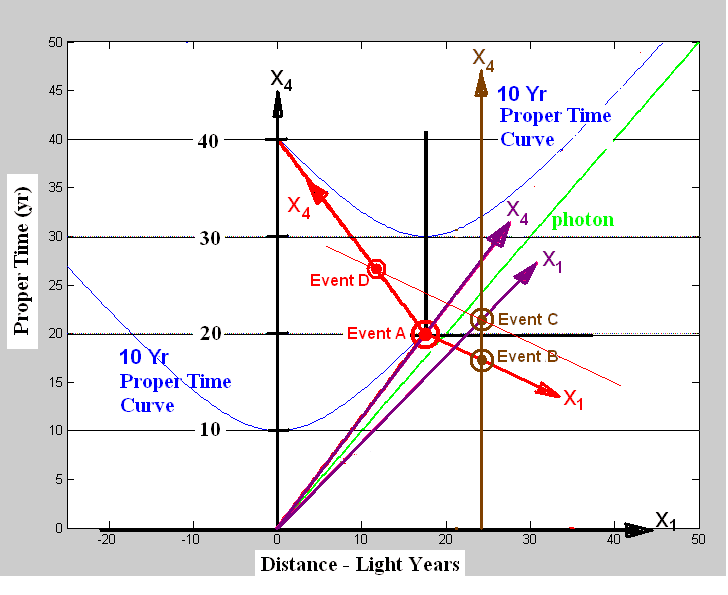
There seems to be confusion over the sequence of inertial frames associated with the traveling twin turnaround. I was simply pointing out what I thought was an interesting result for red clock readings as presented in the traveling twin’s sequence of inertial frames. So, here we will not be concerned about the period on the traveling twin's worldline during the turnaround. To avoid any further anguish over discretizing the turnaround, let’s just simplify the analysis by changing the focus away from the turnaround.
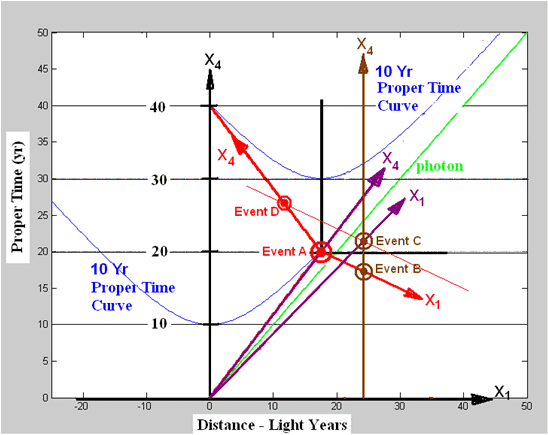
In the sketch below we show the same interesting feature by simply comparing readings on what I now show as the brown clock (red in the earlier sketch) as they are presented in the traveling twins two inertial frames, i.e., the purple frame (before turnaround) and the red frame (after turnaround). Notice that Event C presents a brown clock reading in the purple frame at the start of the outgoing trip of the traveling twin (the purple X1 axis represents the outgoing twin's simultaneous space at the start of his trip).
We show the beginning of the twin return trip as Event A (the traveling twin has just completed the turnaround and has started back home, i.e., the Red frame in the sketch). In this twin’s inertial frame the brown clock is presented on the worldline of the Brown frame as Event B.
When the traveling twin reaches Event D, the Event C is simultaneous with that same event (C simultaneous with D) in the twin’s inertial frame.
So, I am simply making the observation that as the traveling twin moves along his worldline, Event C is encountered at the start of the twin’s outgoing inertial frame before the Event B is encountered in the twin’s return inertial frame, even though as the Brown observer moves along his own X4 (time) axis, he (Brown) naturally experiences Event B before Event C. And Events D and C are simultaneous in the twin’s inertial frame. That’s all. No implications are drawn here—just an interesting observation for one to interpret however one pleases. Some may find nothing of interest here.
So far as the ability to connect the dots beginning with Einstein’s quotes about solipsism, I realized that many forum members may not be familiar with Bertrand Russell’s development of the concepts of sense impressions and ideas and their distinction. Einstein’s comments should be taken in that context. Russell devoted a lengthy discussion to this subject in his book. He develops this platform to launch the argument in support of an external objective reality. The argument between realists (such as Einstein) and idealists (a significant number of philosophers) has to begin on the turf of the inner experience, so that’s where Einstein has taken it up in the quotes presented earlier where he referenced the “objective” physical reality and asserted the logical conclusion that one who rejects this has “no escape from solipsism.” But it is just the logical beginning point for the analysis leading to refuting the positivist’s denial of the external reality out from the apex of an observer’s light cone. I don’t understand why connecting the dots should be that difficult. Einstein claimed emphatically that he was not a positivist.
Now, about invariants. You folks are corrupting the use of the concept to imply what was never intended. You completely ignore the significance of one of Einstein’s postulates: The laws of physics are the same for all frames (we understand this to mean Lorentz frames). The Lorentz inertial hyperplanes of simultaneity are exactly those for which Einstein’s postulate holds. This is fundamental in understanding the sequence of 3-D volumes (hyperplanes of simultaneity) as presenting the physical reality implied by special relativity.
In the sketch below we show the same interesting feature by simply comparing readings on what I now show as the brown clock (red in the earlier sketch) as they are presented in the traveling twins two inertial frames, i.e., the purple frame (before turnaround) and the red frame (after turnaround). Notice that Event C presents a brown clock reading in the purple frame at the start of the outgoing trip of the traveling twin (the purple X1 axis represents the outgoing twin's simultaneous space at the start of his trip).
We show the beginning of the twin return trip as Event A (the traveling twin has just completed the turnaround and has started back home, i.e., the Red frame in the sketch). In this twin’s inertial frame the brown clock is presented on the worldline of the Brown frame as Event B.
When the traveling twin reaches Event D, the Event C is simultaneous with that same event (C simultaneous with D) in the twin’s inertial frame.
So, I am simply making the observation that as the traveling twin moves along his worldline, Event C is encountered at the start of the twin’s outgoing inertial frame before the Event B is encountered in the twin’s return inertial frame, even though as the Brown observer moves along his own X4 (time) axis, he (Brown) naturally experiences Event B before Event C. And Events D and C are simultaneous in the twin’s inertial frame. That’s all. No implications are drawn here—just an interesting observation for one to interpret however one pleases. Some may find nothing of interest here.
So far as the ability to connect the dots beginning with Einstein’s quotes about solipsism, I realized that many forum members may not be familiar with Bertrand Russell’s development of the concepts of sense impressions and ideas and their distinction. Einstein’s comments should be taken in that context. Russell devoted a lengthy discussion to this subject in his book. He develops this platform to launch the argument in support of an external objective reality. The argument between realists (such as Einstein) and idealists (a significant number of philosophers) has to begin on the turf of the inner experience, so that’s where Einstein has taken it up in the quotes presented earlier where he referenced the “objective” physical reality and asserted the logical conclusion that one who rejects this has “no escape from solipsism.” But it is just the logical beginning point for the analysis leading to refuting the positivist’s denial of the external reality out from the apex of an observer’s light cone. I don’t understand why connecting the dots should be that difficult. Einstein claimed emphatically that he was not a positivist.
Now, about invariants. You folks are corrupting the use of the concept to imply what was never intended. You completely ignore the significance of one of Einstein’s postulates: The laws of physics are the same for all frames (we understand this to mean Lorentz frames). The Lorentz inertial hyperplanes of simultaneity are exactly those for which Einstein’s postulate holds. This is fundamental in understanding the sequence of 3-D volumes (hyperplanes of simultaneity) as presenting the physical reality implied by special relativity.
Last edited:
Mentor
- 51,013
- 27,054
bobc2 said:You have totally ignored the importance of Einstein's postulate about the laws of physics and different observer Lorentz frames.
Could you elaborate? I don't understand what point you're trying to make. The only "postulate" I can think of that you could be referring to is the one that says the laws of physics must be invariant under Lorentz transformations; that means the laws have to be written in terms of invariant expressions. That would seem to support what I've been saying.
Mentz114
- 5,429
- 292
bobc2 said:Now, about invariants. You folks are corrupting the use of the concept to imply what was never intended. You completely ignore the significance of one of Einstein’s postulates: The laws of physics are the same for all frames. The Lorentz inertial hyperplanes of simultaneity are exactly those for which Einstein’s postulate holds. This is fundamental in understanding the sequence of 3-D volumes (hyperplanes of simultaneity) as presenting the physical reality implied by special relativity.
How would you express "The laws of physics are the same for all frames" without using frame independent concepts ? Nor do I believe "inertial hyperplanes of simultaneity are exactly those for which Einstein’s postulate holds". I think you may be confused.
Mentor
- 51,013
- 27,054
bobc2 said:No implications are drawn here—just an interesting observation for one to interpret however one pleases. Some may find nothing of interest here.
In other words, this observation is irrelevant to the rest of the discussion? Fair enough; then I won't bother commenting further on it.
bobc2 said:So far as the ability to connect the dots beginning with Einstein’s quotes about solipsism, I realized that many forum members may not be familiar with Bertrand Russell’s development of the concepts of sense impressions and ideas and their distinction. Einstein’s comments should be taken in that context.
I am familiar with Russell's writings on these concepts; the best exposition I know of is in Russell's book Our Knowledge of the External World. I have no problem with the general claims Russell makes in that book, and I would agree that the views Einstein expressed in general terms were similar. The basic idea is that, even if we start by only granting "existence" to our direct sense-impressions, we can't make sense of those sense-impressions without committing ourselves to the existence of an "external world".
However, the disagreement we're having is not about whether an external world exists; it's about *what*, specifically, we are entitled to claim "exists" based on a certain set of sense impressions--i.e., what, exactly, is the "external world" that we need to believe in in order to make sense of a given set of sense impressions. See further comments below.
bobc2 said:But it is just the logical beginning point for the analysis leading to refuting the positivist’s denial of the external reality out from the apex of an observer’s light cone.
Nobody here is making a "positivist denial" of external reality. But you have assumed, without proof, that the sense impressions we receive from our past light cone *force* us to believe in an "external reality" consisting of an instantaneous 3-D world. That's simply not a valid claim. To see why, contrast it with the following alternative claim:
Based on the sense impressions we receive, we can only make sense of them by believing in the existence of external objects that send us light signals containing information about them. But the information we receive this way is time-delayed; for example, the Sun that I see is the Sun as it was eight minutes ago, *not* the Sun as it is "now". So the "external world" that I am *forced* to believe in based on my sense impressions does not include the Sun "now"; it only includes the Sun up to eight minutes ago.
I can, of course, make the further claim that, since it is highly unlikely that anything significant will have happened to the Sun in the eight minutes it took for the light I am seeing now from the Sun to get to me, it is highly probable that there is in fact a Sun now--i.e., that the Sun's worldline extends beyond the portion I have direct evidence of in my past light cone. But that is a *different* kind of claim from the claim that I have to believe in an external world based on my sense impressions. The claim that the Sun exists now is an *extrapolation* from the direct data in a way that the claim that the Sun existed eight minutes ago is not.
bobc2 said:You completely ignore the significance of one of Einstein’s postulates: The laws of physics are the same for all frames. The Lorentz inertial hyperplanes of simultaneity are exactly those for which Einstein’s postulate holds.
Einstein's postulate says nothing about hyperplanes of simultaneity. Go look at the relativistic formulations of any law of physics--Maxwell's Equations, the Einstein Field Equations, quantum field theory--and tell me where in those laws the hyperplanes of simultaneity are.
Mentor
- 37,302
- 16,434
It isn't about connecting dots. You claimed that Einstein said something that he simply did not say. You may believe that he meant to say what you claimed, or that what you claimed is implied by things that he said, but the unavoidable FACT is that he simply didn't say what you claimed he said.bobc2 said:So far as the ability to connect the dots beginning with Einstein’s quotes about solipsism, ... I don’t understand why connecting the dots should be that difficult.
Why don't you take ownership of your own opinions rather than trying to foist them off to Einstein? Say what you think, defend your ideas on their own merits, and simply leave Einstein out of it. Even where he shares your opinion, that is just a fallacious appeal to authority.
The invariants are also the same for all frames, so I don't know what makes you think that we are ignoring the significance of the first postulate by focusing on them instead of frame-variant quantities.bobc2 said:Now, about invariants. You folks are corrupting the use of the concept to imply what was never intended. You completely ignore the significance of one of Einstein’s postulates: The laws of physics are the same for all frames (we understand this to mean Lorentz frames).
bobc2
- 842
- 7
I'm really getting confused about what your fundamental objections are aside from the side bars on interpretations and philosophy.
Are you claiming that Event C is not in the traveling twin's simultaneous space at the start of his journey?
Are you claiming that Events A and B are not in the simultaneous space of the twin just after he has completed his turnaround?
Are you claiming that Events D and C are not in the simultaneous space of the twin when the twin has arrived on his worldline at Event D?
Are you claiming that Event C is not in the traveling twin's simultaneous space at the start of his journey?
Are you claiming that Events A and B are not in the simultaneous space of the twin just after he has completed his turnaround?
Are you claiming that Events D and C are not in the simultaneous space of the twin when the twin has arrived on his worldline at Event D?
Last edited:
Similar threads
- agnimusayoti
- · Replies 18 ·
- STEM Academic Advising
- Replies
- 18
High School
Solving the twin paradox with special relativity
- alan123hk
- · Replies 37 ·
- Special and General Relativity
- Replies
- 37
- simpleton
- · Replies 3 ·
- Special and General Relativity
- Replies
- 3
- ZawL
- · Replies 2 ·
- Special and General Relativity
- Replies
- 2
- fog37
- · Replies 3 ·
- Special and General Relativity
- Replies
- 3
Undergrad
Special relativity and time dilation
- DanPease
- · Replies 25 ·
- Special and General Relativity
- Replies
- 25
- paradoxical67
- · Replies 17 ·
- Special and General Relativity
- Replies
- 17
- NoahsArk
- · Replies 71 ·
- Special and General Relativity
- Replies
- 71
- Dimani4
- · Replies 7 ·
- Special and General Relativity
- Replies
- 7
Graduate
Relativity and time (twin paradox)
- Jonnyb42
- · Replies 10 ·
- Special and General Relativity
- Replies
- 10