Understanding 3D Solid Deformation: A Cube with No X-Direction Force

Click For Summary

Discussion Overview

The discussion revolves around understanding the deformation of a cube under specific loading conditions, particularly focusing on the absence of force in the x-direction. Participants explore the implications of this constraint on strain and stress calculations, utilizing generalized Hooke's law. The context is primarily homework-related, involving theoretical and mathematical reasoning.

Discussion Character

  • Homework-related
  • Mathematical reasoning
  • Debate/contested

Main Points Raised

  • One participant expresses confusion about calculating strain and stress in the x-direction due to the absence of force, suggesting that they might use generalized Hooke's law once the force is determined.
  • Another participant questions the assumption of strain in the x-direction, pointing out that if the block is constrained, the strain should be zero.
  • A participant reflects on the relationship between tensile and compressive forces in the y and z directions, proposing that this leads to negative strain in the y-direction and positive strain in the z-direction.
  • There is a correction regarding a sign error in the calculation of stress in the y-direction, indicating that it should be negative.

Areas of Agreement / Disagreement

Participants exhibit disagreement regarding the interpretation of strain in the x-direction, with some asserting it should be zero due to constraints, while others initially suggest non-zero values. The discussion remains unresolved on the correct application of generalized Hooke's law and the implications of the sign in stress calculations.

Contextual Notes

Participants express uncertainty about the definitions of strain and stress in constrained conditions, and there are unresolved mathematical steps regarding the application of generalized Hooke's law. The discussion also highlights potential misinterpretations of the problem statement.

DrVirz
Messages
24
Reaction score
0
Hi all,
Having some trouble getting the final answer on the question below, the fact that the cube doesn't have a force in the x direction is throwing me off. Once I fine the force(??) in the x-direction, I can just use the generalized Hooke's law to obtain strain? Any help is appreciated.
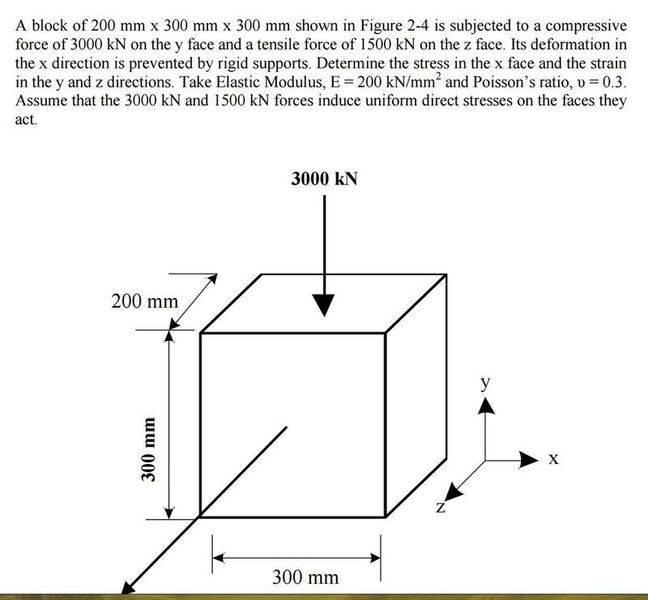
Homework Statement


Capture_zpsav4w8qd6.jpg


2. Equations in upload of solution.

See my solution for relevant equations.
http://[ATTACH=full]199721[/ATTACH]
 

Attachments

  • bf1547f2-5bb8-42b3-871b-965c1fe23c4c_zps5mvmhhq7.jpg
    bf1547f2-5bb8-42b3-871b-965c1fe23c4c_zps5mvmhhq7.jpg
    10.2 KB · Views: 196
Last edited by a moderator:
Physics news on Phys.org
In the block is constrained in the x-direction, what is the strain in the x-direction? What does your first equation give you in this case?

Chet
 
Chestermiller said:
In the block is constrained in the x-direction, what is the strain in the x-direction? What does your first equation give you in this case?

Chet

So I am assuming Sigma(x) = 0, therefore, Strain(x) = -1.00005 x10^-4

However the question says to find the stress in the x-direction, which I have taken as 0?

Or, do I sub Epsilon(x) as 0 and therefore would be able to find Sigma(x) from the first equation? After second thought I think this is correct due to 0 deformation in the x direction hence strain is 0?
 
DrVirz said:
So I am assuming Sigma(x) = 0, therefore, Strain(x) = -1.00005 x10^-4

However the question says to find the stress in the x-direction, which I have taken as 0?
How can you say that the strain in the x direction is not zero, when the problem statement says that strain in the x direction is zero? What does the word "constrained" mean to you?

Chet
 
I realized this soon after I posted my previous response and edited it soon afterwards, it make sense now.

Due to the tensile force in the y direction and the compressive force in the z direction the block obviously expands in the z direction and contracts in the y direction? Therefore, shouldn't Epsilon(y) be negative and Epsilon(z) be positive. Is this done by changing the sign (+ or -) for the Sigma values in the generalised Hooke's law? I.E. Sigma(y) should in fact be -50MPa?

You can see the two different answers on either side of my page.
717d3a72-5a50-4632-aa33-2d243fc07cc9_zpscik2qcsj.jpg
 
You have a sign error in the calculation of the stress in the y direction. It should be negative.

Chet
 

Similar threads

Replies
1
Views
1K
  • · Replies 2 ·
Replies
2
Views
5K
  • · Replies 15 ·
Replies
15
Views
4K
  • · Replies 2 ·
Replies
2
Views
2K
Replies
1
Views
3K
  • · Replies 2 ·
Replies
2
Views
7K
  • · Replies 1 ·
Replies
1
Views
2K
  • · Replies 2 ·
Replies
2
Views
5K
Replies
11
Views
6K
  • · Replies 3 ·
Replies
3
Views
2K