Understanding Cell Arrangement in Laptop Battery Rebuilding

  • Thread starter Thread starter cadaver
  • Start date Start date
  • Tags Tags
    Battery Laptop
Click For Summary

Discussion Overview

The discussion revolves around the arrangement of lithium-ion cells in a laptop battery pack, specifically focusing on the voltage outputs and the configuration of the cells. Participants seek to clarify the electrical connections and measurements related to the battery's performance and structure.

Discussion Character

  • Exploratory
  • Technical explanation
  • Debate/contested

Main Points Raised

  • One participant describes their intention to rebuild a laptop battery using six 3.7V 1800 mAH Li-Ion cells and questions the voltage readings at various points (VP, VG, VH, VM).
  • Another participant suggests redrawing the circuit for clarity, implying that a visual representation might help in understanding the arrangement.
  • A different participant challenges the voltage output of 14.8V, proposing that it may indicate a configuration of four cells or pairs in parallel, followed by series wiring, and questions whether the correct output should be 11.1V instead.
  • This participant also explains that VM and VH are likely used for balancing the cells and provides a potential voltage reading scenario based on an 11.1V battery configuration.
  • Concerns are raised about the voltage levels of individual cells, indicating that readings below 2.8-3.0V could suggest undercharging, while readings above 4.2-4.3V could indicate overcharging.

Areas of Agreement / Disagreement

Participants express differing views on the voltage output of the battery pack, with some supporting the 14.8V claim while others argue for an 11.1V configuration. The discussion remains unresolved regarding the exact arrangement and implications of the voltage readings.

Contextual Notes

There are uncertainties regarding the specific wiring configuration of the cells and the implications of the voltage readings at different points in the circuit. The discussion does not clarify the assumptions behind the proposed configurations.

cadaver
Messages
2
Reaction score
0
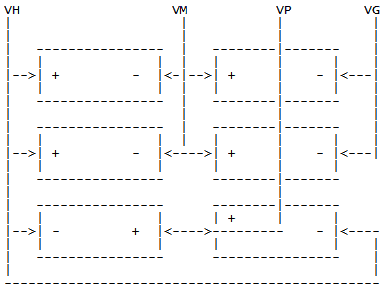
So I am in the process of rebuilding my laptop battery for higher capacity cells. I would appreciate it if someone can help me understand the arrangement of the cells. From my research, each cell is 3.7V 1800 mAH Li-Ion cells. There are 6 of them in the battery pack. In this arrangement:

Untitled.png


I will guess and say that the VP is receiving 7.4v and VG is the ground. But why is VH and VM receiving both positive and ground of 14.8v? And what do they stand for?
 
Last edited:
Engineering news on Phys.org
cadaver said:
So I am in the process of rebuilding my laptop battery for higher capacity cells. I would appreciate it if someone can help me understand the arrangement of the cells. From my research, each cell is 3.7V 1800 mAH Li-Ion cells. There are 6 of them in the battery pack. In this arrangement:


View attachment 36565

I will guess and say that the VP is receiving 7.4v and VG is the ground. But why is VH and VM receiving both positive and ground of 14.8v? And what do they stand for?

I think you should redraw the circuit on paper so its easier to understand, you should see what's going on better.
 
It is exactly how I drew it on the image above. From what I see in the battery case, there are wires going from the battery terminals to VH, VM, VP, VG which are solder points on the circuit board. I'm just trying to figure out how can one input receive both + and - ?
 
pardon me for posting to an old thread, but i came across this in a search...

i'm a little confused by your diagram. i don't understand how it would be putting out 14.8v. if your battery is putting out 14.8v i would think you have 4 cells, or pairs wired in parallel then, wired in series (4 * 3.7 = 14.8) do you mean 11.1v?

VM & VH would be used for balancing afaik. if it's an 11.1v battery, VM would be between the first and second cell(s) in series, and would read 3.7v. VH would be between the second and third, and would read 7.4v. then measuring the VP (B+) you would see 11.1v.

those numbers would be appox. if an individual cell is below 2.8-3.0v it's possibly undercharged. above 4.2-4.3v it's possibly overcharged. so you may be getting a slightly different voltage reading.
 

Similar threads

Replies
15
Views
4K
Replies
7
Views
3K
  • · Replies 2 ·
Replies
2
Views
2K
Replies
10
Views
5K
  • · Replies 6 ·
Replies
6
Views
18K
Replies
5
Views
2K
  • · Replies 1 ·
Replies
1
Views
2K
  • · Replies 2 ·
Replies
2
Views
2K
Replies
0
Views
2K
  • · Replies 11 ·
Replies
11
Views
2K