Understanding Harmonic oscillator conventions

Join the discussion
Ask a follow-up here, or get your own question answered by working scientists, mathematicians and engineers — people, not an autocomplete.
Real named experts · corrections over time · the nuance an AI answer skips
6 replies · 2K views
Djawu
Messages
3
Reaction score
0
TL;DR
see the equations down below
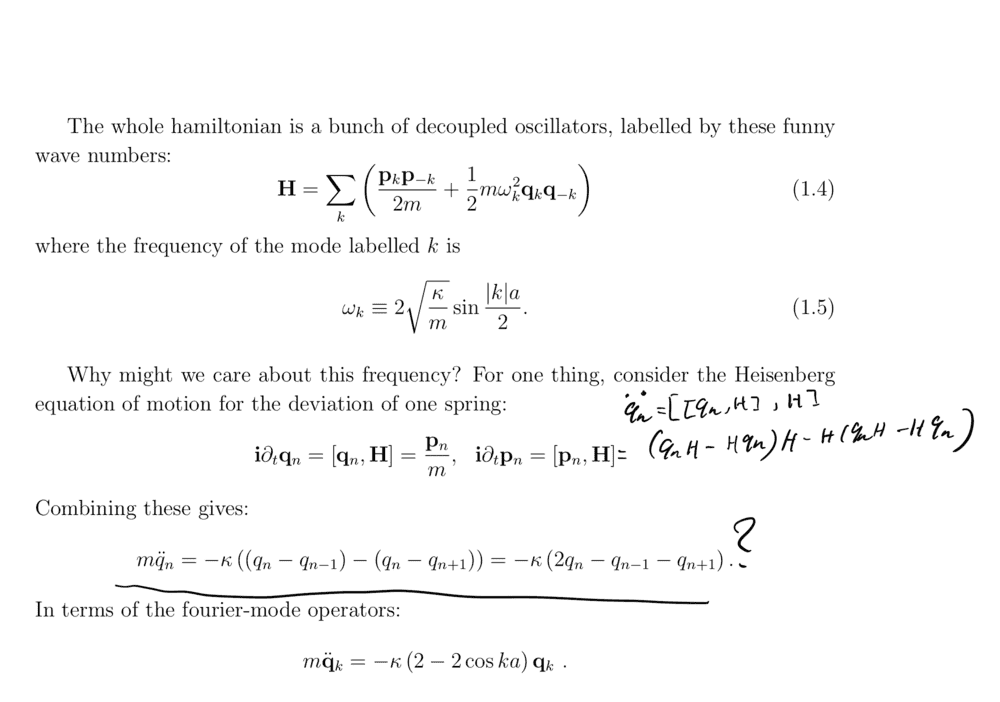
I don't quite understand how he got the line below. By using discrete time approximation, we can get the second order time expression. But i don't see how by combining terms he is able to get such expression.
2221CD22-724B-414B-AA43-820599DB3FEB.png
 
Physics news on Phys.org
PeterDonis said:
Who is "he" and where did this come from?
This is a private document shared only within the department. I have the permission to quote parts of it without releasing the rest.
 
Simply substitue the second Hamilton’s equation into the first.
 
Hint: ##q_n## can be written as a Fourier series with coefficients ##q_k##, and vice versa.
For details see e.g. Kittel, Introduction to Solid State Physics, Appendix C: Quantization of Elastic Waves: Phonons
 
Last edited:
  • Like
Likes   Reactions: vanhees71
Djawu said:
This is a private document shared only within the department. I have the permission to quote parts of it without releasing the rest.
But I recognize these notes, they are available for free on the author's public website...? But perhaps you have your own reasons for not disclosing, in any case Demystifier's hint will get you in the right direction.
 
king vitamin said:
But I recognize these notes, they are available for free on the author's public website...? But perhaps you have your own reasons for not disclosing, in any case Demystifier's hint will get you in the right direction.
sharp eyes ;)