Understanding Harmonic oscillator conventions

Click For Summary

Discussion Overview

The discussion revolves around understanding the conventions and derivations related to harmonic oscillators, particularly focusing on a specific line or expression derived from a private document. Participants are trying to clarify the source and validity of the expression, as well as the methods used to arrive at it.

Discussion Character

  • Exploratory
  • Technical explanation
  • Debate/contested

Main Points Raised

  • Some participants express confusion about the derivation of a specific expression, questioning how it was obtained through discrete time approximation.
  • There is uncertainty regarding the identity of "he" and the origin of the expression being discussed.
  • One participant suggests substituting the second Hamilton’s equation into the first as a potential method for clarification.
  • Another participant hints that the variable ##q_n## can be expressed as a Fourier series, referencing a specific source for further details.
  • Some participants note that the document in question is private but acknowledge that similar notes are publicly available, raising questions about the necessity of confidentiality.

Areas of Agreement / Disagreement

Participants do not reach a consensus on the source of the expression or the appropriateness of referencing the private document. Multiple competing views regarding the derivation and the identity of the author remain present.

Contextual Notes

There are limitations regarding the clarity of the source material and the assumptions underlying the derivations discussed. The discussion also reflects varying levels of access to the referenced documents.

Djawu
Messages
3
Reaction score
0
TL;DR
see the equations down below
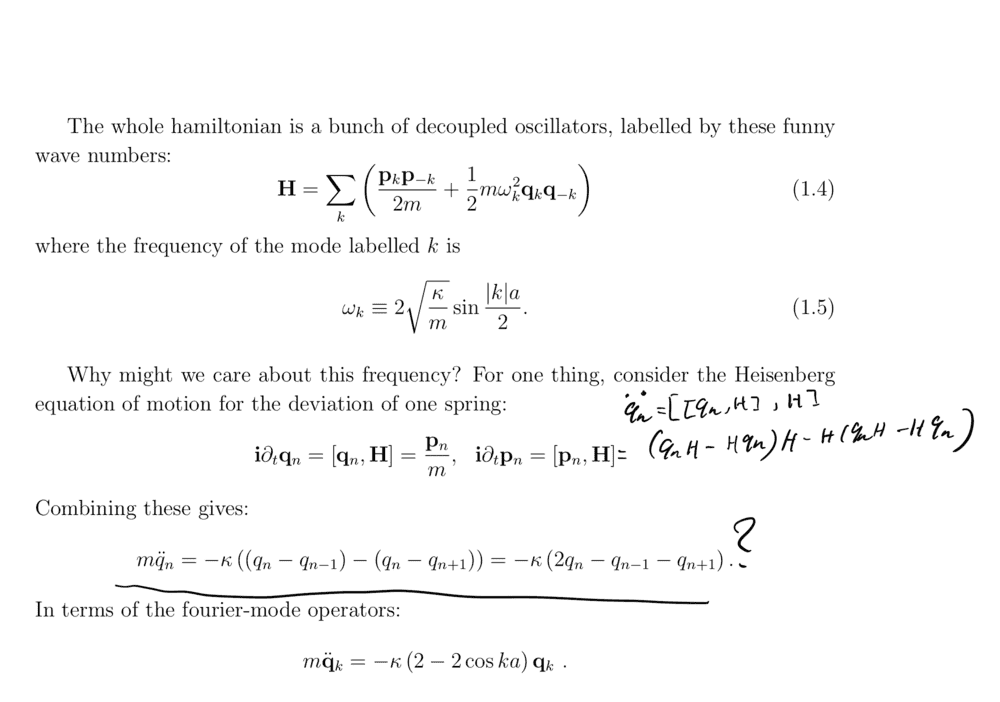
I don't quite understand how he got the line below. By using discrete time approximation, we can get the second order time expression. But i don't see how by combining terms he is able to get such expression.
2221CD22-724B-414B-AA43-820599DB3FEB.png
 
Physics news on Phys.org
Djawu said:
I don't quite understand how he got the line below.

Who is "he" and where did this come from?
 
  • Like
Likes   Reactions: vanhees71
PeterDonis said:
Who is "he" and where did this come from?
This is a private document shared only within the department. I have the permission to quote parts of it without releasing the rest.
 
Simply substitue the second Hamilton’s equation into the first.
 
Hint: ##q_n## can be written as a Fourier series with coefficients ##q_k##, and vice versa.
For details see e.g. Kittel, Introduction to Solid State Physics, Appendix C: Quantization of Elastic Waves: Phonons
 
Last edited:
  • Like
Likes   Reactions: vanhees71
Djawu said:
This is a private document shared only within the department. I have the permission to quote parts of it without releasing the rest.
But I recognize these notes, they are available for free on the author's public website...? But perhaps you have your own reasons for not disclosing, in any case Demystifier's hint will get you in the right direction.
 
king vitamin said:
But I recognize these notes, they are available for free on the author's public website...? But perhaps you have your own reasons for not disclosing, in any case Demystifier's hint will get you in the right direction.
sharp eyes ;)
 

Similar threads

  • · Replies 3 ·
Replies
3
Views
2K
  • · Replies 2 ·
Replies
2
Views
1K
  • · Replies 4 ·
Replies
4
Views
2K
  • · Replies 7 ·
Replies
7
Views
2K
  • · Replies 1 ·
Replies
1
Views
2K
  • · Replies 5 ·
Replies
5
Views
4K
  • · Replies 2 ·
Replies
2
Views
1K
  • · Replies 1 ·
Replies
1
Views
1K
  • · Replies 8 ·
Replies
8
Views
2K
  • · Replies 9 ·
Replies
9
Views
4K