Understanding Luna's Feelings: What Does My Dog Need?

  • Thread starter Thread starter DaveC426913
  • Start date Start date
Click For Summary

Discussion Overview

The discussion revolves around understanding the behavior of a dog named Luna, particularly her tendency to bury bones and the implications of this behavior on her emotional well-being. Participants explore various aspects of dog behavior, including instincts, stress, and the impact of environment, while considering both theoretical and practical perspectives on pet care.

Discussion Character

  • Exploratory
  • Debate/contested
  • Conceptual clarification
  • Technical explanation

Main Points Raised

  • Some participants suggest that Luna's bone-burying behavior may stem from her instincts as a herding/companion dog, while others propose it could be a response to boredom or anxiety.
  • There is a discussion about whether providing large bone treats is beneficial or potentially stressful for Luna, with some arguing it might trigger her instincts positively, while others express concern about her stress levels.
  • One participant mentions the concept of displacement behavior, where an animal engages in different behaviors when unable to perform a desired action.
  • Another viewpoint highlights the difficulty in interpreting animal emotions and behaviors, suggesting that subtle observations are necessary to understand the underlying causes of behaviors like pacing.
  • Some participants share personal anecdotes about their own dogs engaging in similar behaviors, indicating that such actions can be entertaining and not necessarily problematic.
  • There are suggestions for providing Luna with more physical activity, such as walks or runs, to alleviate potential boredom and stress.
  • Concerns are raised about Luna's adjustment to her living environment, with some suggesting that her behavior may improve as she becomes more familiar with her surroundings.

Areas of Agreement / Disagreement

Participants do not reach a consensus on whether triggering Luna's bone-burying instincts makes her happier or more stressed. Multiple competing views remain regarding the interpretation of her behavior and the best approach to her care.

Contextual Notes

Some participants note the importance of considering Luna's background, including her time spent in different homes and her adjustment to new environments, which may influence her behavior. There are also mentions of the need for more detailed observations to understand her emotional state.

Who May Find This Useful

Pet owners, particularly those with dogs exhibiting similar behaviors, as well as individuals interested in animal behavior and psychology.

DaveC426913
Gold Member
2025 Award
Messages
24,286
Reaction score
8,439
I am new to pet care (of anything larger than a fish). My grand-fur-baby "Luna" that we look after is a 50lb. Giant Spitz, similar to this:
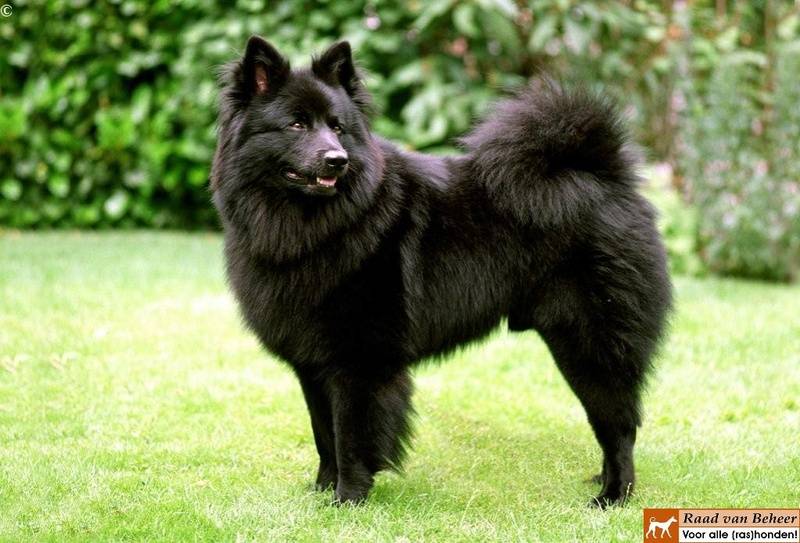
Grote-Keeshond-bruin-zwart.jpg


Spitzen are herding/companion dogs. They need hooman attention. Luna needs more than usual. She's a bit neurotic.

We give her milkbones and stuff, which she happily eats, but occasionally we give her a big sinewy bone treat - bigger than anything else she eats. Sometimes she eats them, but often she tries to bury them somewhere in the house. We stopped letting her bury them outside - the coons are already fed plenty.

When attempting to bury it indoors, it takes her a long time to find a good spot. She is constantly trotting back and forth throughout the house trying different spots. She might pass through the living room a dozen times back and forth (bringing her prize to show us, but never letting us get close enough to touch it. It's a game she plays with her toys too.)

This nervous pacing - it is also something she does when she needs to go outside, or when she's freaked by someone at the door.

So here is my question: In triggering her bone-burying instincts, are we making her happier? Or are we making her more stressed?
 
  • Love
Likes   Reactions: S.G. Janssens
Biology news on Phys.org
Dogs have lots of behaviors. Those favored by an individual dog came be pretty specific to them. Some are probably genetic.
Some dogs are just weird psychologically.

You might want to her a pile of old pillows in the corner to "bury" the bones in.

In the last century, a fairly common model about animal behavior was that some drive or need would build up (for any numbers of reasons) and then some trigger would release the behavior and the drive to do the behavior would be reduced after that.
If that is the case, then it should reduce any stress of having to do with getting the behavior done.

Alternatively, it may be a fun activity for the dog due brought on by doggie boredom, in which case probably no problem.

Another possibility is your dog is worried or neurotic. Maybe doggie downers.
Or reassurance for the dog with separation anxiety (like never leaving it alone). Doesn't sound like that.

You could take your dog for a walk to reduce boredom.
If your dog has a high activity level to satisfy, take her for a run.

You might want to discuss it with whomever you got it from.

Disclaimer: This is like medical advise for a dog (possible PF issues). I am not a dog vet.
 
  • Like
Likes   Reactions: S.G. Janssens
BillTre said:
I am not a dog vet.
Hell, you're not even a dog. I AM a dog and I STILL don't know what that's all about :smile:
 
  • Haha
Likes   Reactions: sysprog, mcastillo356, S.G. Janssens and 2 others
Here is a previous post I made about a baby beaver building dams in someone's house.
Kind of similar kind of out of place behavior.
 
There is also displacement behavior.
When a behavior is inappropriate or not possible to do, but the animal has some drive to do it, it will do a different behavior as some kind of behavioral outlet.
 
It is really difficult to sort out underlying emotions in animal behavior. We can observe behaviors and associate them with things that we identify with OUR emotions. The ABA perspective is that animal behavior is a consequence of the desire to solve a problem. Often gross behaviors like pacing can have multiple underlying reasons and need more subtle observations of details (other associated behaviors) or circumstances (what, where, when, etc.).

Notice, even in your descriptions, I see some subtle differences.
DaveC426913 said:
constantly trotting back and forth throughout the house trying different spots.
DaveC426913 said:
nervous pacing - it is also something she does when she needs to...
The one that stands out to me in the limited description is how she reacts to you. In the game she doesn't want your help. In the nervous pacing, I think she does.

So, remote diagnosis isn't worth much. But, if she is free to choose what to do (i.e. resolve problems), I wouldn't worry too much.

I think a good place to start learning to really observe dog behavior is the short book "On Talking Terms with Dogs: Calming Signals" by Turid Rugaas. Of course it's not the whole library, and only partly addresses this. But it's a short, easy, introduction to what to look for in dog behavior.

PS: Also, take some videos of the behaviors. It's much easier to watch videos in detail instead of real time. I use videos A LOT when I'm teaching detection dog training.

Also this. Not as good as her book, it's too short and doesn't have enough photos. But it is free.
 
Last edited:
  • Like
Likes   Reactions: S.G. Janssens, berkeman and BillTre
BillTre said:
Disclaimer: This is like medical advise for a dog (possible PF issues). I am not a dog vet.
Ack, I misread that as "I am not a dog yet." o0)
 
  • Haha
Likes   Reactions: BillTre
We had a Lab mix many years ago that did that bone hiding game; always with great care, consternation, and some aborted attempts. She loved it and it did not cause any problems. Very entertaining for dogs and humans. Then she would hang about nonchalantly within several feet of the bone to make sure the other dog didn't know where it was. Which had the exact opposite effect, EVERYONE knew then that there was a buried bone nearby, LOL.
 
  • Like
  • Haha
Likes   Reactions: S.G. Janssens, mcastillo356 and berkeman
Our previous dog was good at bringing throw objects back to the thrower (our current one isn't).
We would have someone throw a ball to the other end of the house and then go hid (like in the shower with the curtain closed).
The dog would return to where the thrower was and look around.
If the thrower was not to be found, she would drop the ball, search the house, find the thrower, retreive the ball and bring it to the thrower.
 
  • Like
Likes   Reactions: S.G. Janssens and berkeman
  • #10
DaveC426913 said:
So here is my question: In triggering her bone-burying instincts, are we making her happier? Or are we making her more stressed?
No idea. I have a rescued greyhound, and she also gets stressed sometimes. What about if you get advice from an ethologist?. She said Pepa needs a leader, but I'm afraid I don't know to be that way.

20211125_071244.jpg
 
  • Like
  • Love
Likes   Reactions: BillTre, S.G. Janssens and Hamiltonian
  • #11
DaveC426913 said:
So here is my question: In triggering her bone-burying instincts, are we making her happier? Or are we making her more stressed?
I think with triggering it with a dog in an inappropriate environment it's the latter. As far as I know this behaviour is not absolutely necessary for the dog to feel better: it is just a reaction for some yummy but excess food which by any reason (Full already? Or just too big? Some suspicious folk watching?) cannot be consumed on the spot.

Does she has all the daily activity she needs?
 
  • #12
There are already a lot of good tips above.

To the OP: You did not specify for how long she has been with you, or if it is permanent. (I hope it is permanent, because you seem to give her a lot of thought, which indicates that you care about her well-being.)

In any case, moving is difficult for most humans, but also for dogs. The trying of different spots may be an indication that she is not yet entirely familiar with the new house. It could be that she still needs to settle for her favorite spots and make them "her own". Once she has settled, she may still want to bury bones, but she will probably be less restless.
 
  • #13
Rive said:
Does she has all the daily activity she needs?
Paradoxically, while she likes to go for walks, they never go farther than the end of the block before she strains to come back. She's skittish outdoors. (Doesn't like all the noise and the peeps).

S.G. Janssens said:
In any case, moving is difficult for most humans, but also for dogs. The trying of different spots may be an indication that she is not yet entirely familiar with the new house. It could be that she still needs to settle for her favorite spots and make them "her own". Once she has settled, she may still want to bury bones, but she will probably be less restless.
She's been with us for ... two years? But she does have two homes. Spends 50% of her time with her man, and the other 50% here. Luckily, we are only a hundred yards apart. She certainly has her spots and her routines, and er ... makes no bones about telling us when it's time to go to the office, when it's bedtime and when it's time for treats. (Come to think of it, she has a different routine depending on who she's with.)

She did suffer the trauma of having her former master die on her; that's how we ended up with her.
 
  • Informative
Likes   Reactions: Bystander

Similar threads

  • · Replies 40 ·
2
Replies
40
Views
3K
  • · Replies 11 ·
Replies
11
Views
2K
  • · Replies 24 ·
Replies
24
Views
3K
  • · Replies 6 ·
Replies
6
Views
2K
  • · Replies 42 ·
2
Replies
42
Views
10K
Replies
23
Views
9K
Replies
38
Views
7K
Replies
10
Views
5K
  • · Replies 5 ·
Replies
5
Views
4K
  • · Replies 16 ·
Replies
16
Views
6K