SUMMARY
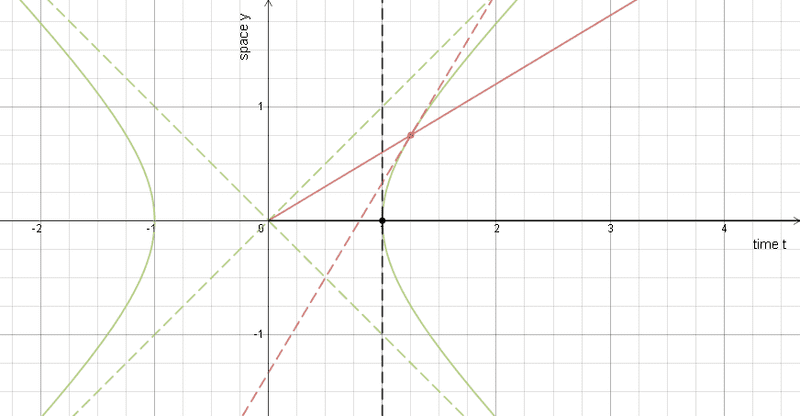
This discussion centers on the properties of Minkowski diagrams in the context of special relativity, specifically addressing the angles between the x and x' axes and the ct and ct' axes. The key conclusion is that these angles are equal due to the Lorentz transformations, which preserve the unit hyperbola and reflect the invariant speed of light across all inertial frames. The relationship between the axes is further explained through the concept of spacetime geometry, where the tangent lines to the hyperbola represent the observer's simultaneity and spatial direction.
PREREQUISITES
- Understanding of special relativity principles, particularly the second postulate regarding the speed of light.
- Familiarity with Lorentz transformations and their mathematical representation.
- Basic knowledge of Minkowski spacetime geometry and hyperbolic geometry.
- Ability to interpret and analyze spacetime diagrams.
NEXT STEPS
- Study the derivation and implications of Lorentz transformations in special relativity.
- Explore the concept of unit hyperbolas and their significance in Minkowski diagrams.
- Learn about the geometric interpretation of spacetime events and simultaneity in special relativity.
- Investigate the differences between Minkowski geometry and Euclidean geometry in the context of spacetime.
USEFUL FOR
Students and educators in physics, particularly those focusing on special relativity, as well as researchers and enthusiasts interested in the geometric interpretation of spacetime and Lorentz transformations.