Understanding Newton's 2nd Law of Motion

Click For Summary

Homework Help Overview

The discussion revolves around understanding Newton's 2nd Law of Motion, specifically the relationship between force, mass, and acceleration. Participants explore the implications of applying a force to an object while considering gravitational forces and their effects on motion.

Discussion Character

  • Conceptual clarification, Assumption checking, Mathematical reasoning

Approaches and Questions Raised

  • Participants question how gravity interacts with the applied force in a horizontal motion scenario. Some express confusion about the acceleration resulting from the force and the role of gravitational force in this context.

Discussion Status

There is an ongoing exploration of the concepts involved, with some participants providing clarifications about the role of normal force and gravitational force in the context of horizontal motion. Multiple interpretations of the problem are being discussed, particularly regarding the net forces acting on the object.

Contextual Notes

Participants note that the discussion assumes no friction and a horizontal surface, which influences how gravitational force is considered in relation to the applied force. There is also mention of the potential complications that arise when friction is introduced.

tomtomtom1
Messages
160
Reaction score
8
Homework Statement
Understanding Newton's 2nd Law of Motion
Relevant Equations
NA
Hello all

I am trying to understanding Newton's 2md Law of Motion which states:-

Force = Mass * Acceleration

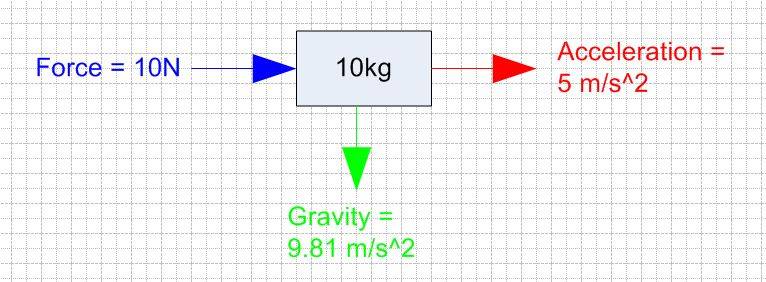
If I had a force of 10Newtons pushing an object along the ground (assume no friction) in a perfectly horizontal direction that has a Mass of 10kg then the objects acceleration would be 5m/s^2 in the horizontal direction.

My question why is gravity factored into this as shown in my sketch below:-
ggg.JPG


Gravity is acting on the mass while a force of 10N is being applied - so my question is shouldn't gravity be considered as another force acting downwards which would effect the acceleration and the direction of the Mass?

I hope this makes sense?
 
Physics news on Phys.org
Just to clarify, as is always done, ##F=\frac{dp}{dt}## where ##p=mv##. If you don't know about calculus, you get the equation you have because mass is usually taken as a constant.
As to your question, yes it should be and is considered as such, but not in the way you're thinking of it, probably. The object in your picture is moving horizontally, and since we're neglecting air resistance and assuming no friction, there's nothing besides the ##10N## force to affect its horizontal motion. Gravity is making the object accelerate downwards, but has no effect on its horizontal motion (since the force of friction is ##F=[(\mu=0)\times N]=0##).
 
Last edited:
tomtomtom1 said:
Homework Statement: Understanding Newton's 2nd Law of Motion
Homework Equations: NA

Hello all

I am trying to understanding Newton's 2md Law of Motion which states:-

Force = Mass * Acceleration

If I had a force of 10Newtons pushing an object along the ground (assume no friction) in a perfectly horizontal direction that has a Mass of 10kg then the objects acceleration would be 5m/s^2 in the horizontal direction.

My question why is gravity factored into this as shown in my sketch below:-View attachment 251669

Gravity is acting on the mass while a force of 10N is being applied - so my question is shouldn't gravity be considered as another force acting downwards which would effect the acceleration and the direction of the Mass?

I hope this makes sense?

The force of gravity is there, but it is "cancelled" out by the normal force of the frictionless ground, because the object is not accelerating in the vertical direction.

You can verify this by drawing the free-body diagram and writing down the x and y components of the force equation.

BTW, once you start to include friction, the gravitational force WILL then be factor, because the frictional force depends on the normal force, and the normal force depends on gravitational force (and angle if it is inclined). So be careful what you are asking for, because you WILL start seeing gravitational force rears its ugly head soon enough.

Zz.
 
  • Like
Likes   Reactions: Delta2
tomtomtom1 said:
If I had a force of 10Newtons pushing an object along the ground (assume no friction) in a perfectly horizontal direction that has a Mass of 10kg then the objects acceleration would be 5m/s^2 in the horizontal direction.
5 m/s^2 is not what I get.

F=ma. Does 10 N equal 10 kg times 5 m/s2?
 
jbriggs444 said:
5 m/s^2 is not what I get.

F=ma. Does 10 N equal 10 kg times 5 m/s2?

should be 1 m/s2

Thank you.
 
  • Like
Likes   Reactions: jbriggs444
Other than the numbers, you also need to understand that the second law is not F = ma, but ##\vec F_{net}=m\vec a##. It is a vector equation in which ##\vec F_{net}## is the sum of all the forces added as vectors and ##\vec a## is the acceleration vector. Among other things it says that if you add all the forces that act on mass ##m##, the acceleration must be in the same direction as that sum. In the drawing you posted, you show a force to the right and the weight straight down. If that is all there is, when you add the two forces, you get a force pointing to the right and down in the "southeast" direction, yet you show the acceleration to the right. That cannot be correct. To resolve the discrepancy between the net force and the acceleration directions, you need to add a force that you missed; it is the normal force that points straight up and is provided by the surface that supports the mass. It is just large enough to cancel the weight so that now the sum of all the forces is to the right.
 
Last edited:
  • Like
Likes   Reactions: learnandteach and Delta2
kuruman said:
It is a vector equation in which ##\vec F_{net}## is the sum of all the forces added as vectors and ##\vec a## is the acceleration vector.
Or the individual force vectors, ##\overrightarrow F_i##, and the associated individual acceleration vectors, ##\overrightarrow a_i## can be treated as ##\overrightarrow F_i = m \overrightarrow a_i##, and the force and acceleration vectors can be summed separately to get ##\overrightarrow F_{net} = m \overrightarrow a_{net}##.
 
  • Like
Likes   Reactions: Delta2

Similar threads

  • · Replies 5 ·
Replies
5
Views
2K
  • · Replies 12 ·
Replies
12
Views
794
Replies
3
Views
2K
  • · Replies 42 ·
2
Replies
42
Views
6K
  • · Replies 4 ·
Replies
4
Views
2K
  • · Replies 17 ·
Replies
17
Views
1K
Replies
13
Views
3K
Replies
4
Views
1K
Replies
9
Views
2K
  • · Replies 38 ·
2
Replies
38
Views
5K