Discussion Overview
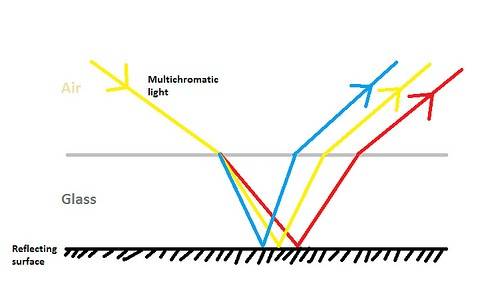
The discussion revolves around the phenomenon of rainbow dispersion in glass and mirrors, particularly focusing on why such effects are not observed at certain angles of incidence. Participants explore theoretical and experimental aspects of light behavior in these materials.
Discussion Character
- Exploratory
- Technical explanation
- Experimental/applied
- Debate/contested
Main Points Raised
- One participant questions why a rainbow or blurry image is not seen when looking through glass or a mirror at a 45-degree angle to the surface normal.
- Another suggests that the deflection caused by dispersion is small compared to the spatial extent of the light source.
- It is noted that rays leaving the glass are parallel, which may prevent color distinction, with colors potentially visible only at the edges of the glass.
- A participant hypothesizes that if an object reflects only three colors, slight displacements of images corresponding to each color might be observed, but they did not notice dispersion in a 5 mm thick mirror.
- There is a discussion about the limitations of Snell's law, with some participants asserting that it does not account for wavelength, while others clarify that the refractive index (n) is wavelength-dependent.
- One participant shares an experimental observation of dispersion using a small mirror in a pot of water, noting that a thicker mirror may be required to see clear dispersion.
- Another participant calculates the refractive indices for red and blue light in glass, suggesting that the observed dispersion aligns with their calculations.
Areas of Agreement / Disagreement
Participants express differing views on the visibility of dispersion in glass and mirrors, with some agreeing on the factors affecting visibility while others propose different experimental setups. The discussion remains unresolved regarding the optimal conditions for observing dispersion.
Contextual Notes
Some participants mention limitations related to the thickness of the glass and the clarity of the experimental setup, as well as the potential impact of impurities in the water on the observations.