Understanding Rainbow Dispersion in Glass and Mirrors

  • Context: Undergrad 
  • Thread starter Thread starter expert_vision
  • Start date Start date
  • Tags Tags
    Rainbow
Click For Summary

Discussion Overview

The discussion revolves around the phenomenon of rainbow dispersion in glass and mirrors, particularly focusing on why such effects are not observed at certain angles of incidence. Participants explore theoretical and experimental aspects of light behavior in these materials.

Discussion Character

  • Exploratory
  • Technical explanation
  • Experimental/applied
  • Debate/contested

Main Points Raised

  • One participant questions why a rainbow or blurry image is not seen when looking through glass or a mirror at a 45-degree angle to the surface normal.
  • Another suggests that the deflection caused by dispersion is small compared to the spatial extent of the light source.
  • It is noted that rays leaving the glass are parallel, which may prevent color distinction, with colors potentially visible only at the edges of the glass.
  • A participant hypothesizes that if an object reflects only three colors, slight displacements of images corresponding to each color might be observed, but they did not notice dispersion in a 5 mm thick mirror.
  • There is a discussion about the limitations of Snell's law, with some participants asserting that it does not account for wavelength, while others clarify that the refractive index (n) is wavelength-dependent.
  • One participant shares an experimental observation of dispersion using a small mirror in a pot of water, noting that a thicker mirror may be required to see clear dispersion.
  • Another participant calculates the refractive indices for red and blue light in glass, suggesting that the observed dispersion aligns with their calculations.

Areas of Agreement / Disagreement

Participants express differing views on the visibility of dispersion in glass and mirrors, with some agreeing on the factors affecting visibility while others propose different experimental setups. The discussion remains unresolved regarding the optimal conditions for observing dispersion.

Contextual Notes

Some participants mention limitations related to the thickness of the glass and the clarity of the experimental setup, as well as the potential impact of impurities in the water on the observations.
expert_vision
Messages
6
Reaction score
0
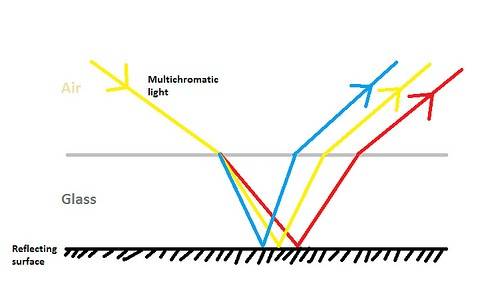
I was just wandering, why when I look through a glass or a mirror at 45 degrees related to it's surface normal I don't see a rainbow/blurry image?

Here is a picture that hopefully, describes better what I mean.

5904309193_c92c7f7386.jpg

Dispersion by Cristi .eXPV, on Flickr
 
Science news on Phys.org
Probably because the deflection caused by the dispersion of the glass is small compared to the spatial extent of the light source.

Claude.
 
The rays that leave the glass are parallel.
Another incoming ray that is parallel, will split the same way, and merge with the other rays, making distinction impossible.
It's only at the edge of the glass that you might see some colors. :)
 
I like Serena said:
The rays that leave the glass are parallel.
Another incoming ray that is parallel, will split the same way, and merge with the other rays, making distinction impossible.
It's only at the edge of the glass that you might see some colors. :)

Let's say we look at an object that reflects only 3 components in visible spectrum at a large distance from one to another (i.e. red, yellow, blue). What I should see in the mirror are 3 images of the object, corresponding to each color, that are slightly displaced.

I looked in a mirror as thick as 5 mm but I couldn't notice any dispersion .. except the multiple reflection (one on the surface and others in the glass .. I was able to see up to five reflections .. not visible in the picture .. to dimmer for my camera).
5905741397_581cf88f80.jpg

SP_A0122 by Cristi .eXPV, on Flickr

I think the angle of refraction changes to little over the spectrum to make it noticeable. Maybe I can put a small mirror in a glass of water and see if anything changes. But how am I going to make a white beam of light. There are going to be impurities in the water, imperfect surface ... a headache, everything will be blurry. I'll see what I can do.

http://en.wikipedia.org/wiki/Snell%27s_law" doesn't take into account the wavelength. Is there another one that does ?
 
Last edited by a moderator:
There's a variant of Snell's law that does:

855b336741150b679007dd522db12eef.png
 
Snell's law doesn't take into account the wavelength.

It does, it's just that n is dependent of the wavelength.
 
Yes I noticed .. I didn't pay attention when I first read the article.
 
Got it .. I placed a small mirror in a pot and filled it with water. The pot is 200+ mm tall and I was able to see dispersion. It's not very clear in the picture, but you get the idea.
5908611308_1af1ce05ab_b.jpg

Photo-0010 by Cristi .eXPV, on Flickr

So you would need a mirror 25 cm thick in order to see clear dispersion. :P
 
Nice! :smile:

I looked up the refractive indices for red and blue.
For glass they are 1.520 resp. 1.525, so that a difference of 0.5%.
With glass about 200 mm thick, that would mean a dispersion in the order of 1 mm.
So that seems to match!
 

Similar threads

  • · Replies 9 ·
Replies
9
Views
3K
  • · Replies 1 ·
Replies
1
Views
2K
  • · Replies 12 ·
Replies
12
Views
3K
  • · Replies 4 ·
Replies
4
Views
3K
  • · Replies 7 ·
Replies
7
Views
5K
Replies
12
Views
9K
  • · Replies 5 ·
Replies
5
Views
4K
  • · Replies 19 ·
Replies
19
Views
6K
  • · Replies 3 ·
Replies
3
Views
3K
  • · Replies 6 ·
Replies
6
Views
3K