Understanding Rigid Column Theory in Fluid Mechanics

axe34
Messages
38
Reaction score
0
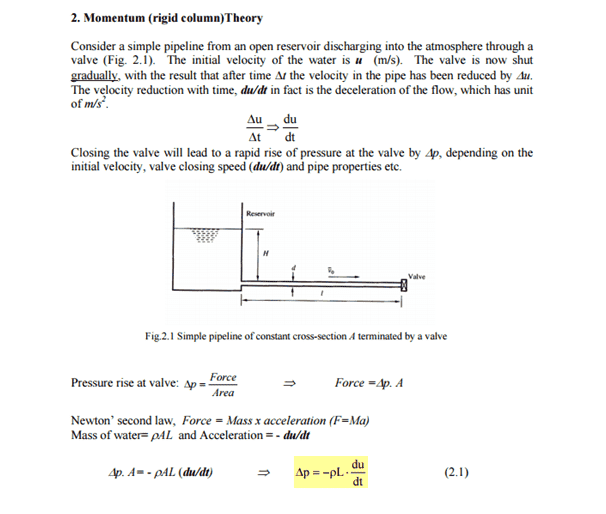
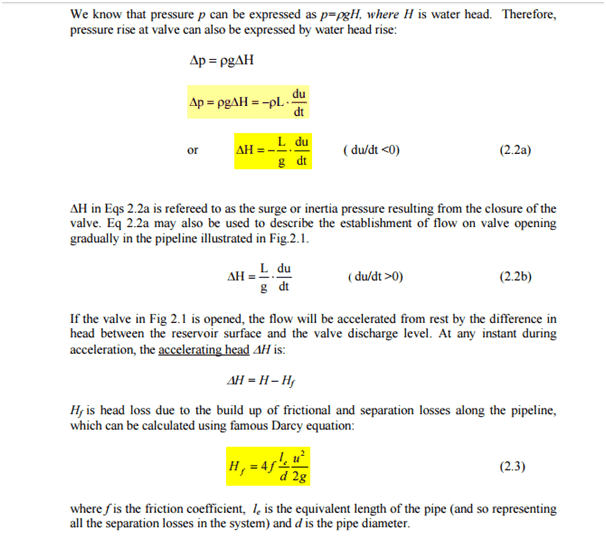
Hello, please see attached text below - this concerns ''rigid column theory''. When a valve is closed, the pressure rises at the valve; the pressure rises above the reservoir pressure by ΔP with a height increase ΔH above H. When the valve is opened, this right hand pressure will disappear and the fluid will start to flow through the open valve.

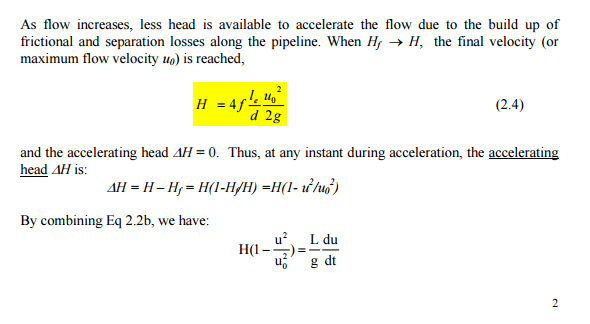
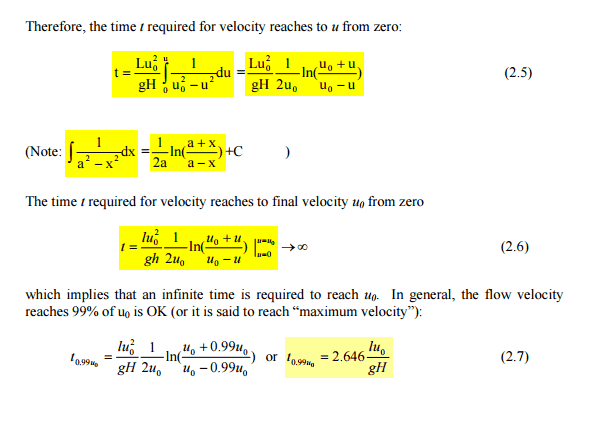
Why is ΔH = H - Hf?
upload_2017-1-2_9-52-28.png


upload_2017-1-2_9-52-43.png


upload_2017-1-2_9-52-59.png
upload_2017-1-2_9-53-11.png
 
Last edited:
Physics news on Phys.org
So the driving force / ##\left ( {\pi\over 4} d^2 \rho g \right ) \ \ ## ΔH is the head H at the entrance of the pipe minus the head loss in the pipe.
 
I've drawn so many diagrams and simply cannot show that delta H = H - Hf!
 
That a question ?
 
The explanations given in the attached document (the first post in this thread) are poor in my opinion.
Here is how I interpret it: when the valve closes, it seems to imply that a piezometer at the valve with show height H + ΔH
upload_2017-1-5_13-45-15.png


Thus, if we define positive direction to the right,

∑forces on the fluid in horizontal pipe = m.a

(ρgH + ρ0).A - (ρg(H+ΔH) + ρ0).A = ρAL. dv/dt where: ρAL is the mass of fluid in the horizontal pipe and ρ0 is atmospheric pressure (A is pipe cross section)

This gives ΔH = - L/g dv/dt which implies that when delta H is positive, then there will be a deceleration of flow. Similarly, upon valve opening, we will see:
upload_2017-1-5_13-45-44.png

If positive direction still to the right,
∑forces on the fluid in horizontal pipe = m.a

(ρgH + ρ0)A - (ρg(H-ΔH) + ρ0)A = ρAL. dv/dt

thus ΔH = L/g dv/dt which implies that when delta H is as shown on the diagram, then there will be a deceleration of flow. Now, I always though that head loss was as shown in the following diagram:
upload_2017-1-5_13-54-5.png


I've drawn the energy grade line (EGL) and hydraulic grade line (HGL) as the piezometer. ΔH, as defined in diagram 2 on this post is shown in white. Delta H is not equal to H - Hf (Hf also called HL).

upload_2017-1-5_13-49-58.png


So, where have I gone wrong?
 

Attachments

  • upload_2017-1-5_13-46-27.png
    upload_2017-1-5_13-46-27.png
    22.5 KB · Views: 697
To be honest, I so far only reacted to the part of your question I could recognize (##H_f##). For the pressure surge I have to read up too.
Text says they close the valve gradually, so the stuff keeps flowing. Instead of assuming a linear deceleration as in the link, the book stops with (2.2a), basically ## F = ma ##. So I agree with you, up to and including
axe34 said:
This gives ΔH = - L/g dv/dt which implies that when delta H is positive, then there will be a deceleration of flow.
Note that in fact so far we haven't said anything about the magnitude of ##\Delta H##.
Rememer that ##\Delta H## is a difference.

Upon valve opening, the inital head at he valve is H and the valve has to counter it with a force ##\rho g H A##. Any form of opening the valve lowers the force the valve can exercise on the liquid (the head at the valve), so there is a negative ##\Delta H## available to accelerate the cylinder of liquid.

So imho the baseline for ##\Delta H## in your second picture is the top line and ##\Delta H < 0##.

As such, I see no wrong in the treatment in the text: there are no excessive claims, just manipulation of a few equations.

Your third diagram depicts a steady state: ##{du\over dt}=0## so there is no ##\Delta H##.
 

Similar threads

  • · Replies 5 ·
Replies
5
Views
2K