Understanding Simultaneity Through Male & Female Clocks Meeting

Click For Summary

Discussion Overview

The discussion revolves around a thought experiment involving two clocks, one male and one female, moving towards each other and their synchronization from different reference frames. Participants explore concepts related to simultaneity, time dilation, and length contraction within the framework of special relativity, examining how these principles apply to the scenario presented.

Discussion Character

  • Exploratory
  • Technical explanation
  • Conceptual clarification
  • Debate/contested
  • Mathematical reasoning

Main Points Raised

  • One participant proposes a scenario where two clocks are set to zero and start moving towards a midway point after a light flash, questioning how to demonstrate synchronization from the male clock's frame.
  • Another participant suggests computing the proper time of both clocks to analyze synchronization.
  • A different viewpoint argues that the effects of relativity of simultaneity complicate the application of time dilation and length contraction formulas in this scenario.
  • Concerns are raised about the distances between the clocks and the midway point, with one participant noting that the distance from the male clock to the midway point appears larger than from the midway point to the female clock.
  • Participants discuss the implications of length contraction, emphasizing the need for careful application of the relevant formulas and their assumptions.
  • There is a follow-up question regarding the expected speeds of the clocks and the midway point, with a participant noting the discrepancy in expected ratios due to differing distances.
  • Another participant introduces the concept of relativistic velocity addition to explain why the expected speed ratio cannot be as initially assumed.
  • Further clarification is sought on setting up the problem from the male clock's frame, with participants discussing the geometric relationships of events and the necessity of using appropriate coordinates.

Areas of Agreement / Disagreement

Participants express differing views on how to approach the problem, particularly regarding the application of time dilation and length contraction. There is no consensus on the best method to demonstrate synchronization from the male clock's frame, and the discussion remains unresolved regarding the implications of the different reference frames.

Contextual Notes

Participants highlight the importance of using the full Lorentz transformations and the need to carefully consider the geometric relationships of events when switching reference frames. There are unresolved assumptions regarding the initial conditions and the application of relativistic principles.

Who May Find This Useful

This discussion may be of interest to those studying special relativity, particularly in understanding simultaneity, time dilation, and length contraction in different reference frames.

Master Wayne
Messages
26
Reaction score
3
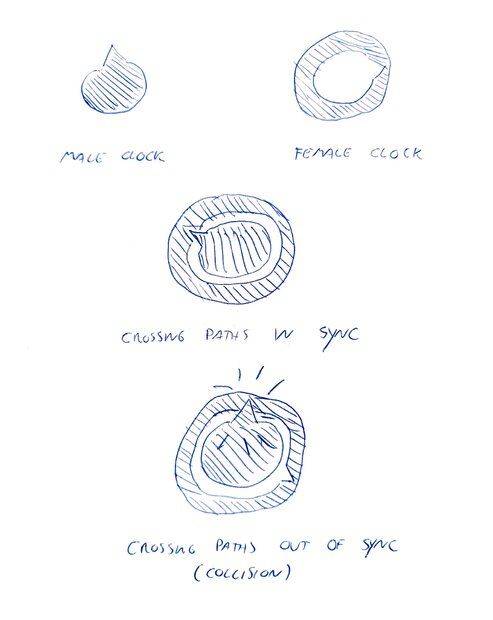
This is not a homework question, just a scenario I've come up with. Imagine I have a male and a female clock moving towards each other. If they're in sync, one will fit inside the other and they'll continue on their way. If not, they'll collide. (Apologies for the crude drawings.)
Whiteboard Aug 15, 2022_1.jpg


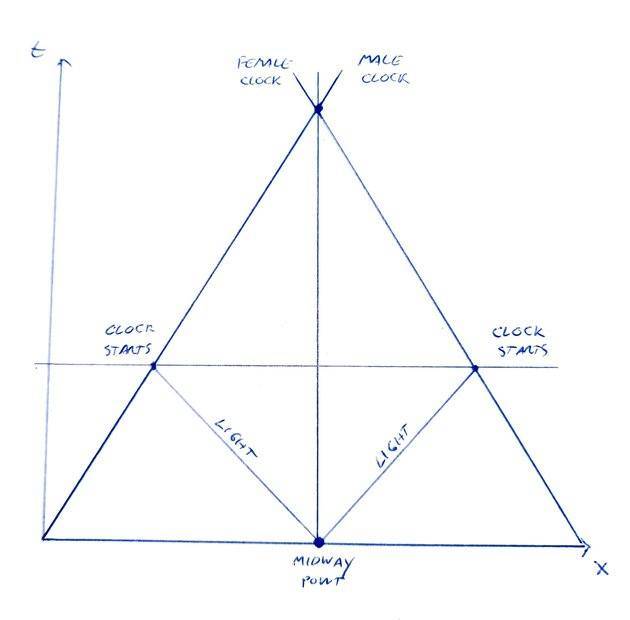
I place these clocks the same distance away from a midway point which contains a light bulb. The clocks travel toward the midway point at the same speed, meeting at that point some time later. Before the clocks start their journey, I set them to show time zero and turn them off. As soon as the clocks start, the light bulb emits a flash that travels in all directions. When that flash hits the clocks, they turn on and start keeping time.
Whiteboard Aug 15, 2022 (1)_1.jpg


From a reference frame at rest with respect to the midway point, the clocks will always be in sync and when they meet at the midway point the male clock will pass through the female clock with no issue. Therefore, this is the outcome we must expect in all reference frames.

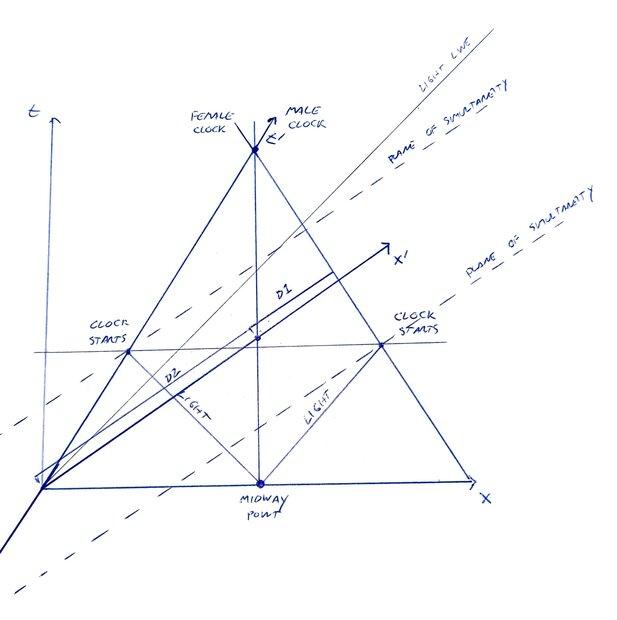
Now, let's analyze things from the reference frame of the male clock. In the image below, I've drawn the axes corresponding to that frame.
Whiteboard Aug 15, 2022 (2)_1.jpg


As we can see, from the male clock's frame the light flash starts the female clock first and only some time later starts the male clock. Therefore, the female clock gets a head start. However, from the male clock's frame the female clock also runs slow due to time dilation. To avoid a paradox, these two facts must combine in order to allow for a perfect synchronization of the clocks at the midway point.

What I'm having a hard time figuring out is how to make this analysis algebraic in order to demonstrate that this synchronization does happen from the male clock's frame. How can I show that from the male clock's frame, the female clock's head start is compensated by time dilation?

Bonus question (which is also confusing me): how come from the male clock's frame, at any given point in time, the distance D2 between the male clock and the midway point is larger than the distance D1 between the midway point and the female clock? Shouldn't I expect both distances to contract equally? This is the difficulty which has prevented me from drawing a new spacetime diagram from the perspective of the male clock (I can't figure out why the initial conditions would be spatially asymmetric).
 
Physics news on Phys.org
Master Wayne said:
How can I show that from the male clock's frame, the female clock's head start is compensated by time dilation?
Just compute the proper time of the male and female clocks from being started to when they meet.
 
  • Like
Likes   Reactions: Master Wayne
Master Wayne said:
How can I show that from the male clock's frame, the female clock's head start is compensated by time dilation?
You don’t, because you lose the effects of relativity of simultaneity - the conditions under which the time dilation and length contraction formulas can be applied are fairly restrictive, and this situation isn’t one in which those conditions hold.

Instead, write down the coordinates of all the relevant events using one frame (preferably the one in which the center is at rest - it ‘s easiest) and then use the full Lorentz transforms to find the coordinates in the frame in which the male clock is at rest.
 
  • Like
Likes   Reactions: Master Wayne
Master Wayne said:
Bonus question (which is also confusing me): how come from the male clock's frame, at any given point in time, the distance D2 between the male clock and the midway point is larger than the distance D1 between the midway point and the female clock?
Correct.

Master Wayne said:
Shouldn't I expect both distances to contract equally?
No, you cannot apply length contraction in the way you seem to want to. One must be very careful about using the time dilation and length contraction formulas because they both come with a set of assumptions that are often glossed over in a way that makes them feel unimportant when they are in fact crucial.
 
  • Like
Likes   Reactions: Master Wayne
Master Wayne said:
What I'm having a hard time figuring out is how to make this analysis algebraic in order to demonstrate that this synchronization does happen from the male clock's frame. How can I show that from the male clock's frame, the female clock's head start is compensated by time dilation?
Write down the ##(t,x)## coordinates of the various events in the symmetric frame, then use the Lorentz transforms to get the coordinates in any other frame. The Lorentz transforms preserve straight lines, so you only need the "junction" events.

This is also the answer to your bonus question.
 
  • Like
Likes   Reactions: Master Wayne
Master Wayne said:
Shouldn't I expect both distances to contract equally?
No. The "length contraction" applies to a distance, which is constant over time in each frame.
 
  • Like
Likes   Reactions: Master Wayne
Orodruin said:
Just compute the proper time of the male and female clocks from being started to when they meet.
I followed this suggestion and obtained the expected result. Thanks for the suggestions. I will now try to do the same using the Lorentz transformations.
 
Orodruin said:
Correct.No, you cannot apply length contraction in the way you seem to want to. One must be very careful about using the time dilation and length contraction formulas because they both come with a set of assumptions that are often glossed over in a way that makes them feel unimportant when they are in fact crucial.
Follow-up question: when setting up the problem from the male clock's frame, I'd expect the midway point to move towards the male clock with speed ##v##, and the female clock to move towards the male clock with speed ##2v##. However, since ##D1## and ##D2## are different (##D2 > D1##) at all times, the ratio between the female clock's speed and the male clock's speed is not 2, but a smaller number. I'm having trouble understanding if this result is correct and if so, why?
 
Master Wayne said:
Follow-up question: when setting up the problem from the male clock's frame, I'd expect the midway point to move towards the male clock with speed ##v##, and the female clock to move towards the male clock with speed ##2v##. However, since ##D1## and ##D2## are different (##D2 > D1##) at all times, the ratio between the female clock's speed and the male clock's speed is not 2, but a smaller number. I'm having trouble understanding if this result is correct and if so, why?
Look up relativistic velocity addition. It can't be ##2v## as then the relative velocity would be ##> c## when ##v> \frac c 2##.
 
  • Like
Likes   Reactions: Master Wayne and malawi_glenn
  • #10
PeroK said:
Look up relativistic velocity addition. It can't be ##2v## as then the relative velocity would be ##> c## when ##v> \frac c 2##.
Of course, makes perfect sense.

But what if I'm trying to setup this same problem from the start from the reference frame of the male clock? Would I be wrong in drawing a spacetime diagram where the female clock's worldline starts at ##x' = 2d##, the midpoint's worldline starts at ##x' = d## and both intersect the ##t'## axis at the same point? After all, this would imply that the female clock's speed is indeed ##2v## (where ##v## is the midpoint's speed), and that ##D1## and ##D2## start out equal to each other. But these are not the results we have found in this discussion so far. Seems odd that I would have to take into consideration the results from another frame of reference when setting up the initial conditions for this frame of reference. What am I missing?
 
  • #11
Master Wayne said:
What am I missing?
The full Lorentz Transformation. Think coordinates.
 
  • #12
Master Wayne said:
what if I'm trying to setup this same problem from the start from the reference frame of the male clock?
Do you mean truly set up the same problem? Or a different problem?

The same problem means all of the events have the same geometric relationship. That means all observables will be the same. It also means the coordinates you use to set up the events in the male clock's frame will not be the same as the ones you used in your OP.

If you use the same coordinates, but now in the male clock's frame instead of the frame you used in your OP, you are setting up a different problem: the geometric relationships between the events will be different. So you should expect different results.
 
  • Like
Likes   Reactions: Master Wayne
  • #13
PeterDonis said:
Do you mean truly set up the same problem? Or a different problem?

The same problem means all of the events have the same geometric relationship. That means all observables will be the same. It also means the coordinates you use to set up the events in the male clock's frame will not be the same as the ones you used in your OP.

If you use the same coordinates, but now in the male clock's frame instead of the frame you used in your OP, you are setting up a different problem: the geometric relationships between the events will be different. So you should expect different results.
Makes perfect sense. Thank you very much.
 

Similar threads

  • · Replies 36 ·
2
Replies
36
Views
4K
  • · Replies 20 ·
Replies
20
Views
2K
  • · Replies 16 ·
Replies
16
Views
2K
  • · Replies 54 ·
2
Replies
54
Views
4K
  • · Replies 67 ·
3
Replies
67
Views
4K
  • · Replies 33 ·
2
Replies
33
Views
2K
  • · Replies 22 ·
Replies
22
Views
2K
  • · Replies 17 ·
Replies
17
Views
1K
  • · Replies 9 ·
Replies
9
Views
275
  • · Replies 51 ·
2
Replies
51
Views
4K