Understanding Terminal Velocity

Click For Summary
SUMMARY

Terminal velocity (Vt) is mathematically defined by the equation Vt = sqrt((2mg)/(CdρA)), where m is mass, g is gravitational acceleration, Cd is the drag coefficient, ρ is fluid density, and A is the object's projected area. The drag coefficient (Cd) is primarily influenced by the object's geometry and orientation during free fall. It is crucial to note that variations in air density, due to factors like altitude, affect terminal velocity; lower density results in higher terminal velocity and vice versa. For accurate calculations, especially for complex shapes, measuring the drag coefficient is recommended.

PREREQUISITES
  • Understanding of basic physics concepts, particularly forces and motion.
  • Familiarity with fluid dynamics, specifically drag forces.
  • Knowledge of the relationship between air density and altitude.
  • Ability to interpret mathematical equations related to motion.
NEXT STEPS
  • Research methods to measure drag coefficients for various object shapes.
  • Study the effects of altitude on air density and its implications for terminal velocity.
  • Explore computational fluid dynamics (CFD) tools for simulating terminal velocity scenarios.
  • Learn about the impact of surface texture on drag coefficients in different fluids.
USEFUL FOR

Physics students, engineers, and anyone interested in aerodynamics or the principles of motion in fluids will benefit from this discussion.

davenn
Science Advisor
Gold Member
Messages
9,725
Reaction score
11,821
hi gang,

from wikipedia...
Mathematically, terminal velocity — without considering the buoyancy effects — is given by
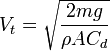
attachment.php?attachmentid=34647&stc=1&d=1303278098.png


where

Vt = terminal velocity,
m = mass of the falling object,
g = acceleration due to gravity,
Cd = drag coefficient,
ρ = density of the fluid through which the object is falling, and
A = projected area of the object.

how do I know what the drag coefficient is ?
I realize air density depends on temperature and pressure and it changes throughout a column on atmosphere.
when a given Vt is quoted for an object ... are they just averaging the air density over the
"drop path" ?

cheers
Dave
 

Attachments

  • termvelocformula.png
    termvelocformula.png
    806 bytes · Views: 636
Physics news on Phys.org
davenn said:
hi gang,

from wikipedia...
Mathematically, terminal velocity — without considering the buoyancy effects — is given by

attachment.php?attachmentid=34647&stc=1&d=1303278098.png


where

Vt = terminal velocity,
m = mass of the falling object,
g = acceleration due to gravity,
Cd = drag coefficient,
ρ = density of the fluid through which the object is falling, and
A = projected area of the object.

how do I know what the drag coefficient is ?
I realize air density depends on temperature and pressure and it changes throughout a column on atmosphere.
when a given Vt is quoted for an object ... are they just averaging the air density over the
"drop path" ?

cheers
Dave

The drag coefficient is mostly dependent on the geometry of the object and which direction on the object is "down". To a small extent, on the nature of the surface of the object. When an object falls, the force of the atmosphere will orient it so that it does not spin, and that orientation will determine the drag coefficient. You can find the drag coefficients for simple objects, but for more complicated objects, probably the best way is to measure it.

The formula is for constant density. If the density changes, the terminal velocity will change. For example, if the density is low, the terminal velocity will be high, but if the density increases, the object will slow down to a lower terminal velocity. You also have to take into account the time it takes to achieve terminal velocity. If, during the time it takes to change, the density changes appreciably, then there is no "terminal velocity", the object will be responding to density changes in a complicated way.
 
If depends on the shape of the object, and it is dimensionless (i.e. it is just a number. it doesn't have "units" like length, etc).

Typical values are less than 0.1 for a streamlined shape like an aircraft wing, 0.3 to 0.35 for a typical small car, about 1.0 for a sphere, and 1.3 for a flat plate perpendicular to the flow direction.

If the air density changes (for example with altitude), the terminal velocity will also change.
 

Similar threads

  • · Replies 22 ·
Replies
22
Views
23K
  • · Replies 7 ·
Replies
7
Views
3K
  • · Replies 5 ·
Replies
5
Views
2K
  • · Replies 14 ·
Replies
14
Views
2K
  • · Replies 7 ·
Replies
7
Views
6K
  • · Replies 3 ·
Replies
3
Views
3K
Replies
18
Views
3K
  • · Replies 12 ·
Replies
12
Views
3K
  • · Replies 11 ·
Replies
11
Views
4K
  • · Replies 6 ·
Replies
6
Views
11K