Understanding the Cockcroft Walton Generator: How Does it Work?

Click For Summary
SUMMARY

The discussion focuses on the operation of the Cockcroft-Walton Generator, a type of voltage multiplier circuit. Participants clarify the charging and discharging behavior of capacitors within the circuit, specifically how capacitors C2 and C3 interact during voltage cycles. It is established that while capacitors can discharge, they do not lose all their voltage; instead, they reach an equilibrium where they share voltage until they are equal. The conversation emphasizes the importance of understanding current flow and voltage levels in the context of the Cockcroft-Walton design.

PREREQUISITES
  • Understanding of basic electrical circuits
  • Knowledge of capacitor behavior in AC circuits
  • Familiarity with voltage multiplication concepts
  • Basic comprehension of current flow and equilibrium in electrical systems
NEXT STEPS
  • Study the operational principles of the Cockcroft-Walton Generator
  • Learn about capacitor charging and discharging cycles in detail
  • Explore voltage multiplier circuits and their applications
  • Investigate animations and visual aids that demonstrate Cockcroft-Walton operation
USEFUL FOR

Electrical engineers, physics students, and anyone interested in high-voltage applications or voltage multiplier circuits will benefit from this discussion.

Abu
Hi everyone. I am doing some research about Cockcroft Walton Accelerators, because I need to be able to explain them to others as a part of a project. However, in order to understand the Cockcroft Walton Accelerator, I need to be able to understand the Cockcroft Walton Generator first. I have written an explanation, but I am worried that it is not correct. This is because when I researched Cockcroft Walton Generators, I have been receiving mixed explanations. If you don't mind, I will explain my reasoning for the processes of this circuit below. I would appreciate it very much if I could receive feedback on my understanding - specifically any errors. Thank you all very much.
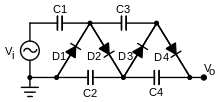
Cockcroft_Walton_voltage_multiplier_circuit.svg.png

Lets say you have a power supply of 10 volts. At the negative peak, C1 will be 10 volts (current travels through D1).

When it alternates to positive peak, C1's 10 volts will discharge to C2 through D2. Since C1 is 10 volts, and the source is 10 volts, that gives C2 20 volts.

When it alternates to negative peak, C1 has its 10 volts recharged, but C3 now gains a voltage too. This is the part I don't understand. C3 gains a voltage of 20 volts (that's a fact), but how come? Does C2 discharge all of its voltage to C3, which leaves C2 with 0 volts and C3 with 20 volts? Or do they both have 20 volts.

In other words, how come all of the capacitors will have 20 volts (except for C1), when we are constantly seeing discharging of the capacitors?

Thank you very much.
 

Attachments

  • Cockcroft_Walton_voltage_multiplier_circuit.svg.png
    Cockcroft_Walton_voltage_multiplier_circuit.svg.png
    2 KB · Views: 612
Physics news on Phys.org
The point between C1 and C3 is at ground potential, and the point left of C2 as well. That puts the point right of C2 at 20 V, if C3 has a lower voltage than 20 V current flows through D3 to charge it. It won’t charge to 20 V during the first cycle - that applies to C2 as well, by the way. These voltages are attained approximately after many voltage cycles and with small current flows.
 
Other than C1, each capacitor is charged with 10 volts from the supply plus 10 volts from the preceding capacitor.

The Wikipedia article has a good explanation- Cockcroft–Walton generator
 
mfb said:
The point between C1 and C3 is at ground potential, and the point left of C2 as well. That puts the point right of C2 at 20 V, if C3 has a lower voltage than 20 V current flows through D3 to charge it. It won’t charge to 20 V during the first cycle - that applies to C2 as well, by the way. These voltages are attained approximately after many voltage cycles and with small current flows.
Ah okay, thank you so much. So it does not mean that capacitor 2 is necessarily losing its voltage, but rather it makes it so that the current running from C2 to C3 has 20 volts, in order to satisfy Capacitor 3? So that means that capacitor 2 will always have 20 volts, right? I originally thought that the charge was physically leaving capacitor 2 to head to capacitor 3 (Is the idea that the capacitors are discharging, meaning they are losing their voltage, to supply other capacitors with voltage, correct?)

Thank you
 
Last edited by a moderator:
"Current running" doesn't have a voltage. There is a current flow until C2 and C3 have the same voltage. The next cycle C2 is charged again, and charges C3 a bit more. If you don't draw any current at the output, then all capacitors will charge to the same voltage and no current flows any more after a while.
 
mfb said:
"Current running" doesn't have a voltage. There is a current flow until C2 and C3 have the same voltage. The next cycle C2 is charged again, and charges C3 a bit more. If you don't draw any current at the output, then all capacitors will charge to the same voltage and no current flows any more after a while.
Okay, thanks. So what do other resources mean when they say that a capacitor discharges? I understood it as the charges that C2 has leave C2 and go to C3, thereby leaving C2 with zero volts and C3 with 20. But you said that the current flows until they are both the same voltage, meaning neither decrease voltage at all. I believe the term discharge is what is tricky for me to comprehend.

Thank you for your patience.
 
Abu said:
I understood it as the charges that C2 has leave C2 and go to C3, thereby leaving C2 with zero volts and C3 with 20.
No, both capacitors are charged at the end. C2 decreases its voltage, C3 increases it, until both have the same charge and voltage.
 
  • Like
Likes   Reactions: Abu
mfb said:
No, both capacitors are charged at the end. C2 decreases its voltage, C3 increases it, until both have the same charge and voltage.
Ah alright, thank you. So basically the capacitors DO discharge, meaning they lose their voltage to charge another capacitor, but they don't discharge completely - C2 will lose some voltage to charge C3, but through the next cycle, C2 will be charged again so that it can give more voltage to C3. Eventually, C3 will reach 20 volts, in which case C1 will continue to replenish C2 to 20 volts, and then the circuit is complete. Am i correct that this is how it works now, or am i still misunderstanding it. Thank you for your help.
 
  • #10
berkeman said:
I looked at those animations a while ago. While I did find them useful, I just want to know if my new explanation in post #8 is correct so I can combine what I learned from this thread as well as the animations you just linked. Thank you for the link, though, it was helpful!
 
  • #11
Abu said:
Ah alright, thank you. So basically the capacitors DO discharge, meaning they lose their voltage to charge another capacitor, but they don't discharge completely - C2 will lose some voltage to charge C3, but through the next cycle, C2 will be charged again so that it can give more voltage to C3. Eventually, C3 will reach 20 volts, in which case C1 will continue to replenish C2 to 20 volts, and then the circuit is complete.
Right.

If you draw some current at the high voltage end, then this equilibrium is never reached and your circuit provides a lower voltage - the more current you draw the lower the voltage gets.
 
  • Like
Likes   Reactions: Abu
  • #12
mfb said:
Right.

If you draw some current at the high voltage end, then this equilibrium is never reached and your circuit provides a lower voltage - the more current you draw the lower the voltage gets.
Well thank you so much for your help. Since my post on number 8 seems right, I think I got a decent grasp on the topic now, thanks to you. I'll refer back to this thread if I have any more questions in the upcoming couple of days or if I need to ask anything else.

Thanks!
 
  • Like
Likes   Reactions: berkeman

Similar threads

  • · Replies 10 ·
Replies
10
Views
2K
  • · Replies 2 ·
Replies
2
Views
2K
  • · Replies 22 ·
Replies
22
Views
5K
  • · Replies 9 ·
Replies
9
Views
2K
Replies
5
Views
2K
  • · Replies 17 ·
Replies
17
Views
6K
  • · Replies 3 ·
Replies
3
Views
2K
  • · Replies 22 ·
Replies
22
Views
5K
Replies
8
Views
4K
  • · Replies 9 ·
Replies
9
Views
2K