Understanding the dynamic load factor (DLF)

  • Context: Engineering 
  • Thread starter Thread starter Tygra
  • Start date Start date
  • Tags Tags
    Dynamic Load
Click For Summary
SUMMARY

The Dynamic Load Factor (DLF) quantifies the ratio of dynamic load to static load, highlighting the increased effects of dynamic loads on structures compared to static loads. It is essential for understanding how oscillations and abnormal deflections occur in concrete and steel structures under dynamic conditions. The calculation of DLF can be approached through experimental testing or analytical methods, as outlined in "Essentials of Structural Dynamics." Key concepts include the dynamic amplification factor (DAF) and the importance of modal frequencies in preventing resonance.

PREREQUISITES
  • Understanding of structural dynamics principles
  • Familiarity with dynamic amplification factor (DAF)
  • Knowledge of modal frequencies and resonance
  • Basic concepts of static and dynamic loads
NEXT STEPS
  • Research methods for calculating Dynamic Load Factor (DLF)
  • Study the implications of modal frequencies on structural design
  • Explore experimental testing techniques for dynamic loads
  • Learn about resonance effects in structural engineering
USEFUL FOR

Structural engineers, civil engineering students, and professionals involved in the design and analysis of concrete and steel structures will benefit from this discussion.

Tygra
Messages
55
Reaction score
8
Homework Statement
What is it and how to calculate it
Relevant Equations
In post
Dear all,

I am currently going through the book called "Essentials of Structural Dynamics" and I have come to a parameter known as the Dynamic Load factor (DLF for short). I am having trouble understanding what this is and how you calculate it for a given problem.

What's confusing is there are different equations to calculate it. I have cut out the equations that are in the book for you to see.
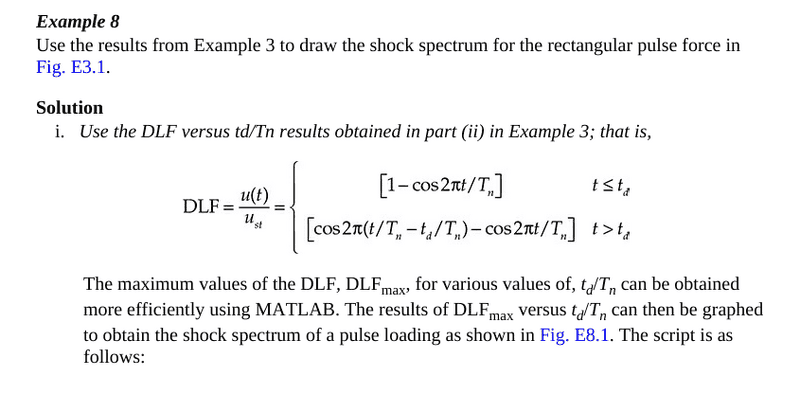
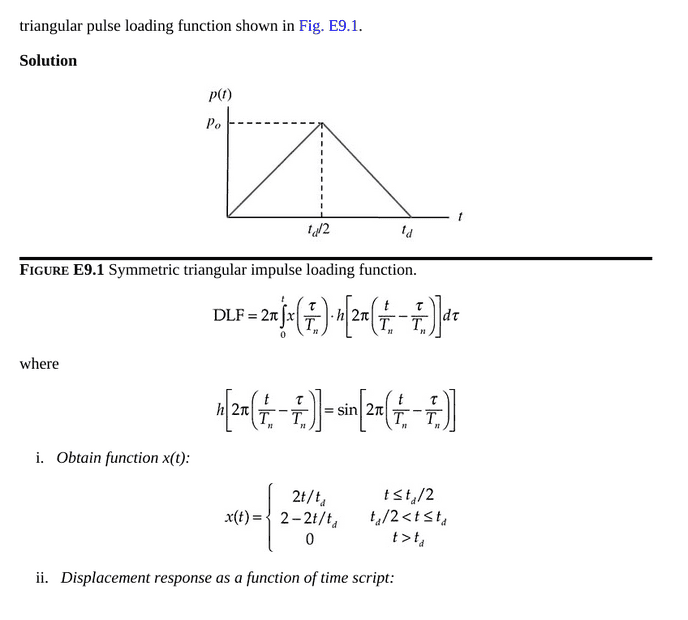
DLF1.png


DLF2.png

DL3.png


So, I am hoping that someone could help me with this?

Many thanks in advance,

Tygra
 
Physics news on Phys.org
Tygra said:
I am currently going through the book called "Essentials of Structural Dynamics" and I have come to a parameter known as the Dynamic Load factor (DLF for short). I am having trouble understanding what this is and how you calculate it for a given problem.
Dynamic load factor quantifies the ratio of the dynamic load to the static load.

Dynamic loads add to the static ones and induce oscillations or waves or abnormal deflections (greater than produced by static loads) in concrete and steel structures.

Experimental testing or analytical methods are usual methods to estimate how much stiffer or stronger a structure must be that it would for resisting static loads only.

Please, see:
https://en.wikipedia.org/wiki/Structural_dynamics

https://en.wikipedia.org/wiki/Dynamic_amplification_factor

https://en.wikipedia.org/wiki/Resonance

"A dynamic load can have a significantly larger effect than a static load of the same magnitude due to the structure's inability to respond quickly to the loading (by deflecting). The increase in the effect of a dynamic load is given by the dynamic amplification factor (DAF) or dynamic load factor (DLF)."

"The natural frequency of a system is dependent only on the stiffness of the structure and the mass which participates with the structure (including self-weight). It is not dependent on the load function.

It is useful to know the modal frequencies of a structure as it allows you to ensure that the frequency of any applied periodic loading will not coincide with a modal frequency and hence cause resonance, which leads to large oscillations."
 

Similar threads

  • · Replies 0 ·
Replies
0
Views
2K
  • · Replies 16 ·
Replies
16
Views
3K
  • · Replies 7 ·
Replies
7
Views
3K
  • · Replies 3 ·
Replies
3
Views
2K
  • · Replies 7 ·
Replies
7
Views
3K
  • · Replies 2 ·
Replies
2
Views
2K
  • · Replies 4 ·
Replies
4
Views
2K
  • · Replies 2 ·
Replies
2
Views
3K
  • · Replies 3 ·
Replies
3
Views
3K
  • · Replies 7 ·
Replies
7
Views
2K