Understanding the Integral of e^x: When is it Equal to xe^x?

  • Thread starter Thread starter robertjford80
  • Start date Start date
  • Tags Tags
    E^x Integral
Join the discussion
Ask a follow-up here, or get your own question answered by working scientists, mathematicians and engineers — people, not an autocomplete.
Real named experts · corrections over time · the nuance an AI answer skips
19 replies · 6K views
robertjford80
Messages
388
Reaction score
0

Homework Statement


I thought sometimes the integral of e^x is xe^x. Under what circumstances is the integral of e^x = xe^x? I think it has something to do with u substitution.
 
on Phys.org
robertjford80 said:

Homework Statement


I thought sometimes the integral of e^x is xe^x. Under what circumstances is the integral of e^x = xe^x? I think it has something to do with u substitution.

Under NO circumstances is the integral of e^x equal to x e^x. I cannot imagine why you think that would hold.

RGV
 
what about the derivative?
 
The derivative of [itex]e^x[/itex] is: [tex]e^x .\frac{d(x)}{dx}[/tex]
 
The derivative of [itex]xe^x[/itex] is, by the product rule [itex](x)'e^x+ (x)(e^x)'= 1(e^x)+ x(e^x)= xe^x+ e^x= (x+ 1)e^x[/itex]. As Ray Vickson said, the integral of [itex]xe^x[/itex] is NOT equal to itself and neither is the derivative.

The only functions having the property that their derivative is equal to the function itself is a constant times [itex]e^x[/itex].
 
HallsofIvy said:
The derivative of [itex]xe^x[/itex] is, by the product rule [itex](x)'e^x+ (x)(e^x)'= 1(e^x)+ x(e^x)= xe^x+ e^x= (x+ 1)e^x[/itex]. As Ray Vickson said, the integral of [itex]xe^x[/itex] is NOT equal to itself and neither is the derivative.

The only functions having the property that their derivative is equal to the function itself is a constant times [itex]e^x[/itex].

I don't think anyone could have explained it better. This should resolve your confusion, robertjford80.
 
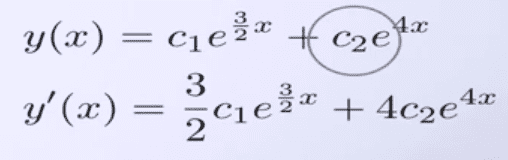
Here's an example

Screenshot2012-05-18at60502PM.png


What's going on here? It clear says that the derivative of

c1e(3/2)x[ = (3/2)c1e(3/2)x
 
so the integral of e^2x is e^2x and the derivative of e^x is e^x but the derivative of e^2x is 2e^2x, is that right?
 
robertjford80 said:
so the integral of e^2x is e^2x and the derivative of e^x is e^x but the derivative of e^2x is 2e^2x, is that right?

Correct, except for the integral of ##e^{2x}## which is ##\frac{e^{2x}}{2}##
 
well, why don't you use the chain rule with e^x which would make it xe^x?


{this referred to number nine's deleted post} i saw it before he deleted it.
 
robertjford80 said:
well, why don't you use the chain rule with e^x which would make it xe^x?


{this referred to number nine's deleted post} i saw it before he deleted it.

The chain rule is to multiply by the derivative, and the derivative of x is 1.

If it helps, d/dx (ex) = 1 * ex
 
thanks villyer, I hadn't thought about that.
 
robertjford80 said:
so the integral of e^2x is e^2x and the derivative of e^x is e^x but the derivative of e^2x is 2e^2x, is that right?

No, the first statement is not right, and is not what you asked originally. The indefinite integral of exp(a*x) for constant a is (1/a)*exp(a*x) + C; the derivative of exp(a*x) is a*exp(a*x). When a = 1 these both give just exp(x). For a = 2 they give (1/2) exp(2x) and 2 exp(2x), respectively.

RGV
 
robertjford80 said:
thanks villyer, I hadn't thought about that.

sharks said:
The derivative of [itex]e^x[/itex] is: [tex]e^x .\frac{d(x)}{dx}[/tex]

That's exactly what i said before.
 
if you're talking about post 4, then i don't think you provided enough info to convey that
 
robertjford80 said:
if you're talking about post 4, then i don't think you provided enough info to convey that
sharks said:
The derivative of [itex]e^x[/itex] is: [tex]e^x .\frac{d(x)}{dx}[/tex]
It's obvious that [itex]\frac{dx}{dx}=1[/itex] which gives [itex]e^x .1=e^x[/itex]. Unless, you didn't know that, but it's really a basic notion of the principles of differentiation.
You should go over the basic principles, as it should help you to understand ##e^x## and the others more complicated that will follow.
 
if it was obvious i would not have posted the question
 
robertjford80 said:
if it was obvious i would not have posted the question

d(ex)/dx = ex

And so

∫ex dx = ___________ ...(i)

Note that integration is just reverse of differentiation.

If you want to verify this , then its simple ! Differentiate the left hand side of equation (i) with respect to x and see if its equal to ex. It will work.

If you want to prove it then analyze it by means of graph of f(x)=ex.

And note if you do this :

d(ex)/d(e) = xex-1

But it can never be xex !
 
Last edited: