SUMMARY
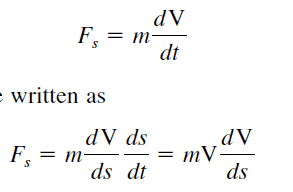
This discussion clarifies the application of the chain rule in thermodynamics, specifically in the context of differentiating a function V that depends on another function s, which in turn depends on time t. The chain rule is applied as follows: if V is a function of s and s is a function of t, then the derivative can be expressed as (dV/dt) = (dV/ds)(ds/dt). This is confirmed through the substitution of u = s(t), leading to the expression (V ∘ s)'(t) = V'(u)u' = (dV/du)(du/dt) = (dV/ds)(ds/dt), demonstrating the correct use of the chain rule in this context.
PREREQUISITES
- Understanding of basic calculus, specifically differentiation
- Familiarity with the chain rule in calculus
- Knowledge of functions and their compositions
- Basic concepts of thermodynamics and its mathematical applications
NEXT STEPS
- Study the application of the chain rule in multivariable calculus
- Explore thermodynamic functions and their derivatives
- Learn about the implications of the chain rule in physical systems
- Investigate examples of function composition in thermodynamic equations
USEFUL FOR
Students and professionals in physics, particularly those studying thermodynamics, as well as mathematicians and engineers who require a solid understanding of calculus and its applications in physical systems.