Understanding Voltage Drop in a Circuit

Click For Summary
SUMMARY

This discussion focuses on understanding voltage drop in a circuit involving resistors R1 and R2. The user initially calculated R1 as 4kΩ and R2 as 1kΩ for a minimum current of 2mA, while the textbook answer states R1 as 5kΩ and R2 as 1kΩ. The conversation highlights the importance of correctly identifying fixed and variable resistances in circuit analysis, as well as the need for clarity in communication regarding corrections to calculations.

PREREQUISITES
  • Basic knowledge of Ohm's Law
  • Understanding of series and parallel resistor configurations
  • Familiarity with voltage drop concepts in electrical circuits
  • Ability to interpret circuit diagrams and values
NEXT STEPS
  • Study Ohm's Law and its applications in circuit analysis
  • Learn about series and parallel resistor combinations
  • Explore voltage drop calculations in more complex circuits
  • Review common mistakes in circuit analysis and how to avoid them
USEFUL FOR

Electrical engineering students, circuit designers, and anyone involved in electronics who seeks to deepen their understanding of voltage drop and resistor behavior in circuits.

Lay1
Messages
44
Reaction score
7
Homework Statement
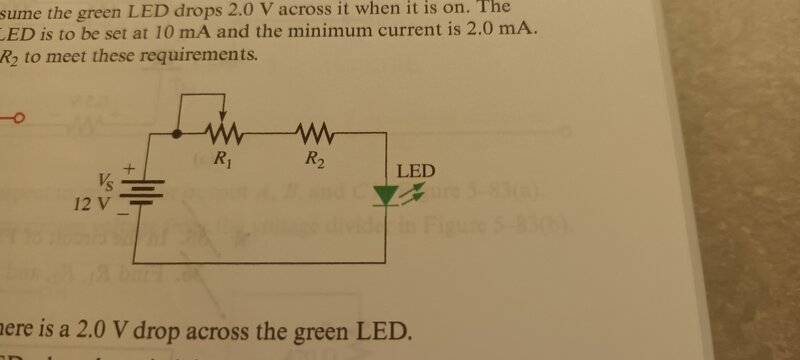
Refer to the figure. Assume the green LED drops 2V across it when it is on. The maximum current in the LED is to be set at 10mA and the minimum current is 2mA. Choose values for R1 and R2 to meet these requirements.
Relevant Equations
V=IR
Here is the figure mentioned above.
20230413_182850.jpg

My thinking is that for maximum current, resistance must be minimum. Thus, R1 is not considered which means the voltage drop of R2 is 10V. So, R2 is 1kohm. For minimum, I=2mA, so R1+R2=5kohm, since R2 is 1kohm, R1 must be 4kohm. This is how I deduce. However, the answer shows that R1=5kohm while R2 is 1kohm. I do not understand why it is so. Could someone help me explain why? Thank you as always.
 
Last edited:
Physics news on Phys.org
Lay1 said:
For minimum, I=2A, so R1+R2=5kohm, since R1 is 1kohm, R2 must be 4kohm. This is how I deduce.
Change the I=2A typo to I=2mA and I agree with you. I think the solution's answer for the minimum current case is incorrect.
 
Lay1 said:
Thus, R1 is not considered which means the voltage drop of R2 is 10V. So, R1 is 1kohm
R1 is not considered and R1 is 1kohm?
 
cnh1995 said:
R1 is not considered and R1 is 1kohm?
Oh, good catch. Another typo! :smile: Yeah, we need the OP to add a reply with the R1/R2 stuff cleaned up.
 
berkeman said:
Change the I=2A typo to I=2mA and I agree with you. I think the solution's answer for the minimum current case is incorrect.
Thank you for your guidance. And also thank you for your confirmation.
 
cnh1995 said:
R1 is not considered and R1 is 1kohm?
I am really sorry for my careless mistake. And thank your for your correction.
 
Lay1 said:
Thank you for your guidance. And also thank you for your confirmation.
Wait, did you see where there are other typos as well? Please reply with the correct values for R1 and R2, where R2 is the fixed resistance to define the maximum current, and R1 is the variable resistance to define the minimum current when added to R2.
 
berkeman said:
Oh, good catch. Another typo! :smile: Yeah, we need the OP to add a reply with the R1/R2 stuff cleaned up.
I have already fixed. Sorry for your inconvinience.
 
berkeman said:
Wait, did you see where there are other typos as well? Please reply with the correct values for R1 and R2, where R2 is the fixed resistance to define the maximum current, and R1 is the variable resistance to define the minimum current when added to R2.
My answer: R1=4kohms and R2=1kohm
The textbook answer: R1=5kohms and R2=1kohm
 
  • #10
Lay1 said:
I have already fixed. Sorry for your inconvinience.
Oh, okay, I see that now. I still agree with the two values you calculated.

For future reference, it's usually best to add a reply to correct any typos that have been mentioned in your Original Post (OP). Otherwise the replies afterward that point out the typos can be confusing for others reading the thread later. It's okay to leave it as-is for now.
 
  • Like
Likes   Reactions: DeBangis21
  • #11
berkeman said:
Oh, okay, I see that now. I still agree with the two values you calculated.

For future reference, it's usually best to add a reply to correct any typos that have been mentioned in your Original Post (OP). Otherwise the replies afterward that point out the typos can be confusing for others reading the thread later. It's okay to leave it as-is for now.
I will be careful in future and I will reply as you have explained. Thank you for your understanding and answer.
 
  • Like
Likes   Reactions: Tom.G and berkeman

Similar threads

  • · Replies 4 ·
Replies
4
Views
2K
Replies
4
Views
2K
Replies
5
Views
726
  • · Replies 10 ·
Replies
10
Views
2K
  • · Replies 4 ·
Replies
4
Views
2K
  • · Replies 3 ·
Replies
3
Views
2K
  • · Replies 3 ·
Replies
3
Views
2K
  • · Replies 11 ·
Replies
11
Views
2K
  • · Replies 6 ·
Replies
6
Views
3K
  • · Replies 1 ·
Replies
1
Views
3K