Understanding Yield Strength & Stress Strain Curve

Click For Summary
SUMMARY

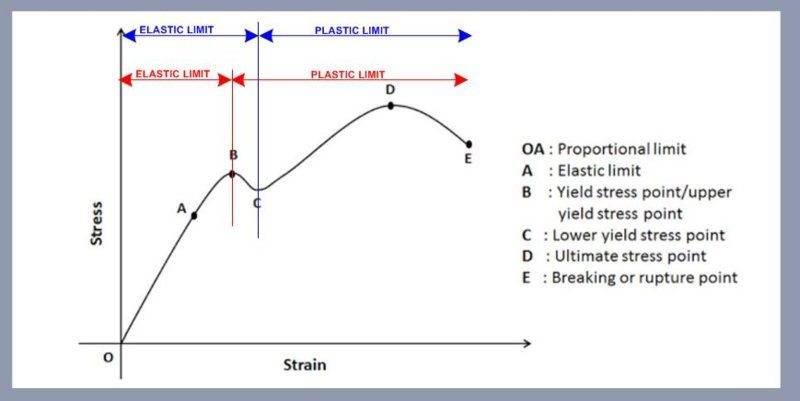
Yield strength is defined as the maximum stress a material can withstand before undergoing plastic deformation. The Yield Point marks the transition between elastic and plastic deformation on the stress-strain curve. In the discussion, two Yield Stress Points, labeled B and C, are identified, with point B indicating the onset of plastic deformation. The limits in red on the graph represent the plastic deformation zone, while the blue limits illustrate the relationship based on the actual area of the material.

PREREQUISITES
  • Understanding of stress-strain curves
  • Knowledge of material properties, specifically yield strength
  • Familiarity with concepts of elastic and plastic deformation
  • Basic grasp of work hardening in materials
NEXT STEPS
  • Research the differences between elastic and plastic deformation in materials
  • Study the implications of work hardening on yield strength
  • Explore the significance of the ultimate strength in stress-strain analysis
  • Examine various materials' stress-strain curves for practical applications
USEFUL FOR

Materials scientists, mechanical engineers, and students studying material mechanics will benefit from this discussion on yield strength and stress-strain curves.

tomtomtom1
Messages
160
Reaction score
8
Hi all

I was hoping someone could shed some light on the following:-

I am trying to understand what Yield strength is and understand the exact limit of where elastic and plastic deformation occurs on a stress strain curve.

Correct me if I am wrong but I define:-

Yield strength as the amount of stress a material can undergo before it deforms plastically.

Yield Point
is the point on the stress strain graph where Elastic deformation ends and Plastic deformation begins.

Would you agree with the above definitions, the reason why I ask is because on a stress strain curve (as shown below), we have 2 x Yield Stress Points shown as B and C.

1) what is the difference between these points.
2) where would the elastic and plastic limits commence from, the limits in Red or the limits in Blue?

ttttttt.JPG
 

Attachments

  • ttttttt.JPG
    ttttttt.JPG
    23.2 KB · Views: 9,927
Engineering news on Phys.org
I think the portion of the curve after point B is caused by work hardening of the material during elongation.
 
This graph from Wikipedia, might help you understand it better:

Stress_v_strain_A36_2.svg

Where:
Pass point 2 (B on your graph), you are in the plastic deformation zone (thus, the limits in red on your graph would make sense). It is interesting to see the same stress-strain curve based on the actual area ##A## instead of the initial area ##A_0## (blue line B). Even though the relationship is not as linear in the plastic zone, it still requires an increase of the actual stress to get an increase in strain.

I can't explain why they wrote the limits in blue on your graph.
 
  • Like
Likes   Reactions: Chestermiller

Similar threads

Replies
5
Views
1K
  • · Replies 2 ·
Replies
2
Views
4K
  • · Replies 9 ·
Replies
9
Views
3K
  • · Replies 3 ·
Replies
3
Views
5K
  • · Replies 1 ·
Replies
1
Views
2K
  • · Replies 16 ·
Replies
16
Views
3K
  • · Replies 5 ·
Replies
5
Views
2K
Replies
8
Views
2K
  • · Replies 2 ·
Replies
2
Views
3K