Understanding Zero-G Flight Physics: How Men Navigate Curved Paths in Airplanes

  • Context: Undergrad 
  • Thread starter Thread starter Aeronautic Freek
  • Start date Start date
  • Tags Tags
    Flight Physics
Click For Summary

Discussion Overview

The discussion centers around the physics of zero-gravity flight in airplanes, specifically how occupants navigate curved paths without touching the walls of the aircraft. Participants explore concepts related to centripetal force, gravity, and the dynamics of motion within a falling airplane.

Discussion Character

  • Exploratory
  • Technical explanation
  • Debate/contested

Main Points Raised

  • Some participants question how occupants do not touch the walls of the airplane when it follows a curved path, suggesting that they move along the same trajectory as the plane.
  • Others propose that gravity is the primary force acting on the occupants, rather than centripetal force, and that the plane does not exert a force on them once it enters a ballistic path.
  • A participant illustrates the concept with an analogy involving balls thrown by friends, emphasizing that all objects share the same velocity and are subject to the same gravitational pull.
  • One participant explains that when the plane follows a parabolic arc, the occupants experience a state of free fall, which creates the sensation of weightlessness.
  • Another participant mentions a practical example from NASA's "Vomit Comet," describing how pilots fine-tune their descent to maintain zero-g conditions, using a metal nut as a visual aid for adjustments.
  • Concerns are raised about the misconception that the airplane shields occupants from gravity, clarifying that gravity acts on them regardless of the plane's presence.
  • Some participants discuss the need for the plane to manage air resistance to maintain the zero-g experience, indicating that it must adjust its engines to counteract drag.

Areas of Agreement / Disagreement

Participants express multiple competing views regarding the forces at play during zero-g flight, particularly concerning the role of gravity and centripetal force. The discussion remains unresolved, with no consensus reached on the mechanics involved.

Contextual Notes

Participants highlight various assumptions, such as the effects of air resistance and the initial conditions of motion. There is also mention of the dependence on the specific flight path taken by the airplane.

Aeronautic Freek
Messages
121
Reaction score
7
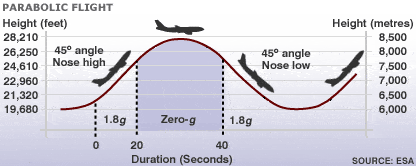
Men in airplane goes in curve path during ZeroG..So how men do not touch neither walls of airplane if plane fly in curve path?
Where is now centripetal force force which drive men in curved path?
_42862923_parabolic_flight416.gif


Last edited:
Science news on Phys.org
Aeronautic Freek said:
Where is now centripetal force force which drive men in curved curved path.
It's gravity.

[and it is primarily not centripetal.]
 
Aeronautic Freek said:
So how men do not touch neither walls of airplane if plane fly in curve path?
The men move on the same curved path as the plane.
 
  • Like
Likes   Reactions: russ_watters
Get yourself and two friends and stand shoulder to shoulder. Throw balls simultaneously forwards at the same speed and upward angle. Why don't the three balls collide? Because they're traveling at the same velocity and the same gravity is pulling them in the same direction. Ditto the guys in the plane.
 
A.T. said:
The men move on the same curved path as the plane.
yes I know ,but why when men leave floor not hit on upper part of airplane walls,plane goes in "circle" so how plane transfer force to drive men in circle?with air inside?
 
Aeronautic Freek said:
yes I know ,but why when men leave floor not hit on upper part of airplane walls,plane goes in "circle" so how plane transfer force to drive men in circle?with air inside?
The plane doesn't go in a circle.

A falling person follows a parabolic (ballistic) path to the ground.
If the plane is careful to dive along that parabolic path, the person inside will not experience any relative motion with respect to the plane. He will appear to float.

It's exactly like an elevator in free fall, just without the horizontal component.
 
  • Like
Likes   Reactions: Lnewqban
Aeronautic Freek said:
...so how plane transfer force to drive men in circle?with air inside?
It's still gravity. The plane is not applying a force on the people inside.
 
The men are initially sitting on the floor and are accelerated to flight speed by the plane. Once the plane enters its ballistic path, the men share its initial diagonally upwards velocity. They are no longer pushed by the plane because it is decelerating at the same rate they are - they all follow the same ballistic trajectory, just like the balls in my earlier example. The passengers can then drift around the cabin by giving themselves a slight extra acceleration by kicking off the walls.
 
  • Like
Likes   Reactions: Lnewqban
Aeronautic Freek said:
yes I know ,but why when men leave floor not hit on upper part of airplane walls,plane goes in "circle" so how plane transfer force to drive men in circle?with air inside?
Their paths have the same shape, so there is no relative movement, so they don't collide.
 
  • #10
Aeronautic Freek said:
but why when men leave floor not hit on upper part of airplane walls
As already said, the plane follows a parabolic arc down, just like the occupants would follow in free-fall given their initial forward and downward velocities.

Maybe this will help -- my ex-wife flew on that "Vomit Comet" as part of her work for NASA, and she told me afterwards about a MacGyver setup that the pilots used to fine tune their downward parabolic path to set and hold zero-g in the aircraft on the descents. They had a metal nut hanging from the ceiling on a string in the cockpit, and as they started their dive, they watched the nut. They initially dove enough to start to make the nut float (the string was no longer taut), and then fine tuned their dive profile to keep the metal nut floating in the cockpit.

So what the pilots were doing to keep the nut floating in the cockpit was the same thing that was happening to the occupants in the main body of the plane. Everything was floating at zero-g in the plane, except for the pilots who were obviously belted in tightly in the cockpit like all good pilots. :smile:
 
Last edited:
  • Like
Likes   Reactions: sophiecentaur
  • #11
berkeman said:
They had a metal nut hanging from a string in the cockpit from the ceiling
I love analogue computation. :smile:
 
  • Like
Likes   Reactions: berkeman and sophiecentaur
  • #12
Aeronautic Freek said:
... so how plane transfer force to drive men in circle? with air inside?
Maybe your misconception is that the hull of the airplane is shielding the men from gravity, so the downwards force must be transmitted to them via contact forces? Gravity acts on the men inside the plane, just as if the plane wasn't there. The plane just needs to fall with them, so it's walls are not in the way.

In more detail: The plane cannot just rely on gravity alone, because of air resistance. It hast to tune the engines to exactly cancel the drag. For the men inside the air falls with them, so they don't approach terminal velocity like skydivers.
 
  • Like
Likes   Reactions: sophiecentaur

Similar threads

  • · Replies 9 ·
Replies
9
Views
3K
  • · Replies 122 ·
5
Replies
122
Views
13K
  • · Replies 27 ·
Replies
27
Views
7K
  • · Replies 81 ·
3
Replies
81
Views
13K
  • · Replies 8 ·
Replies
8
Views
3K
  • · Replies 33 ·
2
Replies
33
Views
6K
  • · Replies 3 ·
Replies
3
Views
2K
  • · Replies 6 ·
Replies
6
Views
2K
  • · Replies 33 ·
2
Replies
33
Views
5K
Replies
37
Views
6K