Units of a vector in a velocity vs time graph?

  • Context: Undergrad 
  • Thread starter Thread starter Joseph M. Zias
  • Start date Start date
  • Tags Tags
    Magnitude Polar Vector
Click For Summary

Discussion Overview

The discussion revolves around the interpretation of vector magnitudes in a velocity vs time graph, specifically addressing the physical meaning and units associated with such vectors. Participants explore the implications of combining different physical dimensions and the validity of using vector representations in this context.

Discussion Character

  • Debate/contested
  • Conceptual clarification
  • Mathematical reasoning

Main Points Raised

  • Some participants assert that the area under a velocity vs time graph represents distance and the slope represents acceleration, but question the units of a vector magnitude derived from these dimensions.
  • One participant argues that combining different physical dimensions (velocity and time) in the form of V^2 + t^2 is meaningless without a dimensionless transformation.
  • Another participant suggests that while vectors can have magnitudes, not all vectors necessarily conform to the Pythagorean theorem, emphasizing the importance of vector addition rules.
  • Some participants propose that it is possible to represent a vector in the velocity vs time context, using specific numerical examples to illustrate their points, although the physical meaning of such a representation is questioned.
  • There are discussions about the nature of vectors in different contexts, such as Euclidean geometry versus thermodynamic state spaces, highlighting that the definition and interpretation of vectors can vary significantly.
  • One participant emphasizes that drawing a vector in a 2D graph does not imply it forms a vector space unless the dimensions are equivalent.

Areas of Agreement / Disagreement

Participants express multiple competing views regarding the validity and physical meaning of vector magnitudes in the context of a velocity vs time graph. There is no consensus on whether such vectors can be meaningfully defined or represented.

Contextual Notes

Participants note that the discussion involves unresolved mathematical steps and the dependence on definitions of physical dimensions. The implications of combining different units and the conditions under which vectors can be defined remain unclear.

Joseph M. Zias
Messages
87
Reaction score
30
This post parallels a post I made in electrical engineering regarding the S plane. I thought I would post an equivalent in basic physics.
So, given a graph of velocity vs time we have on the vertical axis meters/sec and the hormonal axis just meters. Given a plot of V vs t we know the area under the curve is equal to distance and the slope of the curve is acceleration. What would be the units of the magnitude of a vector (polar form) on the graph. Lets say M = square root (V^2 + t^2). What is the unit of M.
 
Physics news on Phys.org
V and t have different physical dimension so V^2+t^2 is meaningless.

By using dimensionless quantity
V^*=\frac{V}{V_{unit}}
t^*=\frac{t}{t_{unit}}
we can transfer it to pure mathematics which enables V*^2+t*^2 , but I do not think it is of your interest.
 
Last edited:
Joseph M. Zias said:
What would be the units of the magnitude of a vector (polar form) on the graph.
What is that magnitude supposed to represent physically?
 
Not all vectors have a magnitude.
And for those that do, it doesn't have to be associated with the Pythagorean theorem.

The most important feature of a vector is the parallelogram rule of addition.,
not "something with a magnitude and direction".
 
It seems we can use magnitude for a V vs t vector. Suppose we have V=5m/s and t=5s. We then have M=square root 50. Now if we start with M=square root 50, angle 45, and disassemble it to an x and y component we would, of course, have t=5 seconds and y=5 m/s. We have just spread out the square root of 50 whatever, assigning part to t and part to V in the appropriate amounts. Thus the whatever becomes t for the x component and V for the y component. I have never seen a physics text address this, but I would not doubt is was covered in some advanced mathematics.
 
Math doesn't work that way.
 
Please explain.
 
https://en.wikipedia.org/wiki/Euclidean_vector#Euclidean_and_affine_vectors
However, it is not always possible or desirable to define the length of a vector. This more general type of spatial vector is the subject of vector spaces (for free vectors) and affine spaces (for bound vectors, as each represented by an ordered pair of "points"). One physical example comes from thermodynamics, where many quantities of interest can be considered vectors in a space with no notion of length or angle.

https://en.wikipedia.org/wiki/Vector_space
In mathematics and physics, a vector space (also called a linear space) is a set whose elements, often called vectors, may be added together and multiplied ("scaled") by numbers called scalars. Scalars are often real numbers, but can be complex numbers or, more generally, elements of any field. The operations of vector addition and scalar multiplication must satisfy certain requirements, called vector axioms.


https://en.wikipedia.org/wiki/Vector_space#Vector_spaces_with_additional_structure

Normed vector spaces and inner product spaces​

"Measuring" vectors is done by specifying a norm, a datum which measures lengths of vectors, or by an inner product, which measures angles between vectors. Norms and inner products are denoted |𝑣|
{\displaystyle |\mathbf {v} |}
and ⟨𝑣,𝑤⟩,
{\displaystyle \langle \mathbf {v} ,\mathbf {w} \rangle ,}
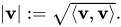
respectively. The datum of an inner product entails that lengths of vectors can be defined too, by defining the associated norm |𝑣|:=⟨𝑣,𝑣⟩.
{\textstyle |\mathbf {v} |:={\sqrt {\langle \mathbf {v} ,\mathbf {v} \rangle }}.}
Vector spaces endowed with such data are known as normed vector spaces and inner product spaces, respectively.
 
Joseph M. Zias said:
Please explain.
m/s and m are different physical units. There is simply no possible meaning in adding their squares. You cannot add 5 kg to 3 meters. It simply has no meaning.
 
  • #10
It seems that in the case of Velocity vs time we can draw the graph and calculate distance or acceleration but are we then also saying that is not permissible to draw a vector since the magnitude is is undefined or not permitted?
My similar question in the EE group regarding the S plane seems to have resolved as both axis can be shown to have units of sec^-1 and that can be added. Vectors are routinely used in that case.
 
  • #11
Just because you can draw it in 2D does not mean it is a vector space.
 
  • #12
Joseph M. Zias said:
It seems that in the case of Velocity vs time we can draw the graph and calculate distance or acceleration but are we then also saying that is not permissible to draw a vector since the magnitude is is undefined or not permitted?
You can draw it, but is has no physical meaning. Unless you define some transformation, that makes the dimensions of the axes equivalent. Like when space and time where combined into space-time via the factor c.

Joseph M. Zias said:
My similar question in the EE group regarding the S plane seems to have resolved as both axis can be shown to have units of sec^-1 and that can be added. Vectors are routinely used in that case.
No problem If the axes have the same dimension.
 
  • #13
Below, I draw ##\vec w = \vec u + \vec v##,
where ##\vec u## is one horizontal unit and ##\vec v## is one vertical unit.

1720898585817.png


Q: What is the magnitude of the vector sum ##\vec w##?
A: It depends.
 
Last edited:
  • #14
robphy said:
Are these vectors "displacements on a PV-diagram in thermodynamics"
It should be noted that thermodynamic state space is generally not a vector space - it is typically a differentiable manifold. As such, displacements of a thermodynamic state belong to the tangent space of the current state, which is a vector space, but differs from state to state.

It is perfectly possible to have base vectors of different physical dimension as long as the tensorial quantities one constructs take this properly into account. For example, the coordinate base vectors in polar coordinates on the Euclidean plane, i.e., ##\partial_r## and ##\partial_\varphi## have physical dimension 1/L and 1, respectively, but still span the same tangent spaces as the regular Cartesian base vectors.
 

Similar threads

  • · Replies 49 ·
2
Replies
49
Views
4K
  • · Replies 25 ·
Replies
25
Views
4K
  • · Replies 7 ·
Replies
7
Views
2K
  • · Replies 13 ·
Replies
13
Views
2K
  • · Replies 9 ·
Replies
9
Views
824
  • · Replies 5 ·
Replies
5
Views
3K
  • · Replies 3 ·
Replies
3
Views
2K
  • · Replies 1 ·
Replies
1
Views
8K
  • · Replies 63 ·
3
Replies
63
Views
4K
  • · Replies 8 ·
Replies
8
Views
7K