Use of the Stefan Boltzmann Law in a Non Equilibrium system?

Click For Summary
SUMMARY

The discussion focuses on the application of the Stefan-Boltzmann Law in non-equilibrium thermodynamics, specifically regarding a metal block heated by a laser in a vacuum. It is established that while the Stefan-Boltzmann Law, which states that energy emitted is proportional to the fourth power of temperature (E ~ T^4), is derived from Planck's Radiation Law assuming equilibrium, it can still be applied in this scenario. The key takeaway is that the block's radiation can be described by the Stefan-Boltzmann Law as long as the power absorbed equals the power radiated, despite the surrounding vacuum being in a non-equilibrium state.

PREREQUISITES
  • Understanding of non-equilibrium thermodynamics
  • Familiarity with the Stefan-Boltzmann Law
  • Knowledge of Planck's Radiation Law
  • Basic principles of thermal radiation
NEXT STEPS
  • Research the implications of non-equilibrium thermodynamics on thermal radiation
  • Study the derivation and applications of Planck's Radiation Law
  • Explore advanced concepts in thermodynamic equilibrium
  • Investigate experimental setups for measuring radiation in vacuum conditions
USEFUL FOR

This discussion is beneficial for physicists, thermodynamics researchers, and engineers working with thermal systems, particularly those interested in the behavior of materials under non-equilibrium conditions.

colorofeternity
Messages
2
Reaction score
0
TL;DR
Is it possible to be able to use the Stefan Boltzmann law for a system which is being constantly heated and is in contact with a perfect vacuum (T = 0K).
Hi everyone,

I am currently trying to work something out in regards to non-equilibrium thermodynamics. If I have a block of metal in vacuum that is being heated by a laser with a constant power P, is it even possible to be able to describe the emission of radiation by the block via the Stefan Boltzmann law (ie E ~ T^4).
The reason why I ask this is that the Stefan-Boltzmann law can be derived from Planck's Radiation law which implicitly assumes that the system is in equilibrium with its surrounding. Clearly that is not occurring in this problem. Any suggestions for what should be used?
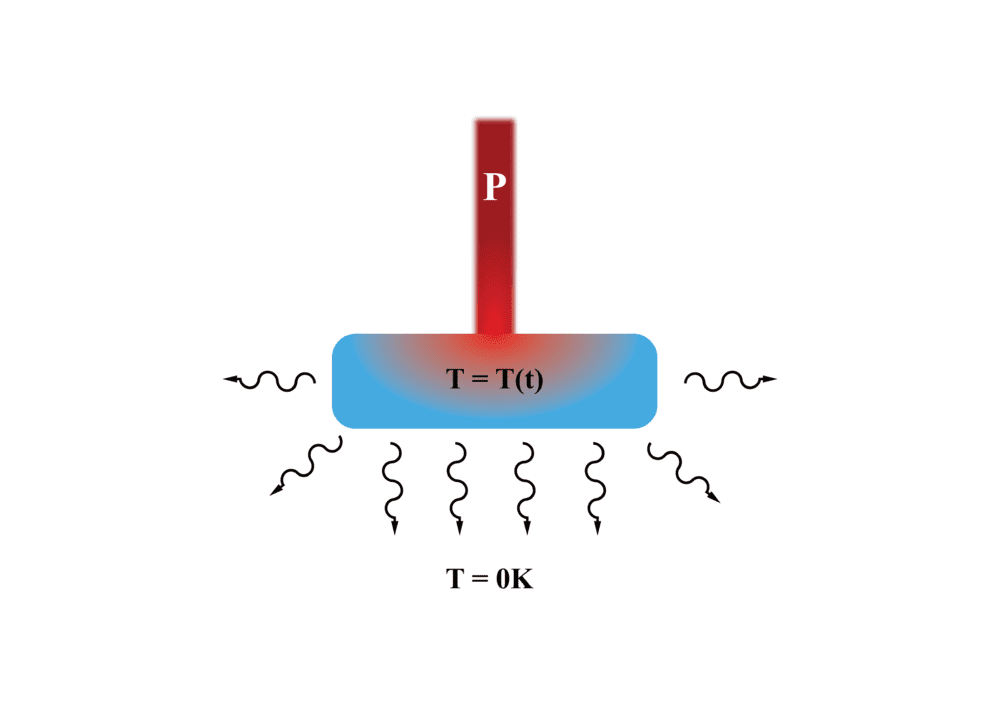
Target_heating.png
 
Science news on Phys.org
A body that radiates energy at the same rate that it absorbs energy will be in thermodynamic equilibrium. The body only needs to be in thermodynamic equilibrium in its surroundings. The surroundings do not have to be in an equilibrium state. The surroundings consist of everything external to the body i.e the universe, which is not in equilibrium. If the block is surrounded by a vacuum, it is not "in contact" with anything. All that matters is that the total power of the radiation incident on the block is equal to the power that is radiated by the block into space.

AM
 
Last edited:

Similar threads

  • · Replies 3 ·
Replies
3
Views
2K
  • · Replies 7 ·
Replies
7
Views
788
  • · Replies 6 ·
Replies
6
Views
2K
  • · Replies 9 ·
Replies
9
Views
2K
  • · Replies 14 ·
Replies
14
Views
2K
  • · Replies 1 ·
Replies
1
Views
2K
  • · Replies 17 ·
Replies
17
Views
4K
  • · Replies 5 ·
Replies
5
Views
2K
  • · Replies 17 ·
Replies
17
Views
4K
  • · Replies 3 ·
Replies
3
Views
966