V & I in Circuit w/ Diodes: Step-by-Step Guide

  • Context: Engineering 
  • Thread starter Thread starter Tekneek
  • Start date Start date
  • Tags Tags
    Circuit Diodes
Click For Summary
SUMMARY

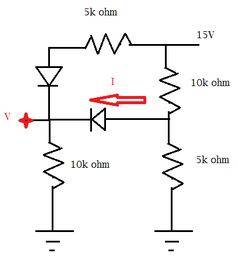
The discussion focuses on analyzing a circuit with two diodes, each having a forward voltage drop of 0.7 volts. Participants suggest a systematic approach of assuming each diode is either conducting or non-conducting, leading to four possible circuit combinations. By redrawing the circuit and estimating node voltages, users can identify which diodes are actually conducting based on voltage consistency. The conversation emphasizes the importance of using realistic diode models and the potential complexity when voltages are near the forward voltage threshold.

PREREQUISITES
  • Understanding of diode characteristics, specifically forward voltage drop of 0.7 volts
  • Basic circuit analysis techniques, including voltage dividers
  • Familiarity with circuit simulation tools for complex analysis
  • Knowledge of assumptions in circuit analysis, particularly regarding diode states
NEXT STEPS
  • Learn about diode modeling in circuit simulations using tools like LTspice or Multisim
  • Explore advanced circuit analysis techniques, including mesh and nodal analysis
  • Study the impact of temperature on diode forward voltage characteristics
  • Investigate practical applications of diodes in rectifier circuits and their analysis
USEFUL FOR

Electrical engineering students, circuit designers, and hobbyists interested in understanding diode behavior in circuits and improving their circuit analysis skills.
Tekneek
Messages
70
Reaction score
0
I have to find the V and I in the following Circuit.

5fg2gh.jpg


I am not sure how to approach this problem. If someone can help me with this step by step it will be great.

Assume Forward voltage drop of 0.7 volts
 
Last edited:
Physics news on Phys.org
There are two diodes. You could start by assuming that each diode is either conducting/on or off. That gives you four combinations. Redraw each of the four circuits replacing diodes that are on with a short circuit and off with an open circuit.

Roughly calculate or estimate the voltages on the various nodes to see if they are consistent with the diode being in the state for that circuit. Some of the four combinations will turn out to be inconsistent with your assumption about the state of the diode and can be discounted.

Once you figure out which diodes are conducting/not it should be easier.
 
CWatters said:
There are two diodes. You could start by assuming that each diode is either conducting/on or off. That gives you four combinations. Redraw each of the four circuits replacing diodes that are on with a short circuit and off with an open circuit.

Roughly calculate or estimate the voltages on the various nodes to see if they are consistent with the diode being in the state for that circuit. Some of the four combinations will turn out to be inconsistent with your assumption about the state of the diode and can be discounted.

Once you figure out which diodes are conducting/not it should be easier.

I forgot to add that we are assuming the diodes have forward voltage drop of 0.7 volts, would that change anything?
 
Tekneek said:
I forgot to add that we are assuming the diodes have forward voltage drop of 0.7 volts, would that change anything?
The approach is exactly the same.
 
NascentOxygen said:
The approach is exactly the same.

But what does it mean by it by
CWatters said:
consistent with the diode being in the state for that circuit. Some of the four combinations will turn out to be inconsistent with your assumption about the state of the diode

How would you account for the voltage drops because of diodes if I make them short circuit and open circuit?
 
Last edited:
Well, if you assume that a diode is non-conducting and analyze the circuit voltages based on that assumption, you may find that the voltage across that diode is such that it is forward-biased. If it is forward-biased, then your assumption that it is non-conducting must be wrong.

A realistic diode model is where the diode is represented by a fixed 0.7v drop, when conducting.
 
So now you have enough information to write some equations. Please show us your work.
 
NascentOxygen said:
Well, if you assume that a diode is non-conducting and analyze the circuit voltages based on that assumption, you may find that the voltage across that diode is such that it is forward-biased. If it is forward-biased, then your assumption that it is non-conducting must be wrong.

A realistic diode model is where the diode is represented by a fixed 0.7v drop, when conducting.

I think I get it, but do i really have to do this every single time. Like making assumptions about 4 combinations?
 
Tekneek said:
I think I get it, but do i really have to do this every single time. Like making assumptions about 4 combinations?

In general, yes, unless you can use your experience and intuition to judge whether the individual diodes are probably on or not. In this circuit it gets easier...
 
  • #10
berkeman said:
So now you have enough information to write some equations. Please show us your work.

Well I assumed both of the diodes were conducting. As a result, I find that the voltage across 5k resistor (on the right side) is lower than voltage across 10k resistor (on the left side). Since current flows from high potential to lower potential, current cannot flow through the diode in the middle from right to left. Meaning, the diode in the middle is off.

And I used voltage divider to find the voltages.
 
  • #11
Tekneek said:
Well I assumed both of the diodes were conducting. As a result, I find that the voltage across 5k resistor (on the right side) is lower than voltage across 10k resistor (on the left side). Since current flows from high potential to lower potential, current cannot flow through the diode in the middle from right to left. Meaning, the diode in the middle is off.

And I used voltage divider to find the voltages.

Good. Sounds like you got it right.
 
  • #12
How would you account for the voltage drops because of diodes if I make them short circuit and open circuit?

Start by assuming they are ideal diodes with no forward voltage drop. With luck the voltages across the diodes will be such that it's obvious which ones are on or off.

If the voltages across the diodes turn out to be close to the forward voltage then it's not so clear if the diode is on or off and the problem gets quite a bit harder. In some cases it's easier to model the circuit in an simulator than to try solving the maths yourself.
 

Similar threads

  • · Replies 1 ·
Replies
1
Views
1K
  • · Replies 20 ·
Replies
20
Views
5K
  • · Replies 1 ·
Replies
1
Views
2K
  • · Replies 15 ·
Replies
15
Views
7K
Replies
15
Views
2K
  • · Replies 6 ·
Replies
6
Views
2K
  • · Replies 5 ·
Replies
5
Views
9K
  • · Replies 1 ·
Replies
1
Views
1K
  • · Replies 10 ·
Replies
10
Views
2K
Replies
9
Views
2K