walking
- 73
- 8
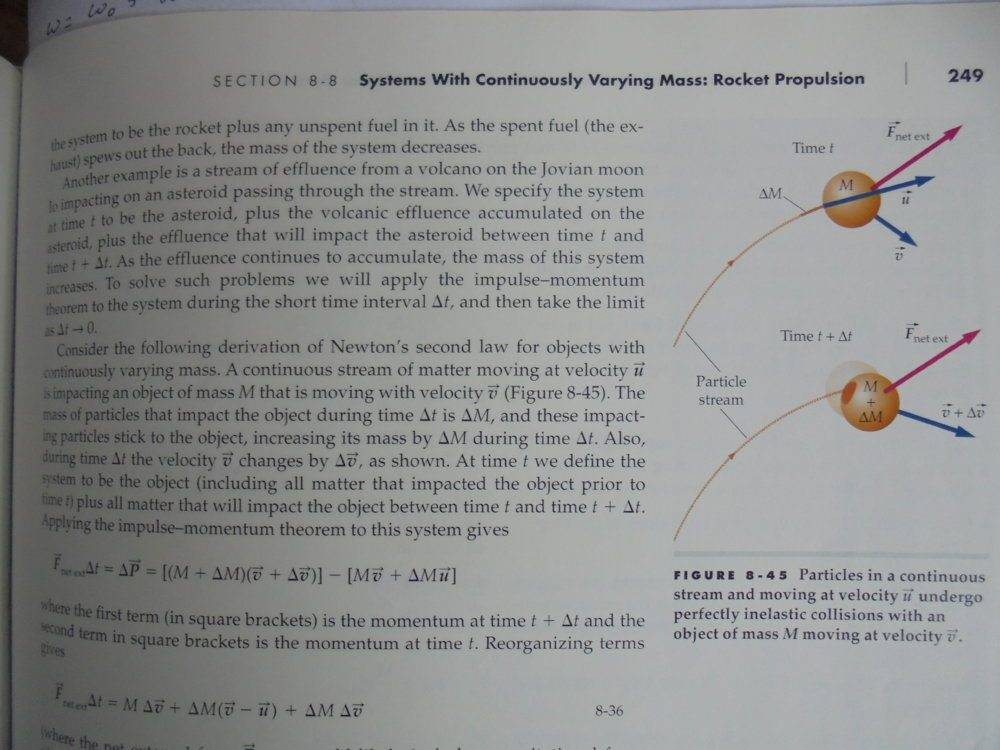
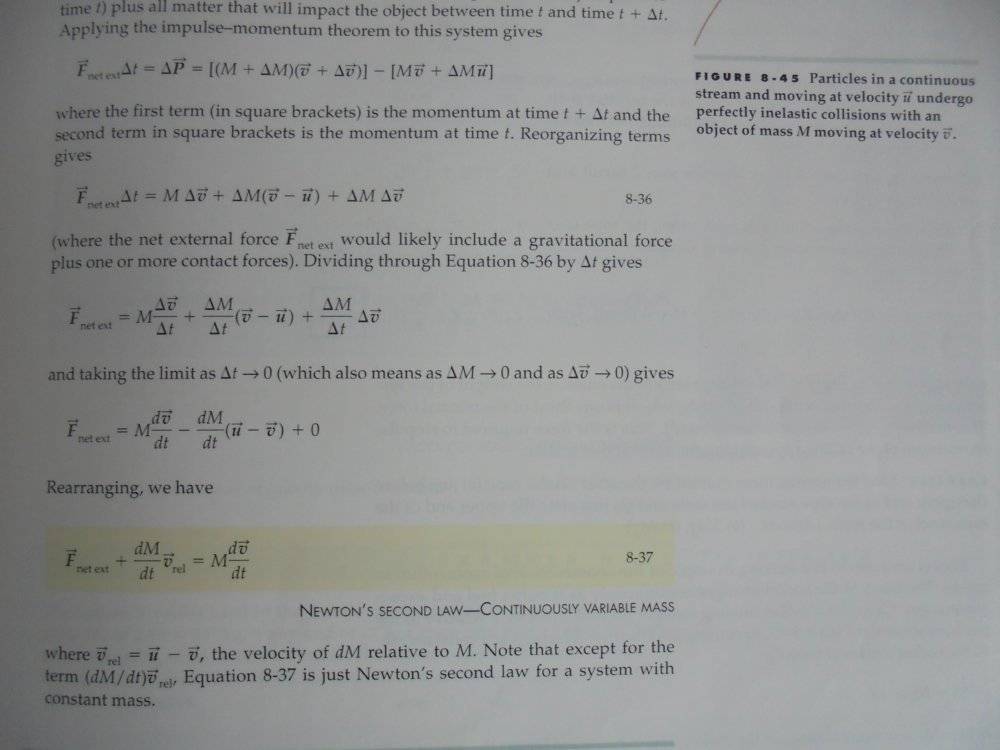
In the book by Tipler & Mosca, the section on F=ma for variable mass derives the following equation:
##\mathbf{F}_{ext}+\frac{dM}{dt} \mathbf{v}_{rel}=M\frac{d\mathbf{v}}{dt}##
where ##\mathbf{F}_ext## is the external force on the system as a whole (ie not just the variable mass sub-system, but the system as a whole), ##\frac{dM}{dt}## is the rate at which the mass of the variable mass sub-system is changing, ##\mathbf{v}_{rel}## is the velocity of the changing mass (whether incoming or outgoing) relative to the variable mass subsystem, ##M## is the mass of the variable mass subsystem at time t, and finally, ##\mathbf{v}## is the velocity of the variable mass subsystem at time t.
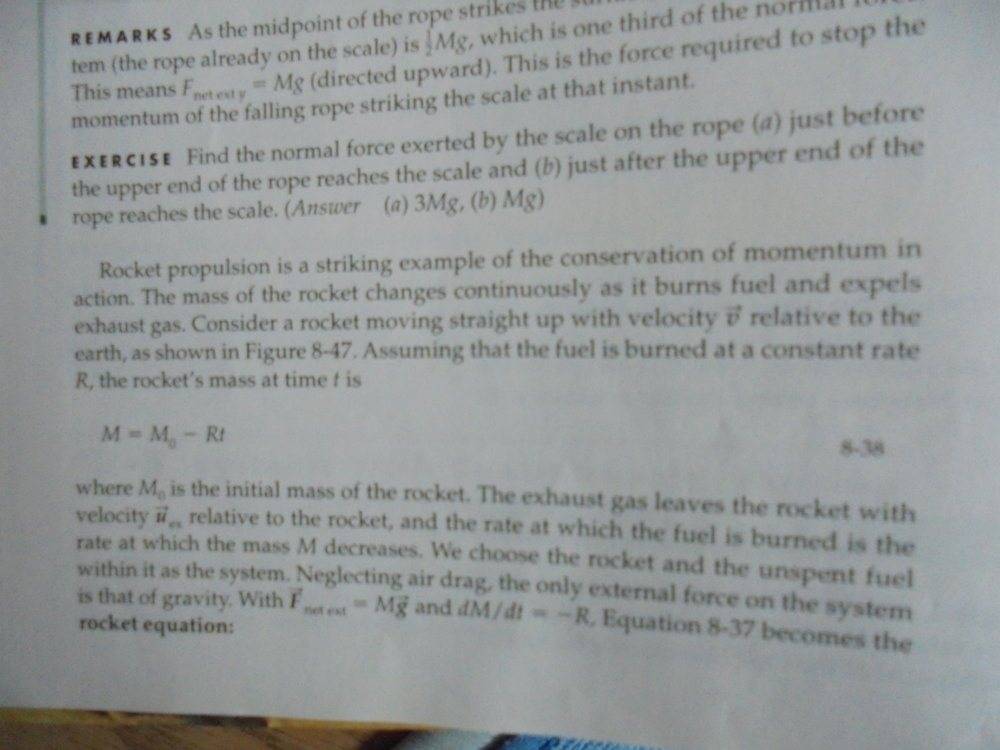
Now I may have misunderstood this equation, but if not then I am slightly confused as to the authors's subsequent derivation of the rocket equation. When deriving this latter equation, they seem to interpret the general variable mass equation completely differently, and ##F_{Ext}## no longer represents the total external force on the system for example. Here is their rocket equation:
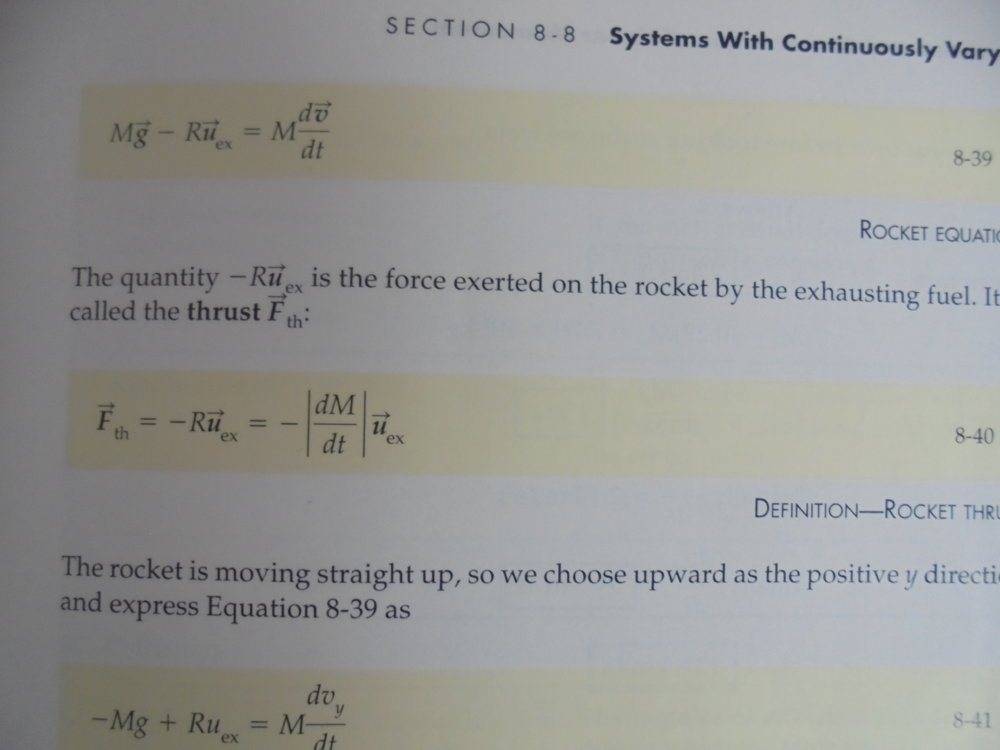
##M\mathbf{g}-R\mathbf{u}_{ex}=M\frac{d\mathbf{v}}{dt}##,
where ##M## is the rocket's mass at time t, -R is the rate at which fuel-mass is leaving, ##\mathbf{u}_{ex}## is the velocity of the leaving fuel relative to the rocket.
As I said, the authors seem to have changed their interpretation of ##F_{ext}##, because when I use the original variable mass equation on a rocket, I get a different answer. Here is my derivation of the rocket equation based on my understanding (a possibly erroneous one) of the general variable mass equation.
For a rocket-fuel system, ##F_{ext}## in the general equation should be the total gravitational force on the rocket and the fuel. If we let the initial mass of the rocket-fuel be ##M_0##, then ##F_{ext}=M_0\mathbf{g}##. Then deriving the rest of the rocket equation as the authors do, I get
##M_0\mathbf{g}-R\mathbf{u}_{ex}=M\frac{d\mathbf{v}}{dt}##,
which doesn't agree with their equation. The problem, as I highlighted above, seems to be the authors's use of ##F_{ext}##. Here are their derivations of both equations.
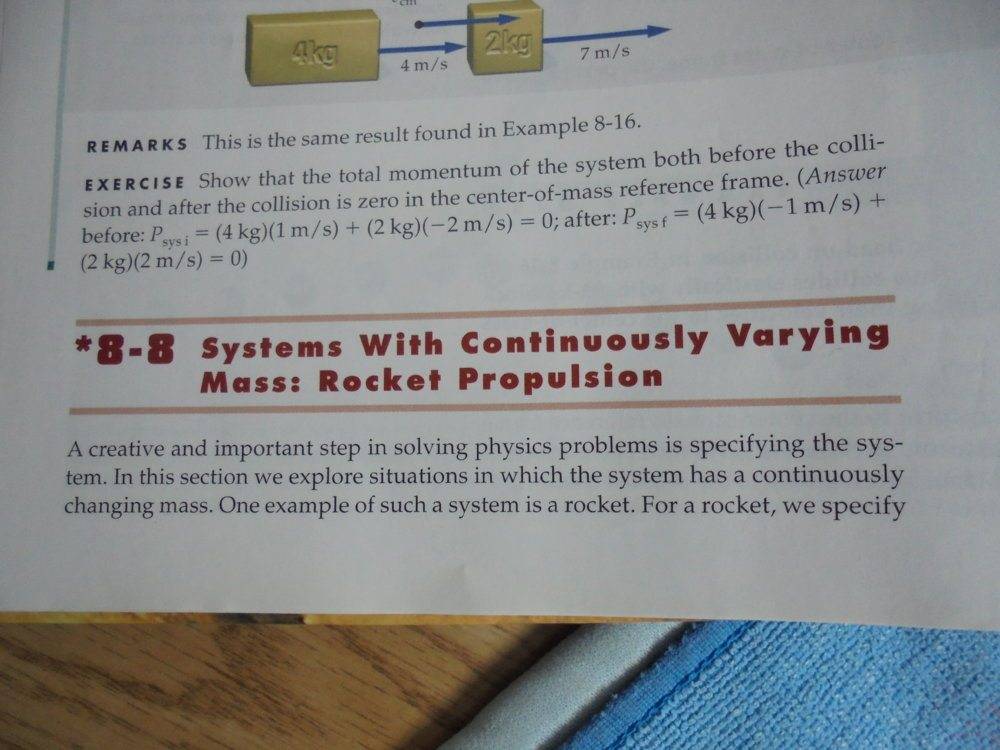
General variable mass F=ma:
Rocket equation:
##\mathbf{F}_{ext}+\frac{dM}{dt} \mathbf{v}_{rel}=M\frac{d\mathbf{v}}{dt}##
where ##\mathbf{F}_ext## is the external force on the system as a whole (ie not just the variable mass sub-system, but the system as a whole), ##\frac{dM}{dt}## is the rate at which the mass of the variable mass sub-system is changing, ##\mathbf{v}_{rel}## is the velocity of the changing mass (whether incoming or outgoing) relative to the variable mass subsystem, ##M## is the mass of the variable mass subsystem at time t, and finally, ##\mathbf{v}## is the velocity of the variable mass subsystem at time t.
Now I may have misunderstood this equation, but if not then I am slightly confused as to the authors's subsequent derivation of the rocket equation. When deriving this latter equation, they seem to interpret the general variable mass equation completely differently, and ##F_{Ext}## no longer represents the total external force on the system for example. Here is their rocket equation:
##M\mathbf{g}-R\mathbf{u}_{ex}=M\frac{d\mathbf{v}}{dt}##,
where ##M## is the rocket's mass at time t, -R is the rate at which fuel-mass is leaving, ##\mathbf{u}_{ex}## is the velocity of the leaving fuel relative to the rocket.
As I said, the authors seem to have changed their interpretation of ##F_{ext}##, because when I use the original variable mass equation on a rocket, I get a different answer. Here is my derivation of the rocket equation based on my understanding (a possibly erroneous one) of the general variable mass equation.
For a rocket-fuel system, ##F_{ext}## in the general equation should be the total gravitational force on the rocket and the fuel. If we let the initial mass of the rocket-fuel be ##M_0##, then ##F_{ext}=M_0\mathbf{g}##. Then deriving the rest of the rocket equation as the authors do, I get
##M_0\mathbf{g}-R\mathbf{u}_{ex}=M\frac{d\mathbf{v}}{dt}##,
which doesn't agree with their equation. The problem, as I highlighted above, seems to be the authors's use of ##F_{ext}##. Here are their derivations of both equations.
General variable mass F=ma:
Rocket equation: