SUMMARY
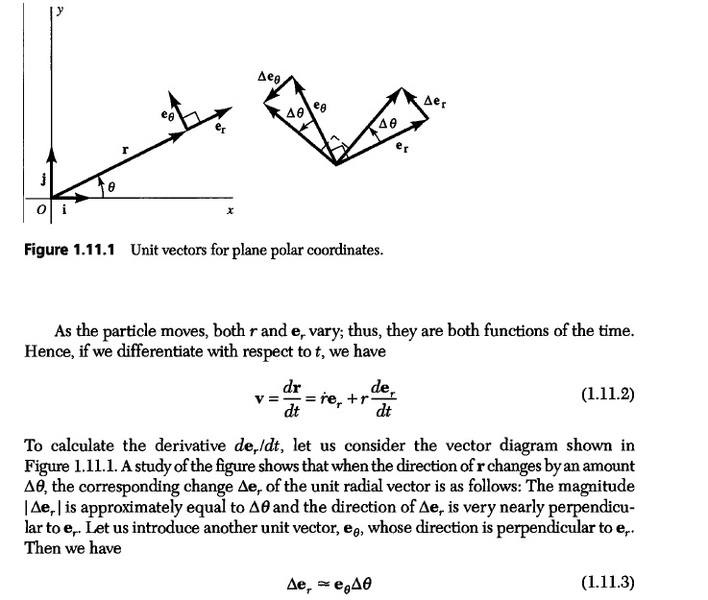
The discussion centers on the relationship between the magnitude of the change in the radial unit vector, Δer, and the change in angle, Δθ, in plane polar coordinates. It is established that the arc length spanned by Δθ is represented as δ = |er|Δθ, where |er| is the unit magnitude of the radial vector. Due to the small size of Δer, it is concluded that Δer is approximately equal to δ, leading to the assertion that Δer ≈ Δθ. This geometric interpretation clarifies the connection between angular displacement and radial displacement in polar coordinates.
PREREQUISITES
- Understanding of plane polar coordinates
- Basic geometry principles related to arc length
- Familiarity with unit vectors
- Knowledge of angular displacement concepts
NEXT STEPS
- Study the derivation of arc length in polar coordinates
- Explore the properties of unit vectors in vector calculus
- Learn about the applications of polar coordinates in physics
- Investigate the relationship between angular velocity and linear velocity
USEFUL FOR
Students and professionals in mathematics, physics, and engineering who are working with polar coordinates and seeking to deepen their understanding of velocity concepts in this coordinate system.