Velocity of an Object given its position as a function of time

Click For Summary
The discussion centers on solving a problem related to the velocity of an object given its position as a function of time. The original poster confirmed their solution was correct but noted their teacher suggested a quicker method using a calculator. Participants emphasized the importance of understanding that speed is the derivative of position and acceleration is the derivative of speed. There was also feedback on the clarity of the original poster's work, despite some formatting issues with the images. Overall, the conversation highlights the balance between manual calculations and the efficiency of using technology in problem-solving.
Strand9202
Messages
10
Reaction score
2
Homework Statement
Velocity of an object: Picture of problem and work attached
Relevant Equations
Speed =s(t)
Acceleration = s'(t)
Velocity = s"(t) or a'(t)
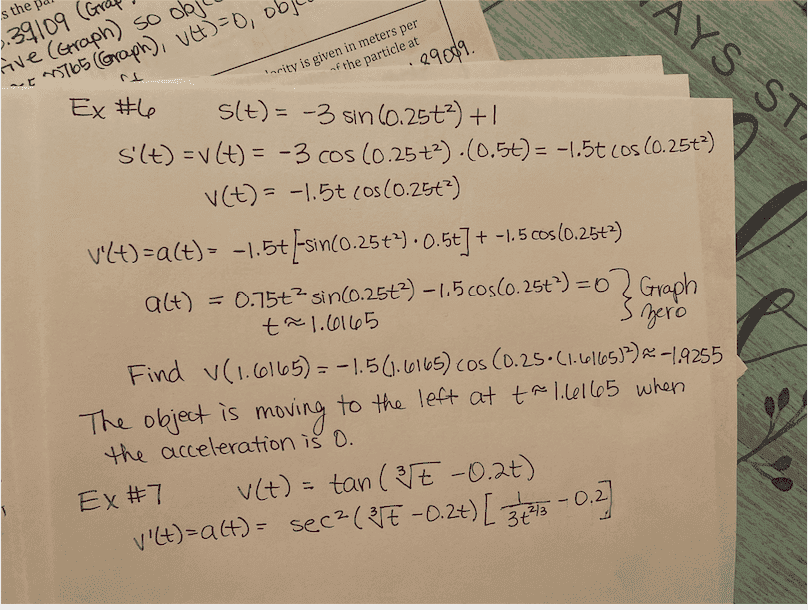
Attached is the problem and my work through the problem. I got the problem correct, but my teacher said this could be done quicker on a calculator. Any idea how it could be done quicker.
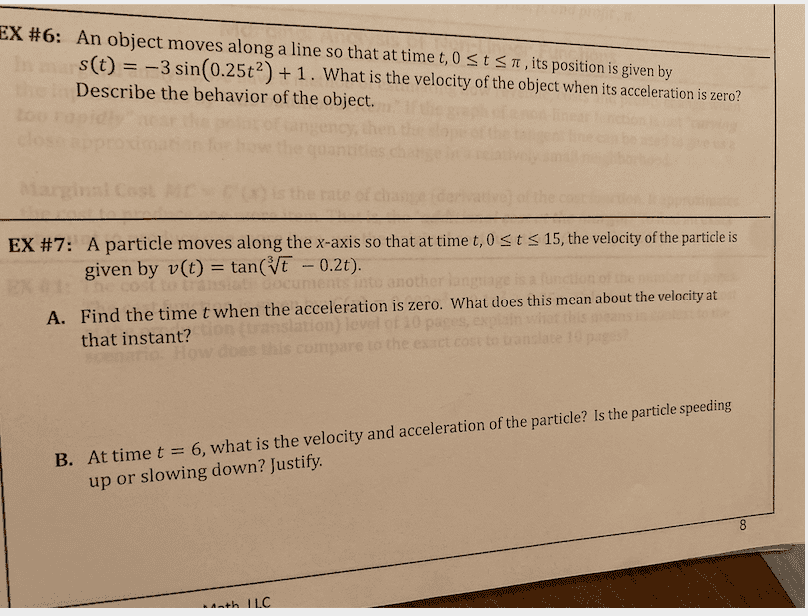
Screen Shot 2021-02-08 at 8.23.12 PM.png

Screen Shot 2021-02-08 at 8.23.25 PM.png
 

Attachments

  • 63452099186__DCDFFA52-49D9-4E49-B69A-84ED1CA44B81.jpeg
    63452099186__DCDFFA52-49D9-4E49-B69A-84ED1CA44B81.jpeg
    57.2 KB · Views: 155
  • 63452097838__A519283C-EC71-4527-BAEA-EDB73A167AA7.jpeg
    63452097838__A519283C-EC71-4527-BAEA-EDB73A167AA7.jpeg
    70.4 KB · Views: 144
Last edited:
Physics news on Phys.org
Check your relevant equations.
In #6, s(t) is the position, not the speed (an unfortunate choice of variables).
Speed is the derivative of position
Acceleration is the derivative of speed.
 
FactChecker said:
Check your relevant equations.
In #6, s(t) is the position, not the speed (an unfortunate choice of variables).
Speed is the derivative of position
Acceleration is the derivative of speed.
My work for number 6 is correct. My teacher checked it, but they said I could have used a calculator to find it quicker.
 
Sorry, I missed that your work was correct. In any case, I stopped reading when I saw that your "Relevant Equations" are all wrong.
Do you have a graphing calculator? Maybe your teacher means that you can look at the graph of position and determine the answer.
 
Strand9202 said:
I got the problem correct, but my teacher said this could be done quicker on a calculator.
Well, lots of things can be done more quickly on a calculator, but so what? If I were the teacher, and I've taught many calculus classes, I would be happy with your work.
As a PF member, I'm not quite as happy, since your images are all rotated by 90°. Your handwriting is very clear, though, and the images are well-lit.
 
Mark44 said:
Well, lots of things can be done more quickly on a calculator, but so what? If I were the teacher, and I've taught many calculus classes, I would be happy with your work.
As a PF member, I'm not quite as happy, since your images are all rotated by 90°. Your handwriting is very clear, though, and the images are well-lit.
Sorry I thought I put the right side pictures up. I reedited and attached the correct ones.
 
Question: A clock's minute hand has length 4 and its hour hand has length 3. What is the distance between the tips at the moment when it is increasing most rapidly?(Putnam Exam Question) Answer: Making assumption that both the hands moves at constant angular velocities, the answer is ## \sqrt{7} .## But don't you think this assumption is somewhat doubtful and wrong?

Similar threads

Replies
5
Views
1K
  • · Replies 21 ·
Replies
21
Views
3K
  • · Replies 7 ·
Replies
7
Views
2K
  • · Replies 11 ·
Replies
11
Views
2K
  • · Replies 6 ·
Replies
6
Views
1K
  • · Replies 24 ·
Replies
24
Views
3K
  • · Replies 4 ·
Replies
4
Views
1K
  • · Replies 33 ·
2
Replies
33
Views
3K
Replies
22
Views
3K
  • · Replies 14 ·
Replies
14
Views
2K