Discussion Overview
The discussion revolves around the effects of placing a thin sheet of copper over strong magnets on the current path and voltage gradient, particularly in the context of a science project involving current gradients in the human body during surgical cauterization. Participants explore experimental setups, materials, and measurement challenges related to this topic.
Discussion Character
- Exploratory
- Technical explanation
- Debate/contested
- Experimental/applied
Main Points Raised
- One participant questions whether the current path in a copper sheet will be distorted when half of it is placed over strong magnets while 5 Amps flows through it.
- Another participant agrees that the current will be distorted but notes that copper's high conductivity may result in minimal voltage generation, making measurements difficult.
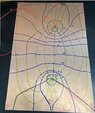
- A participant shares their own experimental setup involving 4 amps and 0.2 volts in a copper plate, asking if the voltage gradient would be affected by neodymium magnets.
- There is a suggestion to use a more resistive material than copper for better measurement outcomes, with a discussion on potential alternatives and the challenges of soldering resistors together.
- One participant proposes using thermal imaging to visualize current distribution in a more resistive material.
- Another idea involves setting up a vertical water tank with conductive fluid to observe bubble deflections under a magnetic field, although its feasibility is uncertain.
- Participants suggest various materials, including silicon wafers and resistance paper, for the experiment.
- There is a recommendation to consider using an electromagnet to create a strong magnetic field over a larger surface area.
- One participant proposes using a fluid instead of a solid to visualize deflections rather than measuring voltage differences.
- A question arises regarding the passivation of silicon wafers by SiO2, which could affect their use in the experiment.
Areas of Agreement / Disagreement
Participants generally agree that the current path will be distorted when copper is placed over magnets, but there is no consensus on the best materials or methods for conducting the experiment. Multiple competing views and suggestions remain regarding the experimental setup and materials.
Contextual Notes
Participants express uncertainty about the effectiveness of various materials and methods, highlighting limitations in measurement capabilities and the challenges of achieving clear results in the proposed experiments.
Who May Find This Useful
Readers interested in experimental physics, materials science, and current measurement techniques may find this discussion relevant.