Volume of solid region double integral

Join the discussion
Ask a follow-up here, or get your own question answered by working scientists, mathematicians and engineers — people, not an autocomplete.
Real named experts · corrections over time · the nuance an AI answer skips
27 replies · 3K views
woopydalan
Messages
18
Reaction score
15
Homework Statement
Set up the integral for both orders of integration and use the more convenient order to find the volume of the solid region bounded by the surface f(x, y) and the planes.
##f(x, y) = x##
Planes: ##z = 0##, ##y = \sqrt{25 − x^2}##, ##y = 0##
Relevant Equations
##\iint\limits_R f(x,y) \, dA##
I sketched this out. With the z=0 and y=0 boundaries, we are looking at ##z \geq 0## and ##y \geq 0##

I believe ##0 \leq x \leq 5## because of the boundary of ##y=\sqrt{25-x^2}##.

This is my region

##\int_0^5 \int_0^\sqrt{25-x^2} x \, dydx ##
## =\int_0^5 xy \vert_{0}^{\sqrt{25-x^2}} \, dx##
## =\int_0^5 x\sqrt{25-x^2} \, dx##
Using U-substitution ##u = 25-x^2##, and ##du = -2x \, dx##,
## =-\frac{1}{2} \int_0^5 u^{\frac{1}{2}} \, du##
## =-\frac{1}{2} \cdot \frac{2}{3} u^{\frac{3}{2}} \vert_{0}^{5}##
##=\frac{125}{3}##

However, it seems this is not correct as when I submit this answer I get a response that it is incorrect. Am I doing something wrong with my boundaries for the integrals?
 
Last edited:
Physics news on Phys.org
Ok sorry, I didn't write that correctly in the post, but it would be

##-\frac{1}{2} \cdot \frac{2}{3} (25-x^2)^{\frac{3}{2}} \vert_{0}^{5} ##
## = 0 - (-\frac{1}{3} \cdot 25^{\frac{3}{2}}) ##
## = \frac{125}{3} ##

In these problems, the challenge is usually setting up the bounds for the integrals. I'm wondering if I chose the incorrect ones? It's easy enough to verify the integral solution with wolframalpha.
 
haruspex said:
What makes you think x=0 is a boundary?
Well, as I explained in the OP, because ##y = \sqrt{25-x^2}##, so certainly ##x=5## is a boundary. If not ##x=0##, then ##x=-5##. If it's -5, then the volume is 0.
 
  • Like
Likes   Reactions: Delta2
Delta2 said:
yes I also believe x=-5 is the correct boundary, but since you want the volume you should calculate $$\iint |f(x,y)|dxdy$$
Interesting, that was never in the textbook as far as the absolute value.
 
woopydalan said:
Interesting, that was never in the textbook as far as the absolute value.
Well, if you don't put the absolute value and you go ahead calculate the integral without it and with the new x-boundaries (from -5 to +5) you ll get zero as result.
 
Delta2 said:
Well, if you don't put the absolute value and you go ahead calculate the integral without it and with the new x-boundaries (from -5 to +5) you ll get zero as result.
Understood, that's why I figured the boundary is x=0.
 
Delta2 said:
Nope x=0 is not the correct boundary, it is x=-5 to x=+5 and the actual volume is double of what you calculated...
Ok, I got it. But I wonder if ##\lvert f(x,y) \rvert## is a general rule, or just because the nature of this function is why it was necessary to use
 
In my opinion it is a general rule if you want to calculate the volume between some region of the xy-plane (where z=0), and z=f(x,y), otherwise if you don't put the absolute value, you ll end up subtracting volume in the region of xy-plane where f(x,y) becomes negative. If f(x,y) is positive for all x,y in the region of interest in the xy-plane , then ok there is no need of absolute value.
 
Delta2 said:
In my opinion it is a general rule if you want to calculate the volume between some region of the xy-plane (where z=0), and z=f(x,y), otherwise if you don't put the absolute value, you ll end up subtracting volume in the region of xy-plane where f(x,y) becomes negative. If f(x,y) is positive for all x,y in the region of interest in the xy-plane , then ok there is no need of absolute value.
Thinking about it a little more now, how can x < 0? The boundary z=0, and if x=z, then you shouldn't have a negative value for x, no?
 
BvU said:
Imagine the solid shape is made of wood. Two parts. ##|f| ## to get the volume.

##\ ##
I don't follow that at all. What about the boundary z=0? So if f(x,y) = z = x, how can x<0?
 
woopydalan said:
I don't follow that at all. What about the boundary z=0? So if f(x,y) = z = x, how can x<0?
No, f(x,y)=x does not make z=x. f(x,y) is given as a bounding surface of z, not the value of z everywhere. We can rewrite the conditions as"where z lies between the values 0 and x".
Personally I've never been happy with the presumption that areas and volumes cannot be negative, but @Delta2 is right that that is the usual convention, so the correct volume integral is ##\int|z|dxdy##, with the ranges always running from the lower bound to the higher.
 
  • Like
Likes   Reactions: Delta2
haruspex said:
No, f(x,y)=x does not make z=x. f(x,y) is given as a bounding surface of z, not the value of z everywhere. We can rewrite the conditions as"where z lies between the values 0 and x".
Personally I've never been happy with the presumption that areas and volumes cannot be negative, but @Delta2 is right that that is the usual convention, so the correct volume integral is ##\int|z|dxdy##, with the ranges always running from the lower bound to the higher.
I guess I don't understand. ##f(x,y) = z## is the 3-dimensional equivalent of ##f(x) = y##. If the surface is bound by ##z=0## and ##y= \sqrt {25-x^2}##, and ##y=0##, I know that ##y \geq 0##. How can ##f(x,y) < 0##? If that's the case, I don't really even know what the bound ##z=0## means or why it matters if ##z < 0## is permissible.
 
The bounds of z=0 and z=f(x,y), means that our volume of interest contains points (x,y,z) such that $$0\leq z\leq f(x,y)$$, OR $$f(x,y)\leq z\leq 0$$ (and the other constraints that refer to x and y). So the bound of z=0 doesn't mean necessarily that it is a lower bound but it can be an upper bound as well IF f(x,y) goes negative.
 
Last edited:
woopydalan said:
I guess I don't understand. ##f(x,y) = z## is the 3-dimensional equivalent of ##f(x) = y##. If the surface is bound by ##z=0## and ##y= \sqrt {25-x^2}##, and ##y=0##, I know that ##y \geq 0##. How can ##f(x,y) < 0##? If that's the case, I don't really even know what the bound ##z=0## means or why it matters if ##z < 0## is permissible.
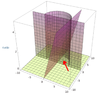
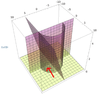
It might help if you can visualise it.
##y= \sqrt {25-x^2}## Is a horizontal semicircle radius 5, centred at the origin. In 3D, that as a boundary, combined with the y=0 boundary, defines an infinite vertical half cylinder.
z=0 is the horizontal plane through the origin, while z=x is a plane at 45 degrees containing the y axis.
These three boundaries enclose two separate wedges meeting at the y axis.
In one wedge, the z=0 plane is the upper bound, while in the other wedge it is the lower bound.
 
  • Like
Likes   Reactions: Delta2
So basically z can be anything EXCEPT 0. Kind of a dumb boundary IMO
 
woopydalan said:
So basically z can be anything EXCEPT 0. Kind of a dumb boundary IMO
It's no different in that respect to the way the other boundaries are prescribed. You are given that ##y=\sqrt{25-x^2}## is a boundary, not that ##y<\sqrt{25-x^2}##. Which side of that lies the enclosed region has to be deduced from the other boundaries. The only complication in the z=0 boundary is that the enclosed region lies a part on each side.
 
haruspex said:
It might help if you can visualise it.
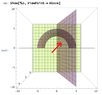
1626485522484.png

1626485578924.png

Alternatively, you can use integration under polar coordinates:
$$\int_0^{\pi}\int_0^5 | r\cos \theta \, r | drd\theta$$
 

Attachments

  • 1626484132267.png
    1626484132267.png
    56.9 KB · Views: 299
  • 1626484193828.png
    1626484193828.png
    52.9 KB · Views: 255
  • 1626484258694.png
    1626484258694.png
    31.8 KB · Views: 299
Last edited:
  • Like
Likes   Reactions: Delta2
Leo Liu said:
View attachment 286087
View attachment 286088
View attachment 286089
Alternatively, you can use integration under polar coordinates:
$$\int_0^{\pi/2}\int_0^5 r\sin \theta \, rdrd\theta$$
Nice diagrams, thanks, except that as noted earlier in the thread the enclosed volume includes an identical region with z<0 and x<0.
For the region shown in your diagrams, the volume was found in post #1.
 
haruspex said:
Nice diagrams, thanks, except that as noted earlier in the thread the enclosed volume includes an identical region with z<0 and x<0.
For the region shown in your diagrams, the volume was found in post #1.
Thanks for pointing out my mistake :D Do they look good now? Also the bounds for theta are [0, Pi] under polar coordinates right?
 
woopydalan said:
So basically z can be anything EXCEPT 0. Kind of a dumb boundary IMO
z can be anything between 0 and f(x,y). But don't take for granted that f(x,y) is positive.