Water evaporation in semi-open system

Click For Summary
SUMMARY

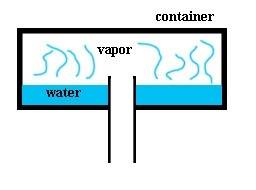
The discussion revolves around the physics of water evaporation in a semi-open system, specifically a closed container with a bottom opening. At a constant water temperature of 80°C and a container temperature of 90°C, the equilibrium vapor pressure of water is 0.46 atm. The pressure inside the container remains at 1 atm due to the open system, allowing water vapor to escape when its partial pressure exceeds that of the surrounding air. The conversation highlights the importance of understanding partial pressures and mass transfer dynamics in calculating evaporation rates.

PREREQUISITES
  • Understanding of vapor pressure and its relationship to temperature
  • Fick's law of diffusion for mass transfer calculations
  • Basic thermodynamics principles, including the 0th Law of Thermodynamics
  • Knowledge of heat transfer mechanisms, including conduction and convection
NEXT STEPS
  • Research the application of Fick's law in calculating mass flow rates of gases
  • Study the principles of thermodynamics related to phase changes and vapor pressure
  • Explore methods for calculating evaporation rates in open systems under varying pressure conditions
  • Investigate the effects of temperature gradients on evaporation and condensation processes
USEFUL FOR

Physicists, chemical engineers, environmental scientists, and anyone interested in the dynamics of evaporation and mass transfer in semi-open systems.

TheFistGuy
Messages
7
Reaction score
1
Hello guys!
I'am having trouble getting my head around the physics of evaporation in quite specific situation.

So i have a closed container with opening in the bottom (cross-section in picture below). Let's say that water has a constant temperature of 80°C and container has a temperature 90°C, therefore the water cannot condense on the inner edges of the container. Outside the container is air with sea-level pressure.
cont.jpg

So water evaporates and since vapor is lighter than air and it rises up. As it builds up in the container it should create some pressure (right?). Then due to the pressure the vapor should start escaping through the bottom (right?). So the first question is how much pressure is needed for the vapor to escape through the bottom?
And since vapor pressure builds up, that should slow the rate of evaporation. Is there any way to calculate this?

I will appreciate any help or links to related problems. Thanks!
 
Physics news on Phys.org
What is the equilibrium vapor pressure of water at 80 C? If the pressure in the room is 1 atm, what do you think the total pressure in the "vapor space" within the container above the liquid water is?
 
At 80 C vapor pressure is 0.46 atm.
Pressure in the "vapor space" space should still be 1atm since it's an open system.
What does that tell me?
 
TheFistGuy said:
At 80 C vapor pressure is 0.46 atm.
Pressure in the "vapor space" space should still be 1atm since it's an open system.
What does that tell me?
That tells you that the most that the average partial pressure of the water vapor in the head space can be at any time is 0.46 atm. The rest of the gas has to be air.
 
If the pressure outside the partially enclosed space is 1 atm, (assuming the opening isn't extremely small), then the pressure inside is 1 atm. I am not sure how the water remains 10° cooler than the container it is in, could you explain that (apparent) violation of the 0th Law of Thermodynamics? (Two objects in contact at equilibrium will reach the same temperature). While pressure is one way, and often used, to characterize a gas's composition, it is better here to consider that the key question is about the mixing of the air water gas with the atmosphere - which will occur around the opening. In real world conditions, the air-water mix will cool and water will condense into fog droplets and fall (there will also be some water vapor diffusion - unless the air is at 100% rh)
 
So if I get this right, then the only way vapor starts flowing through the bottom opening into atmosphere is if the vapor temperature is at least 100 C, i.e., water boils ??

ogg said:
I am not sure how the water remains 10° cooler than the container it is in, could you explain that
The container is being heated. Therefore water will be few degrees cooler that container.
 
TheFistGuy said:
So if I get this right, then the only way vapor starts flowing through the bottom opening into atmosphere is if the vapor temperature is at least 100 C, i.e., water boils ??
No, they certainly were not telling you that. The gases act independent of each other: as long as the partial pressure of water vapor in your container is higher than the partial pressure of atmospheric water vapor, water vapor flows out.
 
So far we have established that the composition of the vapor in the overhead space involves a mole fraction of water vapor of ≤ 0.46 and a mole fraction of air of ≥0.54 (all at 1 atm.). In the air outside, the mole fraction of water vapor is much less than 0.46 and the mole fraction of air is close to 1. So there is a concentration difference between the gas outside and the gas in the overhead space. Therefore, there is a mass transfer driving force for water vapor to exit the head space. Part of this the mass transfer (probably not much because the higher temperature is on top) can be by convection, so most will likely occur by diffusion in the tube. Knowing the diffusion coefficient, Fick's law can be used to determine the mass flow rate of water vapor. There is also heat transfer occurring by conduction occurring simultaneously within the tube. All this can be modeled.
 
russ_watters said:
as long as the partial pressure of water vapor in your container is higher than the partial pressure of atmospheric water vapor, water vapor flows out.

And should not that be when vapor temperature is atlest 100 C?

Edit: ok no. Water vapor pressure in atmosphere is 0.023 bar at 20 C
 
  • Like
Likes   Reactions: russ_watters
  • #10
I have a related question but a bit different. Suppose I have a bottle of liquid (other than water - similar or low volatility). The bottle has a small opening (say 10 mm) on its top and wind blows over the top of the bottle. So, there will be pressure drop through the orifice or opening.
Is there any way to calculate for a given pressure drop what will be the evaporation rate?

Or let me rephrase the question -

Is there any method to determine rate of evaporation in a open system with surrounding pressure less than atmospheric (or maybe vaccum) ?
 

Similar threads

  • · Replies 30 ·
2
Replies
30
Views
7K
  • · Replies 4 ·
Replies
4
Views
2K
  • · Replies 10 ·
Replies
10
Views
3K
  • · Replies 7 ·
Replies
7
Views
2K
  • · Replies 40 ·
2
Replies
40
Views
4K
  • · Replies 4 ·
Replies
4
Views
9K
  • · Replies 11 ·
Replies
11
Views
4K
  • · Replies 32 ·
2
Replies
32
Views
4K
  • · Replies 10 ·
Replies
10
Views
2K
  • · Replies 11 ·
Replies
11
Views
3K