Waveguide standing wave pattern

Click For Summary
The discussion centers on measuring the standing wave pattern in an X-band waveguide using a slotted line with a short circuit termination, where the expected rectified sine wave pattern is not observed. Participants suggest that the observed results may reflect phase variation rather than amplitude variation and inquire about how changing the load affects the pattern. One contributor notes that the results in air appear better, indicating potential issues with the waveguide setup. Recommendations include using a 3dB attenuator to improve matching and filtering the signal source to eliminate harmonics that could interfere with measurements. The conversation emphasizes the need for more experienced insights into waveguide behavior and measurement techniques.
JuanCarlos
Messages
3
Reaction score
0
Hi everybody, that's my question, I have been measuring the standing wave pattern within a waveguide (X band) using a slotted line, I put a short circuit termination and the theory said that we expect a rectified sine, but I don't get that, my result is in the picture
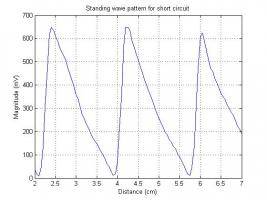
thump_8136214swrpat.jpg


I can't explain my results and I have tried with two different microwave sources (10.5 GHz).

I appreciate your help.
 
Engineering news on Phys.org
JuanCarlos said:
Hi everybody, that's my question, I have been measuring the standing wave pattern within a waveguide (X band) using a slotted line, I put a short circuit termination and the theory said that we expect a rectified sine, but I don't get that, my result is in the picture

thump_8136214swrpat.jpg


I can't explain my results and I have tried with two different microwave sources (10.5 GHz).

I appreciate your help.

That looks more like the phase variation along a line than the amplitude variation. Is that possible?
 
How does that pattern change when you change the load on the end (good match / fair match / short circuit) ?
 
I have measured the standing wave pattern in the air using the same source and the results looks better, of course that's not a short circuit but the wave is not inclined.

thump_8136530swrair.jpg


I've been thinking if it is about the propagation mode.
 
sophiecentaur said:
How does that pattern change when you change the load on the end (good match / fair match / short circuit) ?

The picture is a short circuit, and when the load is changed, the swr and the phase changes, but the wave is still inclined.

thump_8136540swrarb.jpg


That's an arbitrary load pattern.
 
You need someone with more experience with waveguide, I think. My actual work was all on UHF and coax feeder.
If I were chasing strange things like that, I think I'd put a 3dB attenuator (resistive) in the source to improve that match and put a good terminating load at the end. If I couldn't get a flattish line then, I would be scratching my head. I could suggest that harmonics in the signal source could be setting up another standing wave which adds to the one you want? (Not relevant if you are using a 'proper' receiver but could be, if you are just using a simple detector.) Solution: filter the output of the signal source.
 
Thread 'I thought it was only Amazon that sold unsafe junk'
I grabbed an under cabinet LED light today at a big box store. Nothing special. 18 inches in length and made to plug several lights together. Here is a pic of the power cord: The drawing on the box led me to believe that it would accept a standard IEC cord which surprised me. But it's a variation of it. I didn't try it, but I would assume you could plug a standard IEC cord into this and have a double male cord AKA suicide cord. And to boot, it's likely going to reverse the hot and...

Similar threads

Replies
15
Views
2K
  • · Replies 50 ·
2
Replies
50
Views
6K
Replies
10
Views
2K
  • · Replies 5 ·
Replies
5
Views
3K
  • · Replies 5 ·
Replies
5
Views
1K
  • · Replies 13 ·
Replies
13
Views
4K
  • · Replies 2 ·
Replies
2
Views
2K
  • · Replies 10 ·
Replies
10
Views
2K
  • · Replies 21 ·
Replies
21
Views
1K
  • · Replies 41 ·
2
Replies
41
Views
16K