Weight required to balance a boom stand?

  • Context: Undergrad 
  • Thread starter Thread starter xseven
  • Start date Start date
  • Tags Tags
    Balance Weight
Click For Summary
SUMMARY

This discussion focuses on calculating the necessary counterweight to balance a boom stand for acting classes, specifically when a 10 kg weight is attached to the boom arm. The calculations involve measuring the distance from the apex of the leg triangle to the counterweight placement point, leading to a required counterweight of approximately 23.72 kg for minimal stability. For practical use, a more substantial counterweight of 40 kg is recommended to ensure stability against external forces. Additionally, the discussion suggests redesigning the stand with three legs set at 120 degrees for improved balance and stability.

PREREQUISITES
  • Understanding of basic physics principles related to levers and balance
  • Familiarity with geometry, specifically triangles and ratios
  • Knowledge of weight distribution and counterbalancing techniques
  • Experience with designing and constructing boom stands or similar equipment
NEXT STEPS
  • Research the principles of torque and leverage in physics
  • Learn about the design and construction of stable boom stands
  • Explore advanced counterweight systems for camera equipment
  • Investigate the use of adjustable leg configurations for improved stability
USEFUL FOR

This discussion is beneficial for stage designers, filmmakers, and anyone involved in constructing or using boom stands for cameras or lighting equipment, particularly those seeking to enhance stability and balance in their setups.

xseven
Messages
2
Reaction score
0
Hi!

I am trying to build a stand with a boom arm for my acting classes and I need to find the weight required to balance it. The problem is that it looks like I was more like a swan when I was swimming in the physics lessons ... no a lot of drops stayed on my plumage ... :)
Help?!
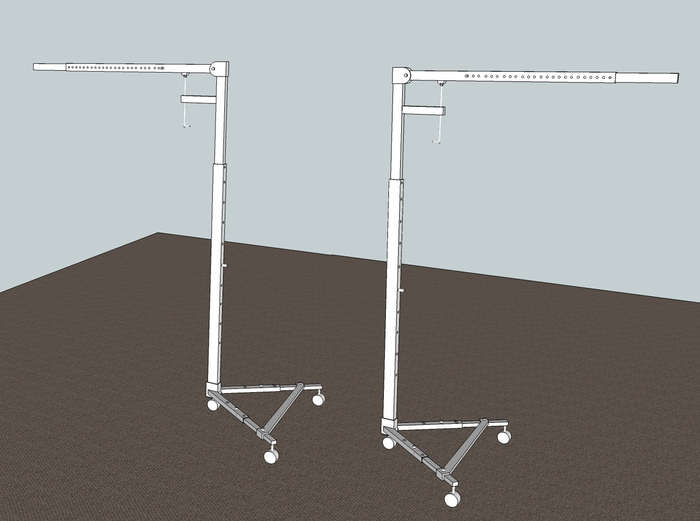
stand10.jpg


Data:

Stand height: "H" (more or less 2 m fully extended)
Boom arm: "B" (again, more or less 2 m fully extended) - the arm can be lifted rotating a threaded rod so I assume the length of the boom is (for the purpose of a formula) a+b (where "a" will be between the hinge and the rod's point of contact)
Legs: "L"

The questions that are troubling me are as follows:

1. What is the most stable configuration of legs? an angle of 90°? 60°?
2. What formula can calculate the weight required to stabilize the system when weight "W" (more or less 10 KG) is attached to the boom arm fully extended pointing away from the legs?
3. What formula can calculate the weight required to stabilize the system when weight "W" is attached to the boom arm fully extended pointing in the same direction with the legs?
... And 4 (already feeling that I push the limits of your patience) ... I would like the threaded rod to be as short and as close as possible to the main pole - is there a way to calculate the force required to raise the boom arm with the weight to a 45° angle from the horizontal position? How close to the stand can I put it and still manage to have a smooth rotating action?

Humbly yours,

Cat
 
Physics news on Phys.org
#2 is the easiest to answer. Measure the length of the arm with the boom fully extended. Then measure the distance from the apex of the leg triangle (where it meets the upright) to the point where the counterweight will be placed on the legs. This will give you a ratio of length to length. Let's say it's 1.02 meters to .43 meters. The weights that will balance will be to each other in the inverse ratio to this ratio of lengths. The weight of 10 kg is a given. You have to find that weight which is to 10 kg as 1.02 meters is to .43 meters. That means solve for: ?/10 = 1.02/.43 The product of the means equals the product of the extremes, so multiplying means gives 10 X 1.02 = 10.2. To find the missing extreme 10.2 is divided by .43 = 23.72 kg counterweight needed.

That's not the weight you should use, though. That weight will only just balance. The thing could still be knocked over with a feather unless you add much more ballast. The calculation just gets you the absolute minimum counter weight that will prevent it from falling over by itself.
 
So ... assuming that the boom arm will be 2m and the distance from the apex to the counterweight will be 0.5 m that will give a ratio of 4:1 - for 10KG on the boom arm a 40KG weight will act as a balance ballast. (ignoring the weight of the boom arm itself etc)
What would be the approach for #3?

Thank you for your help!
 
xseven said:
So ... assuming that the boom arm will be 2m and the distance from the apex to the counterweight will be 0.5 m that will give a ratio of 4:1 - for 10KG on the boom arm a 40KG weight will act as a balance ballast. (ignoring the weight of the boom arm itself etc)
Thank you for your help!
You're welcome. Looks like you have it down.

What would be the approach for #3?
I'm not so sure about this one, but I think the procedure would be to subtract the leg distance (.5 m) from the boom length (2m) for a new ratio of 1.5 to .5. The counterweight, 30 kg, would have to be placed as close up to the upright as possible.

Here, again, this is the absolute minimum weight to prevent the thing from falling over by itself. In practice you should add much more. Just have to experiment, adding weight till you can knock it and bump into it a reasonable and realistic amount.

If this is to hold a camera I would redesign it altogether to have three long legs set at 120 degrees. I would make the boom like a mike boom, sticking out in both directions with a movable counterweight on it. In that way you could keep the center of gravity of the boom, camera, and counter weight pretty much over the upright. I would mount the boom to the upright with a large bolt and wing nut (with washers). It could be pivoted up and down by loosening and tightening the wing nut.
 

Similar threads

  • · Replies 10 ·
Replies
10
Views
2K
  • · Replies 13 ·
Replies
13
Views
3K
  • · Replies 15 ·
Replies
15
Views
5K
  • · Replies 2 ·
Replies
2
Views
2K
  • · Replies 24 ·
Replies
24
Views
2K
  • · Replies 28 ·
Replies
28
Views
3K
Replies
9
Views
2K
  • · Replies 10 ·
Replies
10
Views
4K
  • · Replies 8 ·
Replies
8
Views
2K
  • · Replies 2 ·
Replies
2
Views
3K