Weird thinking of electric field inside a hollow cylinder.

Click For Summary
SUMMARY

The electric field inside a hollow cylinder is zero due to the cancellation of electric field contributions from charged arcs. When considering a positive charge off-center within the cylinder, the forces from the arcs defined by intersecting lines of charge are antiparallel and equal in magnitude, leading to a net electric field of zero. This principle mirrors the behavior of electric fields within uniformly charged shells, where solid angles are used for analysis. The critical mistake in the initial reasoning was not recognizing that the contributions from the arcs cancel each other out.

PREREQUISITES
  • Understanding of electric fields and charge distributions
  • Familiarity with the concept of line charge density (λ)
  • Knowledge of Coulomb's law and its applications
  • Basic grasp of vector addition in physics
NEXT STEPS
  • Study the derivation of the electric field for a uniformly charged shell
  • Learn about Gauss's Law and its applications to cylindrical symmetry
  • Explore the concept of electric field lines and their properties
  • Investigate the behavior of electric fields in different geometrical configurations
USEFUL FOR

Students of electromagnetism, physics educators, and anyone seeking to deepen their understanding of electric fields in cylindrical geometries.

TwoEG
Messages
13
Reaction score
0
While I was studying with electric field about cylinder, I learned that for a very long cylinder, the electric field in the hollow of cylinder will be zero.

http://physics.stackexchange.com/questions/156789/electric-field-of-hollow-cylinder

However, I couldn't accept this intuitively, and thought up this weird idea.

We can express electric field E of charged line like

##E=\frac \lambda {2\pi\epsilon_0 r}##

Thus, we knows that (+) charge between two parallel lines with same charge density will always move to their center, right?

Then, suppose we have a (+) charge in a cylinder other than on its axis, and let's see that cylinder above from it.
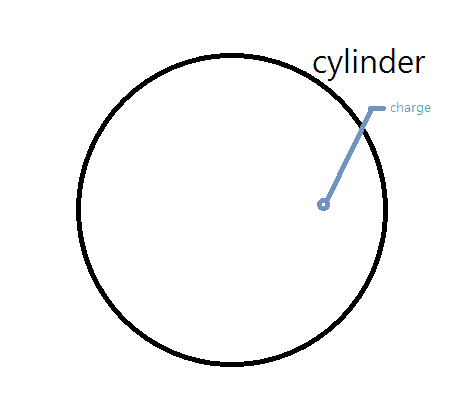
1.png


And this is what really confuses me.

2.png


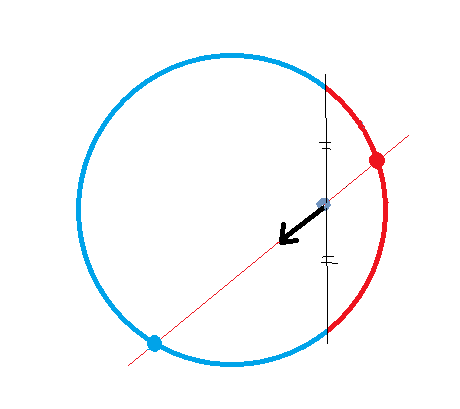
Draw a line that passes charge, then it'll meet with circle(cylinder) at two points(lines). Since a red dot(line) is always closer than a blue dot(line), sum of all forces will head to the left(?).
3.png


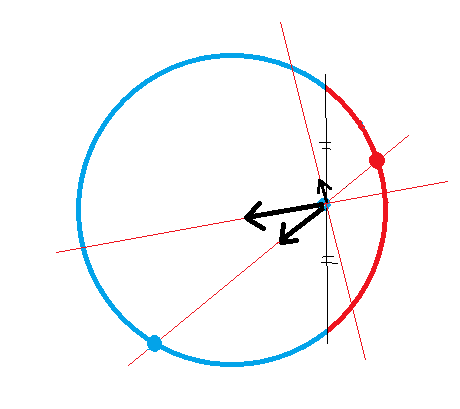
But this weird calculation conflicts with the fact that E=0 in the hollow of the cylinder.

What is a critical mistake of this logic(?). Will it be possible to explain why this image is wrong without using exact calculation?
 
Physics news on Phys.org
It is good that you worry about this. The critical mistake in the logic is this. Imagine two intersecting lines crossing at your off-center point. They define a blue arc dsblue and a red arc dsred. We make the ds arcs very small, not like in your figures, so that the contributions to the E-field from each arc are antiparallel and can be treated as contributions from lines of charge . The charge on each arc is proportional to ds, so that the magnitude of its contribution to the E-field is $$ dE \sim \frac{ds}{r} = \frac{r d \theta}{r} = d \theta $$ Since the subtended angle by the two arcs is the same, the fields cancel. This argument is similar to the 3d argument for the electric field inside a uniformly charged shell, except there one uses solid angles.
 
kuruman said:
It is good that you worry about this. The critical mistake in the logic is this. Imagine two intersecting lines crossing at your off-center point. They define a blue arc dsblue and a red arc dsred. We make the ds arcs very small, not like in your figures, so that the contributions to the E-field from each arc are antiparallel and can be treated as contributions from lines of charge . The charge on each arc is proportional to ds, so that the magnitude of its contribution to the E-field is $$ dE \sim \frac{ds}{r} = \frac{r d \theta}{r} = d \theta $$ Since the subtended angle by the two arcs is the same, the fields cancel. This argument is similar to the 3d argument for the electric field inside a uniformly charged shell, except there one uses solid angles.

Thanks for cool explanation! They are canceling out each other so clearly... awesome!
 

Similar threads

  • · Replies 5 ·
Replies
5
Views
1K
  • · Replies 5 ·
Replies
5
Views
3K
  • · Replies 4 ·
Replies
4
Views
2K
  • · Replies 2 ·
Replies
2
Views
2K
  • · Replies 2 ·
Replies
2
Views
2K
  • · Replies 1 ·
Replies
1
Views
2K
  • · Replies 3 ·
Replies
3
Views
1K
  • · Replies 6 ·
Replies
6
Views
2K
  • · Replies 7 ·
Replies
7
Views
2K
  • · Replies 7 ·
Replies
7
Views
2K