Welcome to the Math Challenge Board

Click For Summary

Discussion Overview

The discussion revolves around a mathematical problem involving the proof that the lengths of segments PR and QS are equal, given certain geometric conditions. Participants are exploring the implications of a line passing through a point B and intersecting two points P, Q, and two circles at points R, S.

Discussion Character

  • Exploratory
  • Technical explanation
  • Debate/contested
  • Mathematical reasoning

Main Points Raised

  • One participant expresses uncertainty about the clarity of the problem statement regarding the relationship between points P, Q, R, and S.
  • Another participant questions the meaning of "the restriction" and suggests that it may refer to point O lying on the perpendicular bisector of PQ.
  • Some participants note that there are infinitely many lines through point B, which complicates the assertion that PR equals QS.
  • A participant mentions the need for a diagram to clarify the relationships between the points and lines involved.
  • One participant claims to understand the question and acknowledges the confusion but has not yet found a proof.
  • A detailed geometric argument is presented involving angles and segments in a semicircle, leading to the conclusion that PR equals SQ under the given conditions.
  • Another participant praises the solution provided by a peer, indicating a positive reception of the argument presented.

Areas of Agreement / Disagreement

Participants express varying levels of understanding regarding the problem, with some agreeing on the conditions under which PR equals QS, while others highlight the ambiguity and potential for multiple interpretations. The discussion remains unresolved regarding the proof itself, as not all participants have reached a consensus on the solution.

Contextual Notes

There are limitations in the clarity of the problem statement and the definitions of the geometric relationships involved. The discussion also reflects unresolved mathematical steps and assumptions about the configuration of points and lines.

Albert1
Messages
1,221
Reaction score
0
HI : good to see you everybody ,I am a new comer on this board
Being a math teacher ,I always trained my students with various difficult problems
from now on I am going to post a sequential challenging questions for people to share
most of them I know the answer and the solution of it , maybe your solution is quicker and smarter (Yes)
please try it many thanks

here comes the problem :

28l6yj9.jpg

 
Last edited by a moderator:
Mathematics news on Phys.org
Re: Prove PR=QS

Hi Albert, :)

The second sentence in your question isn't clear to me.

a line passing through point B and intersects two points \(P,\,Q\) with \(O\) and intersects \(R,\, S\) with \(O_1\) and \(O_2\), respectively prove: \(\overline{PR} = \overline{QS}\)

There are infinitely many lines passing though \(B\) and not all of them will have \(PR = QS\). Can you please elaborate a bit more on what you mean by this sentence.

Kind Regards,
Sudharaka.
 
Re: Prove PR=QS

Can you plot a line passing through point B ,
satisfying the restriction and show that PR and QS are not equal ?
 
Re: Prove PR=QS

Albert said:
Can you plot a line passing through point B ,
satisfying the restriction and show that PR and QS are not equal ?

I might be missing something here but what is meant by "the restriction"? Do you mean that \(O\) lies on the perpendicular bisector of \(PQ\) ?
 
Re: Prove PR=QS

Sudharaka said:
I might be missing something here but what is meant by "the restriction"? Do you mean that \(O\) lies on the perpendicular bisector of \(PQ\) ?
yes, that must be
 
Re: Prove PR=QS

Albert said:
yes, that must be

But in that case there are infinitely many lines as I have claimed above, since for every chord of a circle the perpendicular bisector passes through the center of the circle. Refer >>this<<.
 
Re: Prove PR=QS

the line passing through point B must also intersect with those of two small circles :
O1,and O2, at point R and S respectively as mentioned before
 
Re: Prove PR=QS

Albert said:
the line passing through point B must also intersect with those of two small circles :
O1,and O2, at point R and S respectively as mentioned before

I think we are misunderstanding each other. To clarify further I have created this diagram using http://www.geogebra.org/cms/ and drawn two possible lines for \(PQ\).

w1vaep.jpg
 
Re: Prove PR=QS

where is your points R1,S1 and R2,S2
we want to prove P1R1=Q1S1 , and P2R2=Q2S2
 
  • #10
Re: Prove PR=QS

I understand the question now. It seems that for all lines drawn through \(B\), \(PR=QS\). Sorry for the confusion. :)

I haven't found the proof yet, but I am trying... :confused:
 
  • #11
Re: Prove PR=QS

geom.jpg
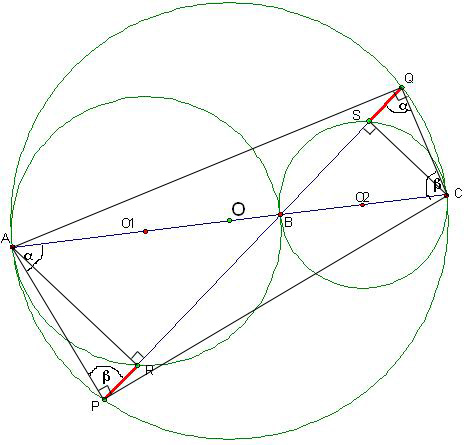
In the diagram, all the angles marked as right angles are angles in a semicircle (and therefore are indeed right angles). The two angles marked $\alpha$ are equal, as are the two angles marked $\beta$ (angles in the same segment). From the triangle $APC$, $AP = AC\cos\alpha$. From the triangle $ARP$, $PR = AP\cos\beta$. So $PR = AC\cos\alpha\cos\beta.$

In the same way, $CQ = AC\cos\beta$ (from triangle $AQC$) and $SQ = CQ\cos\alpha$ (from triangle $CSQ$), and so $SQ = AC\cos\alpha\cos\beta = PR.$
 
  • #12
Re: Prove PR=QS

Opalg:very good solution (Yes)
 
  • #13

Attachments

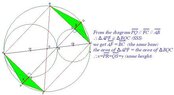
  • PR=QS.JPG
    PR=QS.JPG
    15.5 KB · Views: 100

Similar threads

  • · Replies 2 ·
Replies
2
Views
1K
  • · Replies 5 ·
Replies
5
Views
3K
  • · Replies 5 ·
Replies
5
Views
7K
  • · Replies 4 ·
Replies
4
Views
4K
  • · Replies 93 ·
4
Replies
93
Views
12K
  • · Replies 104 ·
4
Replies
104
Views
17K
  • · Replies 28 ·
Replies
28
Views
15K
  • · Replies 107 ·
4
Replies
107
Views
20K
  • · Replies 83 ·
3
Replies
83
Views
22K
  • · Replies 2 ·
Replies
2
Views
1K