SUMMARY
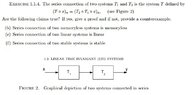
The discussion focuses on the definitions of memoryless, linear, and stable properties in the context of mathematical systems. Memoryless properties indicate that the future state of a system depends only on its current state, not on past states. Linear properties refer to systems that adhere to the principles of superposition and homogeneity. Stability pertains to the behavior of a system in response to external disturbances, ensuring that it returns to equilibrium after perturbations. These definitions are crucial for understanding system dynamics in various fields such as control theory and signal processing.
PREREQUISITES
- Understanding of basic mathematical concepts related to systems theory
- Familiarity with control theory terminology
- Knowledge of signal processing fundamentals
- Experience with proofs in mathematical contexts
NEXT STEPS
- Research the implications of memoryless properties in Markov processes
- Study linear systems and their applications in control theory
- Explore stability criteria such as Lyapunov stability
- Examine examples of memoryless, linear, and stable systems in engineering
USEFUL FOR
Students and professionals in mathematics, engineering, and physics who are looking to deepen their understanding of system properties and their applications in real-world scenarios.