What Causes Electric Field Breakdown in P-N Diodes?

  • Context: Graduate 
  • Thread starter Thread starter quietrain
  • Start date Start date
  • Tags Tags
    Ac Diodes
Click For Summary

Discussion Overview

The discussion focuses on the mechanisms behind electric field breakdown in p-n diodes, particularly in the context of reverse biasing, as well as the behavior of rectified AC signals. Participants explore the relationship between covalent bonds, charge carriers, and the effects of doping in semiconductors.

Discussion Character

  • Exploratory
  • Technical explanation
  • Debate/contested
  • Mathematical reasoning

Main Points Raised

  • Some participants describe how, in reverse bias, the depletion zone widens and increases the voltage barrier, making current flow more difficult until breakdown voltage is reached.
  • Others propose that breakdown occurs due to the breaking of covalent bonds under high electric fields, allowing electrons to become free and contribute to current flow.
  • There is a discussion about the processes of breakdown, including impact ionization and tunneling, with references to Zener diodes.
  • Participants question why the rectified waveform does not align directly with the AC source waveform on an oscilloscope, suggesting that the oscilloscope's mode may affect the display.
  • Some participants inquire about the role of doping in determining the concentration of holes and electrons in the p-n diode, indicating that it influences which region contains which type of charge carrier.

Areas of Agreement / Disagreement

Participants express various viewpoints regarding the mechanisms of electric field breakdown and the behavior of rectified signals. There is no clear consensus on the specifics of these processes, and multiple competing explanations are presented.

Contextual Notes

Participants reference different processes for breakdown and the effects of oscilloscope settings, indicating a need for clarity on definitions and conditions related to these phenomena.

Who May Find This Useful

This discussion may be useful for individuals interested in semiconductor physics, electrical engineering, and the practical applications of diodes in circuits.

quietrain
Messages
648
Reaction score
2
i am not sure if this is considered electrodynamics under classical forum but oh well, here goes

i was reading wiki about p-n diodes and its that for reverse bias diode, because of the anode attracting the holes WITH the cathode attracting the electrons, the depletion zone widens and causes an increase in voltage barrier, so current will be harder to flow.

so when breakdown voltage is reached, the electric field due to the depletion zone breaks down and current flows. so what exactly does the electric field breakdown means?

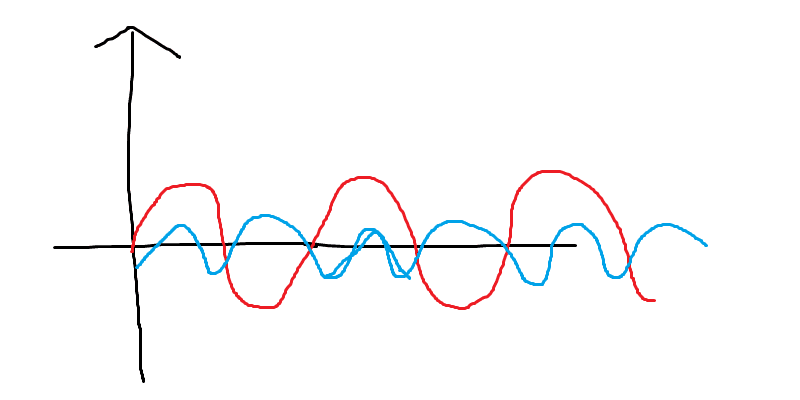
also regarding rectified ac, i realize that when i rectify an AC source half or full wave, it seems that the oscilloscope shows
ac.png


with the blue part rectified wave, and red the ac transformer source.

so why issnt the blue part directly fitting the red curve? i have to adjust the position of the blue curve upwards on the oscilloscope to fit nicely.

also when full wave rectifying, what gives the extra rectified upward curve? is it the diode causing the original downward ac curve to flip up?

thanks loads sry for the long question
 
Physics news on Phys.org
in reverse biasing when we apply high reverse voltage then ,electron in the diode bonded by covalent bond gets free due to the brockage of covalent bond & breakdown ocures.the covalent bond are broke up due to the high electric field across the junction,the break down voltage depend on the doping of the semiconducter...
 
nikhil khatri said:
in reverse biasing when we apply high reverse voltage then ,electron in the diode bonded by covalent bond gets free due to the brockage of covalent bond & breakdown ocures.the covalent bond are broke up due to the high electric field across the junction,the break down voltage depend on the doping of the semiconducter...

why does having the covalent bond breaking up allows for electricity to pass through?

does covalent bonding has anything to do with the holes and electrons in the p-n semiconductor diode?
 
quietrain said:
why does having the covalent bond breaking up allows for electricity to pass through?

does covalent bonding has anything to do with the holes and electrons in the p-n semiconductor diode?

yes ,when covalent bond breaks then electron leave its place from the bond & thus creat a hole there in this manner when one bond break up then a pair of hole& electron is generated.
 
quietrain said:
so when breakdown voltage is reached, the electric field due to the depletion zone breaks down and current flows. so what exactly does the electric field breakdown means?

Breakdown can occur through various processes, but generally carriers are generated by impact ionization (avalanche breakdown), or because they can tunnel through the junction (like in a Zener diode). You can check these terms on wikipedia or google for more details.

so why issnt the blue part directly fitting the red curve? i have to adjust the position of the blue curve upwards on the oscilloscope to fit nicely.

Is your oscilloscope in AC mode by any chance? In AC mode, the oscilloscope will remove the DC component, so the rectified wave is "centered". If you set it to DC mode, the curves should match up.

also when full wave rectifying, what gives the extra rectified upward curve? is it the diode causing the original downward ac curve to flip up?
Yes, sort of. In the half-wave rectifier, the diode stops the current one way. In the full-wave rectifier, there's always a diode that let's the current through.
 
nikhil khatri said:
yes ,when covalent bond breaks then electron leave its place from the bond & thus creat a hole there in this manner when one bond break up then a pair of hole& electron is generated.

so why does the p-n diode already has a high concentrations of holes at one side and another set of high concentration of electrons at another side as explained in wikipedia?

is it due to doping?
 
caffenta said:
Breakdown can occur through various processes, but generally carriers are generated by impact ionization (avalanche breakdown), or because they can tunnel through the junction (like in a Zener diode). You can check these terms on wikipedia or google for more details.


Is your oscilloscope in AC mode by any chance? In AC mode, the oscilloscope will remove the DC component, so the rectified wave is "centered". If you set it to DC mode, the curves should match up.


Yes, sort of. In the half-wave rectifier, the diode stops the current one way. In the full-wave rectifier, there's always a diode that let's the current through.

ah isee thanks!
 
quietrain said:
so why does the p-n diode already has a high concentrations of holes at one side and another set of high concentration of electrons at another side as explained in wikipedia?

is it due to doping?

yes it depend on doping that which region will contain holes & which will contain electron ...
 
nikhil khatri said:
yes it depend on doping that which region will contain holes & which will contain electron ...

ah i see thank you!
 

Similar threads

  • · Replies 14 ·
Replies
14
Views
5K
  • · Replies 10 ·
Replies
10
Views
4K
  • · Replies 9 ·
Replies
9
Views
4K
  • · Replies 10 ·
Replies
10
Views
5K
  • · Replies 6 ·
Replies
6
Views
3K
  • · Replies 5 ·
Replies
5
Views
3K
  • · Replies 5 ·
Replies
5
Views
3K
  • · Replies 21 ·
Replies
21
Views
3K
Replies
6
Views
4K
  • · Replies 5 ·
Replies
5
Views
3K